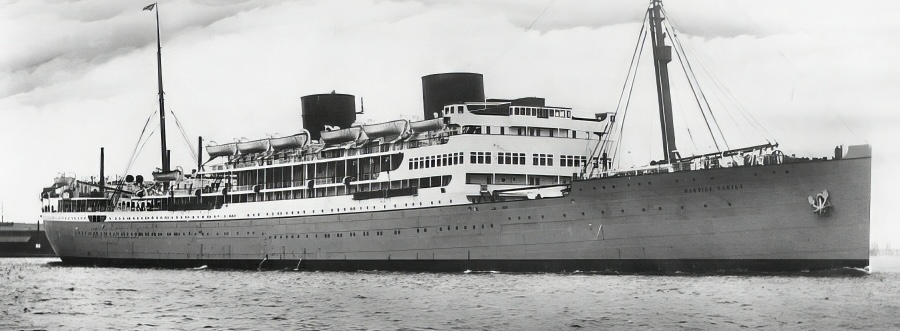
SS Warwick Castle
Union-Castle Line · entered service 1931 · Ship Guide
Overview
SS Warwick Castle was one of Union-Castle’s important interwar liners on the Southampton–Cape Town route, built for the distinctive mail-and-passenger service between Britain and South Africa. She belonged to the lavender-hulled world of Union-Castle’s long-distance imperial route system rather than the North Atlantic speed race, and she represented a modern diesel-powered approach to route service in the early 1930s. Her career later shifted from peacetime liner work to wartime troop transport, ending abruptly with torpedo loss in 1942.
In collecting and interpretation, Warwick Castle is best divided into two main phases: prewar Union-Castle passenger and mail service, and wartime troopship service. Material from those phases should be distinguished carefully rather than treated as a single undifferentiated identity.
Key Facts
Design & Construction Context
Warwick Castle belonged to Union-Castle’s long-established Britain–South Africa mail route, a service pattern that was visually and culturally distinct from the Atlantic express-liner world. Ships in this system balanced passenger comfort, cargo utility, and schedule reliability over very long distances rather than pursuing headline speed records. That route identity is central to understanding the ship.
She also reflects the growing use of motor propulsion in major liners of the period. As a large diesel passenger ship, Warwick Castle represents an interwar phase in which shipping companies were modernizing machinery while preserving traditional route structures and service expectations.
Service History (Summary)
1930–1931: Built by Harland & Wolff at Belfast, Warwick Castle was launched in April 1930, delivered in January 1931, and entered service later that month. Her maiden voyage placed her directly into Union-Castle’s Southampton–Cape Town passenger and mail service.
1930s peacetime service: In her prewar years, she served the South African run as one of Union-Castle’s large modern liners. This is the correct context for passenger lists, route brochures, cabin material, and company ephemera associated with her commercial identity.
Route-world significance: Warwick Castle belongs to the imperial-route world of Southampton, Madeira, Cape Town, and the wider South African service system. She should not be interpreted as if she were primarily an Atlantic prestige liner simply because of her scale.
Second World War service: During the war, her civilian passenger identity gave way to troop transport work. Like many liners of her generation, she became part of the wartime movement network rather than a commercial passenger ship.
14 November 1942: While serving as a troopship in the Mediterranean, she was torpedoed by a German submarine and fatally damaged. The sinking ended her career without any postwar return to Union-Castle commercial service.
Interpretive Notes
A Union-Castle South Africa liner first: Warwick Castle should be read primarily within the Britain–South Africa mail and passenger system, not through North Atlantic liner assumptions.
Prewar and wartime material belong to different worlds: passenger ephemera, route literature, and cabin-class references belong to one interpretive frame, while troopship references and wartime movement records belong to another.
Her identity is strongly shaped by Union-Castle style: the company’s route branding, visual traditions, and imperial service geography matter when interpreting surviving material tied to the ship.
Her story ends in wartime loss, not postwar reinvention: unlike some comparable liners, Warwick Castle had no later civilian second act. That makes surviving prewar commercial material especially important in reconstructing her peacetime identity.
Operation Torch context: Warwick Castle’s final voyage belonged directly to the Allied North African campaign. Her loss in convoy MKF-1X to U-413 should therefore be interpreted within troop and operational movement rather than as an isolated merchant-ship sinking.
The documented toll of 96 dead and 366 survivors gives the event a human scale that should remain attached specifically to that final voyage, not generalized across her earlier commercial career.
Her prewar passenger identity should remain distinct from that wartime endpoint.
That separation preserves the ship’s commercial history as well as the record of her loss.
Evidence-first ship guide