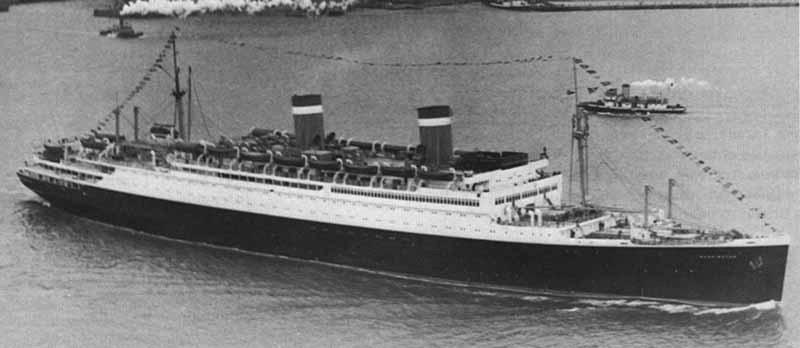
SS Washington
United States Lines · 1933 · Ship Guide
Overview
SS Washington was a major U.S.-built transatlantic liner of the United States Lines and one of the two “Manhattan-class” sisters (with Manhattan) created to restore American visibility on the North Atlantic in the early 1930s. Entering service in May 1933, Washington was not a speed-record ship; her significance lies in something more durable for curatorial work: she was a well-documented, high-capacity schedule liner operating in an era when printed shipboard culture and route marketing were prolific and often dateable.
Her best-known mid-career incident is specific and documentable: on 11 June 1940, shortly after the fall of France, a German U-boat stopped Washington at sea and ordered passengers to abandon ship before allowing the liner to proceed. The episode generated press coverage and (in some collections) commemorative or referential material tied to that date.
Evidence-first note: “SS Washington” can be confused with other ships carrying the name (including the earlier German-built George Washington). For precision in captions and catalog records, use “SS Washington (United States Lines, 1933)” or “Manhattan-class Washington.”
Key Facts
Design & Construction (Context)
The Manhattan-class liners are often described as a Depression-era answer to a simple problem: how to field modern, attractive American ships without trying to outmatch the biggest foreign “superliners” on raw size. In practice, that produced ships with a conservative service speed, solid transatlantic capacity, and a corporate visual identity that is extremely recognizable in surviving ephemera—especially United States Lines advertising, brochures, and shipboard stationery.
For collectors, “built in the U.S.” can be more than a talking point: builder documentation, yard imagery, and contract references (where present) can help anchor a provenance chain. If a piece carries a New York Shipbuilding context, or a company agent imprint tied to the early 1930s route network, it may be closer to publish-ready attribution than generic line-branded souvenirs.
Service History (Summary)
1933–1940: Commercial transatlantic service. From May 1933, Washington sailed the North Atlantic for United States Lines, with service patterns that included New York–Plymouth–Hamburg in the early period (route calls varied by schedule and geopolitical conditions). This era yields the richest volume of collectible material: passenger lists, menus, deck plans, cabin-class guides, and agent brochures.
11 June 1940: U-boat stop incident. The documented U-boat encounter stands out because it is date-specific and unusually narrative for a civilian voyage record. If you encounter items referencing “10 minutes to abandon ship” or similar phrasing, treat the date and the ship name as the primary anchors and corroborate carefully.
1941–1946: Naval service as USS Mount Vernon (AP-22). Acquired and commissioned by the U.S. Navy in June 1941, she was converted for troop transport work and served throughout the war. Wartime material (photos, ship histories, convoy references) frequently uses the naval name; catalog accordingly and cross-reference the civilian identity in notes.
Postwar: Return to commercial service and retirement. After decommissioning, the ship returned to civilian status and is commonly reported to have resumed commercial service in 1947. Later years included refits and eventual retirement and scrapping in 1965.
American-Flag Prestige Without a Speed Race
Washington and sister Manhattan were important because they restored a substantial American-built and American-flag presence to the North Atlantic. Their significance lay more in schedule, national visibility, and dependable large-ship service than in pursuing the Blue Riband.
USS Mount Vernon
After U.S. entry into the Second World War, Washington became USS Mount Vernon (AP-22). U.S. Naval History and Heritage Command records that she served as a Navy transport from 1941 to 1945 before recovering the name Washington.
This is a major attribution boundary. Wartime photographs and records under the name Mount Vernon belong to the same hull but to a military operating system that was physically and administratively distinct from United States Lines passenger service.
Postwar Return and Withdrawal
The liner resumed the name Washington after the war, but her postwar commercial life was comparatively short. She was laid up in 1951 and remained out of active passenger service until scrapping in 1965.
Interpretive Notes
Washington rewards careful cataloging because her identity spans two documentary systems: civilian passenger service and wartime naval transport. As a rule, catalog what the object says first (SS Washington vs USS Mount Vernon), then connect the identities in a controlled note. This keeps the record evidence-forward and prevents “story glue” from becoming the primary identifier.
Two common pitfalls: (1) generic “United States Lines” material that is not ship-specific, and (2) confusion with other “Washington” ships. High-confidence attribution usually requires at least one of the following: printed ship name, dated sailing, route chain, or imagery specific enough to match silhouette details from the correct era.
Evidence-first ship guideSources (Selected)
Use these as a starting index and corroborate publish-ready details (register tonnage by year, route calls by schedule, postwar service dates) with primary sources where possible.
- Ocean Liner Curator — Sources (master bibliography)
- Wikipedia — SS Washington (starting index; corroborate key facts)
- U.S. Naval History & Heritage Command (DANFS) — USS Mount Vernon (AP-22) (official naval history)
- New York Shipbuilding Corporation — SS Washington (builder/yard history summary)
- NavSource — USS Mount Vernon (AP-22) (photo index and service outline)
- United States Merchant Marine / USMM.org — SS Washington U-boat stop narrative (use as a lead; corroborate with contemporary press)
- U.S. Naval History and Heritage Command — SS Washington / USS Mount Vernon identity and service summary