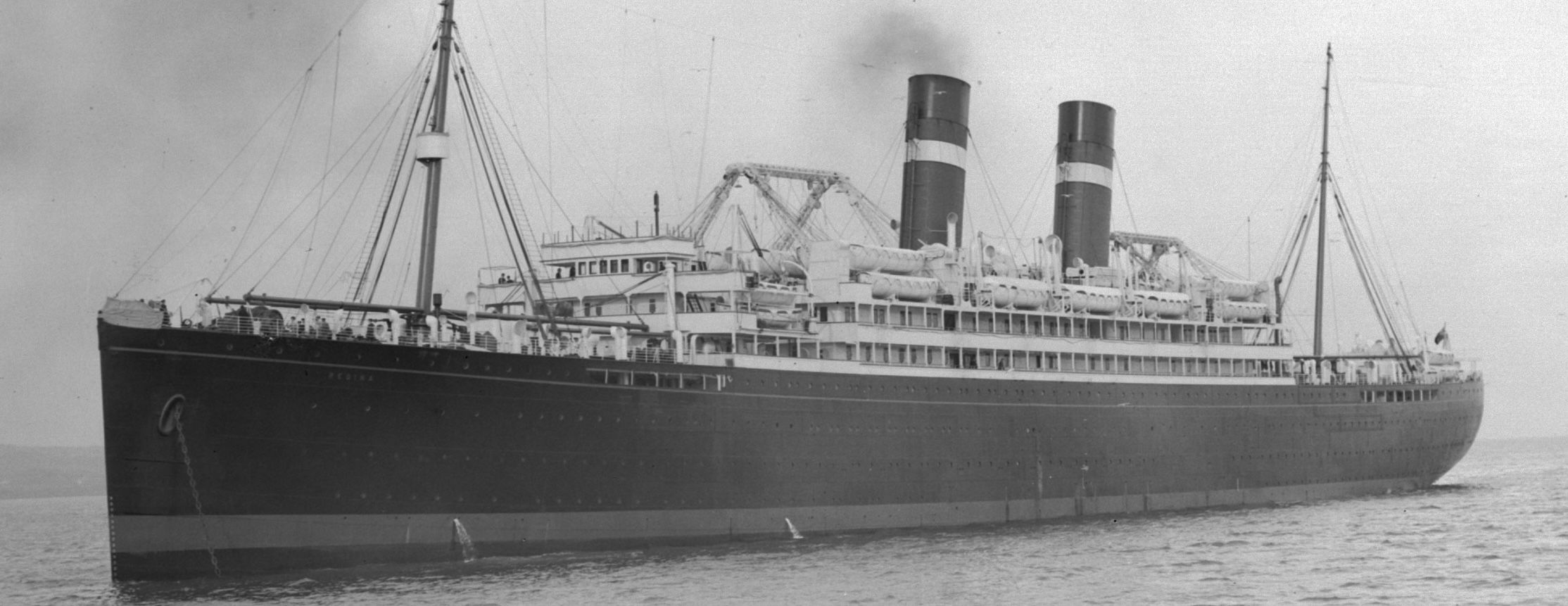
SS Westernland
Launched as Regina · 1917 · Red Star name from 1929 · Ship Guide
Overview
SS Westernland had one of the more complicated ownership and identity histories in the interwar Atlantic fleet. Harland & Wolff's Govan yard launched her on 19 April 1917 as Regina, yard no. 454, for Dominion Line interests. Delivered in October 1918 in a much plainer wartime configuration, she was later returned to the yard and completed as a full passenger liner before entering regular commercial service in 1922.
Her subsequent career crossed several related and unrelated operators: Leyland Line, White Star Line charter, Red Star Line, Arnold Bernstein interests, Holland America Line, the Royal Navy, the Ministry of War Transport, and finally the South Georgia Company. The name Westernland dates from 1929, but even that phase was not a single uninterrupted Red Star ownership story.
The previous guide contained several major factual errors. The ship was built at Harland & Wolff's Govan yard, not Belfast; she was launched in 1917, not 1918; her propulsion used three screws driven by two reciprocating engines plus an exhaust turbine, not twin-screw turbines; and she was not torpedoed and sunk in 1942. She survived the Second World War and was broken up at Blyth in 1947.
Key Facts
Regina: An Interrupted Beginning
Regina was designed before the First World War but completed under wartime conditions. Harland & Wolff records note that she was initially finished as a relatively plain cargo steamer with one funnel and one mast. After the war she returned to the company's Belfast yard in August 1920 for conversion into the passenger liner originally intended, gaining an upper promenade deck, second funnel, second mast, and accommodation for roughly 600 cabin-class and 1,700 third-class passengers.
This two-stage completion history explains why photographs of early Regina can look markedly different from later views. It is not evidence of two separate vessels or a miscaption; the ship's outward form genuinely changed.
Line Service Before Westernland
1922: under Leyland Line management, Regina began regular Liverpool–Halifax–Portland service in March and Liverpool–Quebec–Montreal service in April.
1925: after her Canadian service phase, she began Liverpool–Halifax–New York sailings under charter to White Star Line. This is an important attribution trap: genuine White Star material can refer to Regina even though the ship was not built as a White Star liner.
1929: the ship was renamed Westernland and shifted into Red Star Line identity. Her interwar sailings became associated with the Antwerp–Le Havre–Southampton–New York route.
Westernland and Red Star's Changing Ownership
Red Star Line's Depression-era corporate history was complicated. After International Mercantile Marine retrenchment, German shipping entrepreneur Arnold Bernstein acquired Red Star operations and continued using Westernland. She was refitted to carry tourist-class passengers and resumed the Antwerp–Southampton–New York service in 1935.
In 1939 political persecution in Nazi Germany forced Bernstein out of his businesses. Holland America Line acquired Red Star assets including Westernland, registered her in Rotterdam, and continued the service. The same ship could therefore carry Red Star branding while its ownership and registry changed underneath that public identity.
Second World War
1940: the German invasion of the Netherlands and Belgium ended normal passenger operations. Westernland took refuge in Britain and entered wartime transport service.
1942: rather than being sunk, she was taken into Royal Navy use as a repair ship. She received the pennant number F87 and was later employed as a destroyer depot ship.
1945: control passed to the Ministry of War Transport, with Cunard-White Star involved in management. Her wartime identity therefore extended beyond troop carrying into the less glamorous but vital maintenance infrastructure of the fleet.
Final Years
In 1946 the South Georgia Company acquired Westernland with plans to convert her into a whaling factory ship under Christian Salvesen management. The conversion did not proceed. Instead she was sold to Hughes, Bolckow & Company for demolition and arrived at Blyth on 1 August 1947.
That endpoint matters because the old “sunk in 1942” narrative erased five years of documented naval and postwar history, including an intended industrial conversion that itself reflects the afterlives available to obsolete passenger ships.
Interpretive Notes
Name is not enough: material can belong to Regina, Westernland, Leyland, White Star, Red Star, Holland America, or naval phases. Date, operator, registry, route, and visual configuration should be used together.
Do not confuse this ship with the earlier Red Star Westernland: the name had already been used in the nineteenth century. A date or image is essential for safe attribution.
Physical changes are evidence: the one-funnel wartime delivery form and later two-funnel passenger configuration make this ship a particularly good example of why photographs must be dated before design conclusions are drawn.
Evidence-first ship guide