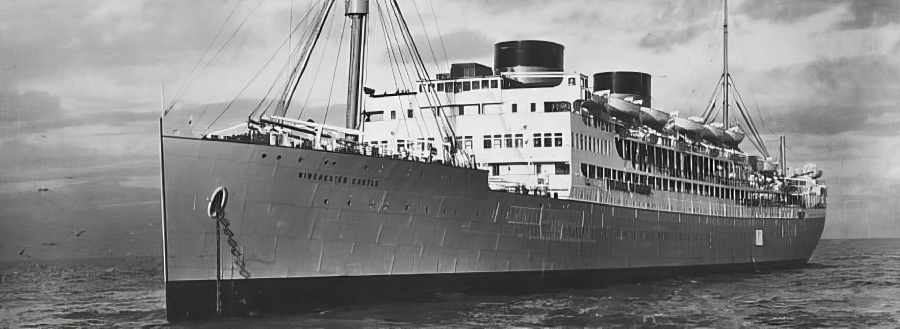
SS Winchester Castle
Union-Castle Line · entered service 1930 · Ship Guide
Overview
SS Winchester Castle was one of Union-Castle’s major interwar liners on the Southampton–South Africa service, built as a large motor ship for the mail-and-passenger route linking Britain with Cape Town and the wider South African network. She belonged to Union-Castle’s distinctive route world rather than the better-known North Atlantic express trade, and her diesel propulsion marked her as part of the company’s modern interwar fleet renewal. Her career later widened into wartime trooping, naval service, combined-operations work, and a postwar return to both emigrant and mail service.
In collecting and interpretation, Winchester Castle is best divided into four phases: pre-1938 Union-Castle mail service, post-1938 modernized mail service, wartime troopship and naval service, and postwar emigrant and restored mail service. Material from those phases should be distinguished carefully rather than treated as one undifferentiated identity.
Key Facts
Design & Construction Context
Winchester Castle belonged to Union-Castle’s highly distinctive South Africa mail-service world, a route system as culturally separate from the North Atlantic express trade as it was geographically different. Ships of this line balanced mail reliability, passenger comfort, and long-distance route discipline rather than record-chasing speed. Her importance lies in that context.
She was also part of Union-Castle’s interwar modernization through large diesel-powered liners. That made her a representative of a more modern route-ship philosophy: efficient, dependable, and visually tied to the company’s evolving Cape mail identity. Her 1938 modernization further sharpened that visual identity and created a meaningful dividing line in her appearance.
Service History (Summary)
1929–1930: Built by Harland & Wolff at Belfast, Winchester Castle was launched in November 1929, delivered in October 1930, and entered the Union-Castle mail service the same month. This began her peacetime career on the Southampton–South Africa route.
1930s prewar service: In her original form, she served as one of Union-Castle’s important passenger mail ships to South Africa. This is the correct context for early passenger lists, menus, route brochures, and company ephemera associated with her commercial identity.
1936 grounding: In February 1936, Winchester Castle stranded near Portland, causing the loss of one round voyage. Though serious enough to prompt investigation, this incident did not define the ship’s long-term role.
1938 modernization: She was the last of the older mailships to be modernized for the revised mail-contract requirements. During this work she received a large single raked funnel, creating a useful visual distinction between earlier and later photographs.
1940–1941 wartime shift: Requisitioned for trooping duties in 1940, she soon moved deeper into wartime service. In 1941 she transferred into the Royal Navy as HMS Winchester Castle.
1941–1944 naval and combined-operations role: During wartime service she made a trooping voyage to Bombay, served as Admiral Mountbatten’s Combined Operations headquarters ship, and took part in training work in Scottish waters. She later operated in major amphibious campaigns, including Operation Ironclad at Diego Suarez, the North African landings, Operation Avalanche at Salerno, and Operation Dragoon in southern France.
1947–1948 postwar austerity service: After the war she was deployed on the UK–South Africa emigrant service with austere accommodation. This phase should be treated separately from both her prewar mail identity and her later restored peacetime form.
1948–1960 return to commercial role: Refurbished by Harland & Wolff, she resumed Union-Castle mail runs in September 1948 and continued in service until replaced by Windsor Castle in 1960. She was then sold for scrapping and broken up in Japan.
Interpretive Notes
A Union-Castle South Africa liner first: Winchester Castle should be interpreted within the Southampton–Cape Town mail and passenger system, not through North Atlantic prestige assumptions.
The 1938 modernization matters: pre-1938 and post-1938 photographs can show meaningfully different external appearances, making this a useful dividing line for dating imagery.
Wartime and peacetime material belong to different worlds: passenger ephemera and route literature belong to one interpretive frame, while combined-operations references, invasion histories, and troopship records belong to another.
Her postwar life includes two distinct civilian phases: the austere emigrant role of 1947–48 should not be confused with the refurbished return to the traditional mail service afterward.
A career marked by refit and repurposing: Winchester Castle moved through prewar mail service, the well-documented 1936 Portland grounding, a 1938 modernization, wartime Combined Operations work, austerity emigrant voyages, and restored peacetime mail service. Those phases changed both the ship’s use and the documentary record surrounding her.
The formal investigation into the Portland grounding is especially valuable because it provides unusually detailed evidence for a peacetime operational incident. It should remain separate from later wartime narratives rather than being absorbed into a generic list of mishaps.
Her postwar emigrant and mail phases also show how quickly a liner’s passenger purpose could change after wartime service. That makes class configuration and voyage type important dating clues in surviving ephemera.
Those changing roles are essential to dating photographs and paper correctly.
Later emigrant voyages also belong to a distinct postwar social history rather than simply a resumed version of the prewar mail service.
Evidence-first ship guide