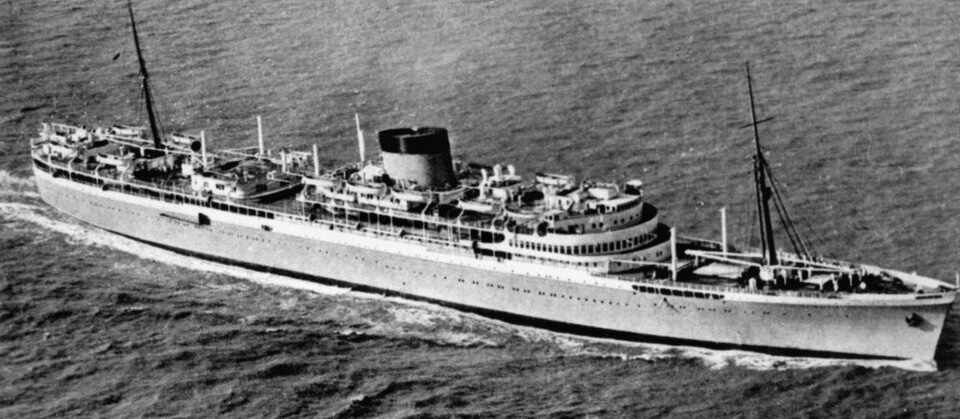
Stirling Castle
Union-Castle Line · 1936 · Ship Guide
Overview
Stirling Castle was one of Union-Castle Line’s major prewar motor liners, built for the Southampton–Cape Town mail and passenger service. She was the first of the near-sister pair later joined by Athlone Castle, and she represented the mature Union-Castle formula: fast diesel propulsion, disciplined mail-route scheduling, and a service identity rooted in the South African run rather than the North Atlantic liner world.
In collecting and interpretation, Stirling Castle is especially important because she captures Union-Castle at a high point of route prestige just before the Second World War. Material connected to her can document three distinct phases: peacetime mail-liner service, wartime troopship use, and the postwar return to commercial operation.
Key Facts
Published figures vary slightly, especially for horsepower and tonnage summaries. For cataloging purposes, preserve the exact wording and figures used by the specific source or artifact being cited.
Design & Construction Context
Stirling Castle belonged to Union-Castle’s late and highly recognizable South African mail-liner tradition. She was not intended for Atlantic speed rivalry, but for schedule discipline, route prestige, and dependable long-distance service between Britain and southern Africa. Her diesel machinery placed her firmly in the modern motor-liner generation rather than the earlier steam era of the line’s history.
In design terms, she helped define the mature interwar Union-Castle style: a large but not giant liner, fast enough to support mail-service timing, and visually distinct within the line’s famous branding culture. For Ocean Liner Curator purposes, that makes her a route-defining ship rather than simply another British liner of the 1930s.
Service History (Summary)
1934–1936: Built by Harland & Wolff at Belfast, launched in August 1935, completed in January 1936, and sent on her maiden voyage from Southampton on 7 February 1936.
1936: Soon after entering service, Stirling Castle set a new route record to Table Bay, reaching it in 13 days 9 hours and beating a much older South African run benchmark. This helps explain her importance within Union-Castle’s mail-service identity.
1936–1939: Served in the regular Union-Castle South African mail service, linking Southampton with Cape ports and Durban in the characteristic route pattern of the line.
Second World War: Requisitioned as a troopship and survived the war intact. Sources credit her with steaming roughly 505,000 miles and carrying about 128,000 personnel during wartime service.
1946–1947: Released from government service in 1946, then refitted by her builders before returning to commercial passenger service in 1947.
Postwar years: Continued in Union-Castle service until the acceleration of the mail schedule in 1965 made the older mail liners too slow for the revised pattern. She was withdrawn on arrival at Southampton on 30 November 1965.
1966: Sold for scrapping in Japan, departed Southampton in February 1966, and arrived at Mihara in March to be broken up.
Mail-Ship Speed and the Cape Route
Stirling Castle was designed around the exacting Union-Castle mail schedule rather than prestige speed for its own sake. Her diesel machinery and approximately 20-knot service speed helped maintain the regular Southampton–Cape timetable that defined the line's commercial identity.
That route discipline matters historically. Union-Castle's passengers, mail, and cargo moved within a highly structured imperial and commercial network linking Britain with South Africa, and the ship's value lay in dependable passage times as much as in size or appearance.
Troopship Service and Postwar Return
Requisitioned during the Second World War, Stirling Castle served as a troop transport on long-distance convoy routes. Surviving convoy records place her in movements through the Red Sea and Suez as part of the Allied transport system.
After the war she was refitted and returned to the Cape mail service, a transition that restored a passenger role to a hull heavily used for military transport. She remained in commercial service until the mid-1960s, giving her a career that spans prewar prestige, wartime logistics, and the final mature decades of the traditional Cape liner.
Interpretive Notes
This is a South African mail liner, not an Atlantic liner: Stirling Castle should be interpreted within the Union-Castle Southampton–Cape service framework, where mail timing and route identity were central.
Peacetime and wartime material should be separated: prewar passenger ephemera, wartime troopship references, and postwar passenger lists belong to distinct interpretive phases and should not be flattened into a single generic “service life.”
She represents mature Union-Castle branding: because she was one of the line’s principal late interwar mail ships, artifacts tied to her can be especially useful for documenting the final strong phase of the classic Union-Castle route tradition.
Evidence-first ship guideSources (Selected)
- Ocean Liner Curator — Sources (master bibliography)
- RMMV Stirling Castle — overview chronology, specifications, and wartime service
- Union-Castle Line — company and route context
- The Yard / Harland & Wolff — builder and yard particulars
- Shipping Wonders of the World — contemporary-style description of Stirling Castle
- GG Archives — passenger-list reference context for Stirling Castle
- Uboat.net — convoy movement including Stirling Castle