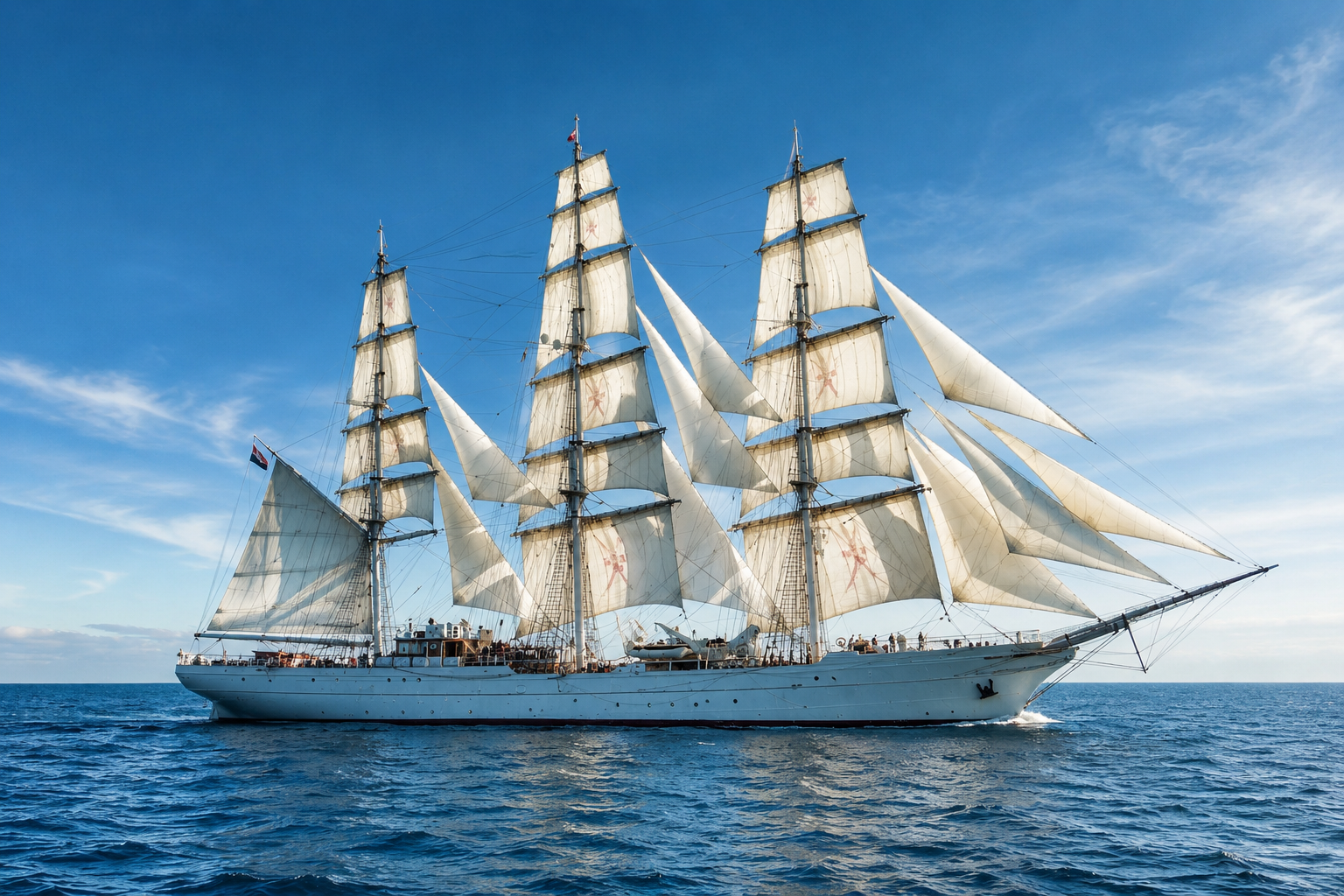
Tall Ships
Traditional sailing vessels · Rigging, interpretation, and research guide
Overview
“Tall ship” is a useful public term, but it is not a single precise vessel type. In modern use it usually means a large, traditionally rigged sailing vessel: a ship, barque, brig, brigantine, barquentine, topsail schooner, or other multi-masted craft whose rig evokes the working age of sail. The phrase is especially common in sail-training, museum, festival, and heritage contexts.
Historically, many of the vessels now described as tall ships were cargo carriers, naval training ships, explorers, school ships, fishing vessels, or preserved working craft. Some are original nineteenth- or early twentieth-century survivors; others are modern reproductions or purpose-built sail-training vessels. The safest interpretation is to identify the specific vessel and rig before making broader claims about age, function, or authenticity.
This page is a reference doorway: it explains the category, flags terminology problems, and encourages evidence-first identification rather than treating “tall ship” as a technical label by itself.
They help explain the maritime world that steamships and liners displaced, preserved, borrowed from, and later commemorated.
Key Facts
Note on terminology: a vessel can be a tall ship without being technically “ship-rigged.” For example, a barque or brigantine may be called a tall ship in public settings, but its specific rig should still be named when accuracy matters.
Rigging & Vocabulary
The most important first step is separating the romantic category from the technical rig. A full-rigged ship carries square sails on all masts. A barque is square-rigged on the fore and main masts but fore-and-aft rigged on the after mast. A brig has two masts, both principally square-rigged. A brigantine usually combines a square-rigged foremast with a fore-and-aft mainmast. Schooners are primarily fore-and-aft rigged, though topsail schooners carry square topsails above that basic arrangement.
These distinctions matter because rig names are not decoration. They describe how a vessel was worked, what crew skills it required, how it handled on long passages, and how it appears in photographs, paintings, plans, and printed material.
Historical Context
Tall ships connect the commercial age of sail to the steamship era. During the nineteenth century, sailing vessels carried cargo, migrants, mail, naval trainees, and raw materials across global routes. Steam did not instantly erase sail: for decades, sail and steam overlapped, with sailing vessels remaining useful where coal supply, operating cost, route, or cargo type favored wind power.
By the early twentieth century, large commercial sailing ships had largely lost the main passenger and express-cargo trades to steamships and ocean liners. Yet sail survived in training, national naval tradition, coastal work, fishing, and later heritage preservation. That survival is why modern tall ships can feel both historical and living: they are not only museum objects, but working classrooms for seamanship.
Tall Ships and Ocean Liners
Tall ships are not ocean liners in the strict sense. Ocean liners were scheduled passenger vessels designed for regular ocean routes, usually under steam, turbine, diesel, or motor propulsion. Tall ships belong to a different technological and operational tradition. Still, they belong in the same wider maritime story because liners inherited routes, ports, navigational practices, ceremonial language, and public fascination from the sailing world.
For Ocean Liner Curator, the connection is interpretive: tall ships help show what changed when steam power made ocean travel more predictable, scheduled, and industrial. They also preserve the visual vocabulary of masts, yards, flags, signal practice, deck labor, and seamanship that remained culturally powerful long after liners became dominant.
Sail Training and Heritage Use
In the modern period, many tall ships operate as sail-training vessels. Their purpose is not simply nostalgia. They teach watchkeeping, line handling, navigation, teamwork, weather awareness, and the discipline of shipboard routine. Organizations and festivals often use “tall ship” as an accessible umbrella term so the public can engage with a range of rigs without first mastering technical vocabulary.
This public accessibility is useful, but it can blur distinctions. A festival poster may call everything a tall ship; a curator’s label should usually go further by identifying the vessel, rig, date, builder, original function, and later modifications.
Collecting Profile
Tall-ship material appears in many forms: photographs, postcards, port souvenirs, sail-training brochures, crew certificates, voyage programs, festival ephemera, ship plans, paintings, prints, and artifacts associated with specific vessels. Because the category is broad, the object’s connection to a named ship is more important than the phrase “tall ship” itself.
Good evidence includes a vessel name, dated voyage or event, identifiable port, credited photographer or printer, institutional source, or a documented chain of custody. Weak evidence includes generic decorative imagery, unsigned “old sailing ship” photographs, undated festival souvenirs, and objects whose only claim is that they “came from a tall ship.”
Interpretive Notes (What to Avoid)
Avoid treating all traditional sailing vessels as interchangeable. “Pirate ship,” “clipper,” “schooner,” “frigate,” and “tall ship” are not synonyms. Also avoid assuming age from appearance: many modern sail-training vessels intentionally use traditional forms, while some genuinely old vessels have been heavily rebuilt.
Strong interpretation begins with a modest statement: what is visible, what is documented, and what remains uncertain. A caption such as “three-masted barque, identified in period handwriting as ___, probably photographed at ___” is more useful than a confident but unsupported claim that a vessel is “an original nineteenth-century tall ship.”
Research Method
When researching a tall ship, start with the rig and name. Then test the identity against build date, owner, route, nationality, hull material, and later career. For photographs, compare mast arrangement, figurehead, funnel if auxiliary-powered, hull profile, deckhouse layout, and visible flags. For printed material, check typography, publisher, event sponsor, and whether the item is period, commemorative, or modern educational material.
Because many tall ships have long lives and multiple names, a single vessel may appear under different national flags, owners, functions, and restorations. Labeling should reflect that complexity rather than flattening a vessel into its most famous identity.
Evidence-first maritime guideSources (Selected)
This list is intentionally conservative.
- Ocean Liner Curator — Sources (master bibliography)
- Sail Training International — Definition of a Tall Ship
- Tall Ships America — What is a Tall Ship?
- National Park Service — Balclutha history
- National Park Service — San Francisco Maritime historic vessels
- Wikipedia — Tall ship (use as a pointer map; verify key claims in specialist sources)