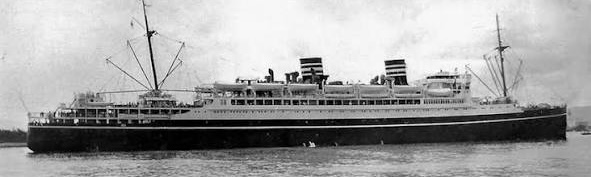
Tatsuta Maru
Nippon Yusen Kaisha · entered service 1930 · Ship Guide
Overview
Tatsuta Maru was one of NYK's three major interwar trans-Pacific motor liners, built by Mitsubishi Shipbuilding & Engineering Co. at Nagasaki as yard no. 451. Laid down on 3 December 1927, launched on 12 April 1929, and completed on 15 March 1930, she followed the same broad Pacific strategy as Asama Maru and Chichibu Maru.
Her career spans three distinct identities: luxury trans-Pacific liner, diplomatic-exchange vessel, and wartime transport. Treating those phases separately produces a more accurate biography than collapsing the ship into either prewar glamour or wartime loss.
Key Facts
Design and Pacific Modernity
Tatsuta Maru belonged to a deliberate NYK effort to modernize the Japan–North America passenger trade with large motor ships. Diesel propulsion, long Pacific range, and multiple passenger classes made the class commercially different from the steam-turbine express liners dominating the North Atlantic. Their modernity was expressed less through record-chasing than through efficient long-distance operation, new machinery, and a presentation calibrated for an international Pacific market.
The ships also generated a distinctive documentary record. Menus, sailing cards, cabin plans, baggage labels, bilingual stationery, and route material often combine Japanese ports with Hawaiʻi and the U.S. West Coast. That route pattern can be more useful for attribution than a generic “NYK liner” caption, especially because Asama Maru, Tatsuta Maru, and Chichibu Maru are frequently confused in later image captions.
1930 Fire and Entry into Service
While almost complete, Tatsuta Maru suffered severe fire damage on 7 February 1930. The damage was repaired rapidly enough for completion the following month. That distinction matters when dating shipyard photographs and publicity: 1929 is the launch year, while 1930 is the completion and service year.
Pacific Service
NYK Maritime Museum describes Asama Maru, Tatsuta Maru, and Chichibu Maru as the company's luxury liners for the San Francisco trade, part of a deliberate response to renewed American and European competition in the Pacific. Their routes linked Japan with Hawaiʻi and the U.S. West Coast and combined prestige accommodation with multiple passenger classes.
Diplomatic Exchange and War
NYK's own history records that Asama Maru, Tatsuta Maru, and Kamakura Maru were used in 1942 to exchange American, British, and Japanese diplomats. Tatsuta Maru then returned to military transport work.
On 8 February 1943 USS Tarpon made radar contact with a large transport south of Honshu and fired four torpedoes; U.S. Naval History identifies the target as the 16,975-ton Tatsuta Maru, bound for Truk with soldiers aboard. U.S. wartime loss tables likewise record her as a transport sunk by submarine action that day.
Reading the Surviving Record
Because the ship's career crossed civilian, diplomatic, and military uses in little more than a decade, surviving material should be dated to phase rather than treated as one undifferentiated archive. A 1930s passenger menu, a 1942 diplomatic-exchange document, and a wartime transport record may all name Tatsuta Maru, but they describe very different institutional purposes and passenger worlds.
That distinction is particularly important for photographs. The three large NYK motor liners shared a family resemblance, and later captions can drift from one sister to another. Original captions, dated voyage context, funnel markings, and route references are stronger evidence than a modern resemblance-based identification alone.
Interpretive Note
For attribution, civilian NYK ephemera, 1942 diplomatic-exchange material, and military transport records should be treated as separate documentary phases. The hull is the same, but the institutional context and meaning of the surviving evidence changed dramatically.
Evidence-first ship guide