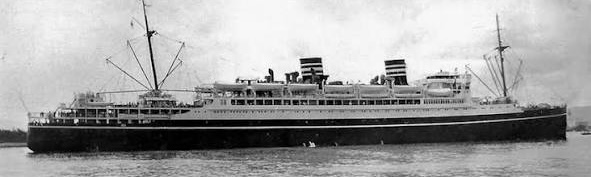
Tatsuta Maru
Nippon Yusen Kaisha (NYK Line) · launched 1929 · Ship Guide
Overview
Tatsuta Maru, launched in 1929 and completed in 1930 for Nippon Yusen Kaisha (NYK Line), was built for the company’s premier high-speed trans-Pacific passenger service. Alongside her sister ships Asama Maru and Chichibu Maru, she represented Japan’s interwar push to compete in the North Pacific passenger trade with modern motor-ship engineering and refined accommodations.
Her peacetime identity is anchored in the long Pacific routes linking Japan, Hawaiʻi, and the U.S. West Coast (commonly cited ports include Yokohama, Honolulu, Los Angeles, and San Francisco, with additional calls in East Asia). During the Second World War she was requisitioned for transport duties. On 8 February 1943, she was torpedoed and sunk by the U.S. submarine USS Tarpon, bringing a dramatic end to one of NYK’s best-known interwar liners.
Evidence-first note: “Tatsuta” is a historic Japanese name that can appear in shrine, place, and ship contexts. For memorabilia attribution, pair the ship name with “NYK Line” and the late-1920s/1930s trans-Pacific era (and, where possible, route ports) to prevent cross-context confusion.
Key Facts
Service Context
NYK’s late-1920s “big motor ships” were designed to signal modernity: long-range Pacific capability, dependable schedules, and passenger spaces calibrated for prestige travel as well as immigrant and third-class traffic. For collectors, this typically means a rich paper trail—menus, sailing cards, cabin plans, baggage labels, and bilingual company stationery—often printed for the trans-Pacific market.
Curator’s cue: if an item references West Coast ports (San Francisco / Los Angeles) and Hawaiʻi alongside Japanese ports, it often supports a Tatsuta Maru trans-Pacific attribution more strongly than “Japan–China” ephemera alone.
1930 Fire and Repair
While nearing completion, Tatsuta Maru suffered major fire damage on 7 February 1930. Contemporary reporting and later ship summaries usually note rapid repair and completion later that spring. This episode is useful for dating shipyard-era photographs or “new ship” publicity material that clusters around early 1930.
Collecting caution: “launched” and “completed” are often conflated in secondary summaries. When dating ephemera, prefer artifacts that explicitly state a voyage date or refer to the ship as “new” in a context you can anchor.
Wartime Requisition and Loss
In wartime service, Tatsuta Maru was used for transport duties in the Pacific. On 8 February 1943 she was attacked and sunk by USS Tarpon. Many accounts connect her final voyage with troop movement, and loss figures vary across summaries; for evidence-first presentation, treat casualty totals as “reported” unless anchored to a specific primary document.
Collecting Notes
- Prefer named ephemera: NYK menus, passenger lists, sailing schedules, and cabin plans explicitly naming Tatsuta Maru.
- Route fingerprint: Yokohama/Kobe + Honolulu + San Francisco/Los Angeles is a strong trans-Pacific pattern for this ship class.
- Separate phases: 1930s civilian service vs. 1942–1943 transport service (different document types, different postal markings).
- Beware vague captions: “NYK liner” photographs are frequently mis-captioned among Asama/Tatsuta/Chichibu—look for funnel markings, dated voyage context, or original captions.
- Wartime souvenirs: Later “history summary” prints and postwar compilations are common; confirm period printing, paper, and provenance.
Sources (Selected)
- Ocean Liner Curator — Sources (master bibliography)
- Wikipedia — Tatsuta Maru (starting index; corroborate key facts)
- WW2DB — Tatsuta Maru (dates / voyage notes; cross-check)
- CombinedFleet (Long Lancers) — escort context referencing Tatsuta Maru loss (use as a lead)
- NYK Line — corporate history (operator context; not ship-specific)
- GG Archives — ocean travel ephemera hub (use with care)