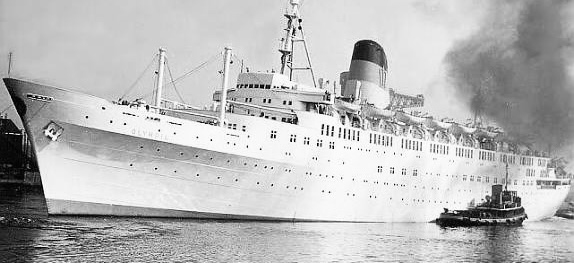
TSS Olympia (1953)
Greek Line · entered service 1953 · Ship Guide
Overview
TSS Olympia was the only passenger liner purpose-built for Greek Line and one of the most important postwar ships associated with Greek transatlantic migration. Completed on the River Clyde in 1953, she was designed for regular service between Europe and North America while retaining the flexibility needed for cruising.
Her career ultimately outlasted the company that commissioned her. After Greek Line collapsed in the 1970s, the ship was rebuilt for full-time cruising and later sailed as Caribe I and Regal Empress. She remained in passenger service until 2009, making her one of the longest-lived major postwar passenger ships.
Key Facts
Greek Line's Purpose-Built Flagship
Greek Line had developed its passenger business largely through older ships acquired from other operators. Olympia was different: she was ordered new and represented the company's most ambitious attempt to build a modern postwar flagship around the needs of Greek emigrants, travelers, and transatlantic tourists.
That distinction makes her especially useful for understanding the company's history. Rather than adapting a pre-existing liner to Greek service, Greek Line could shape Olympia around its own route structure and passenger market from the outset.
Passenger Arrangement and Market
As built, the ship carried a relatively small First Class and a much larger Tourist Class. That balance reflected the economics of the route: Olympia was not primarily a prestige express liner for an elite market, but a practical transatlantic ship intended to move large numbers of passengers between Greece, other Mediterranean ports, northern Europe, Canada, and the United States.
Her accommodation nevertheless included the lounges, dining rooms, deck space, and public facilities expected of a modern postwar liner. The combination of large tourist capacity with respectable public rooms made her well suited to both migration traffic and seasonal cruising.
Maiden Voyage and Route Development
Olympia entered service in October 1953 on a North Atlantic voyage from the Clyde toward New York by way of intermediate ports. Contemporary and later sources differ on the exact day used to describe the maiden departure, with dates in mid-to-late October appearing in published accounts.
Her regular Greece–North America role developed over the following years. By the mid-1950s she was firmly associated with the Piraeus–New York service, usually calling at several Mediterranean and Atlantic ports along the way. The route was later extended to include Haifa.
Migration and the Postwar Atlantic
The ship belongs to a part of liner history that is often overshadowed by the better-known prestige services of Cunard, French Line, or United States Lines. Olympia carried large numbers of migrants and families at a time when sea travel still mattered deeply to Mediterranean communities with relatives and destinations in North America.
Her repeated calls at Halifax are part of that story. Like other postwar migrant ships, she participated in a transatlantic system that was less about record-breaking speed than about dependable transport, family movement, and the social geography of migration.
Shift Toward Cruising
As air travel captured more of the scheduled passenger market, Greek Line increasingly used Olympia for cruises. By the end of the 1960s cruising occupied a growing share of her employment, and around 1970 it became effectively her full-time role.
This evolution was typical of many postwar liners but especially important in Olympia's case. Her survival depended on moving away from the market for which she had originally been built and toward leisure cruising, a transition that would later shape nearly her entire second career.
Greek Line's Collapse
Greek Line faced worsening financial pressure in the early 1970s as fuel costs rose and airline competition intensified. Olympia was laid up before the company finally collapsed in 1975.
The end of Greek Line did not mean the end of the ship. Her sturdy construction, large passenger spaces, and adaptable hull made her a viable candidate for reconstruction at a time when older liners were increasingly being converted into cruise ships rather than immediately scrapped.
From Olympia to Caribe I
After a long lay-up, the former Olympia was acquired for a major rebuild. Her original steam machinery was replaced by diesel engines, and her passenger spaces were reworked for the Caribbean cruise market. She returned to service in the early 1980s under the name Caribe I.
The conversion was substantial enough that the ship's later career should not be treated as a simple continuation of her 1953 configuration. The hull remained the same, but machinery, interiors, operating pattern, and commercial identity all changed.
Regal Empress and Extraordinary Longevity
Renamed Regal Empress in the 1990s, the former Olympia continued cruising from Florida and the Bahamas into the twenty-first century. By then she had become a rare survivor of the classic postwar liner generation.
Her longevity was historically significant in its own right. A ship built for 1950s transatlantic migration remained commercially active in the cruise industry more than half a century later, long after most contemporaries had been broken up.
Why Olympia Matters
Olympia matters because she connects Greek migration, postwar liner design, the decline of scheduled sea travel, and the rise of mass-market cruising in a single hull. She also gives Greek Line a purpose-built flagship narrative that differs sharply from the company's better-known second-hand vessels.
Her long career demonstrates that the end of the liner age was not simply a story of disappearance. Some ships survived by changing markets, machinery, names, and identities while retaining enough of their original structure to remain recognizable across generations.
Collecting Profile
Surviving material includes Greek Line brochures, deck plans, menus, passenger lists, sailing schedules, postcards, tickets, luggage labels, and photographs. Migration-related ephemera can be especially valuable for reconstructing how passengers actually encountered the ship and route.
Later material under the names Caribe I and Regal Empress should be cataloged separately from Greek Line material while retaining the hull identity connection. The visual differences between the 1953 liner and the later cruise ship are substantial.
Interpretive Notes
Maiden-voyage dating is not entirely consistent across secondary sources: published accounts use different October 1953 departure dates. The secure point is that the ship entered service that month and reached New York on her first North Atlantic voyage soon afterward.
“Only purpose-built Greek Line liner” refers to the company's acquisition history: other important Greek Line ships were acquired second-hand, whereas Olympia was ordered new for the company.
Later cruise identities involved major alteration: Caribe I and Regal Empress were the same underlying vessel, but not in the same machinery or accommodation configuration as the original Olympia.
Evidence-first ship guideSources (Selected)
- Ocean Liner Curator — Sources (master bibliography)
- Hellenic Maritime Museum — Greek transatlantic passenger shipping history
- Gjenvick-Gjønvik Archives — Greek Line fleet list
- Seafarers Log, 13 November 1953 — contemporary report on Olympia's first New York visit
- Simplon Postcards — Olympia / Caribe I / Regal Empress career record
- Last Ocean Liners — Greek Line fleet and service profile