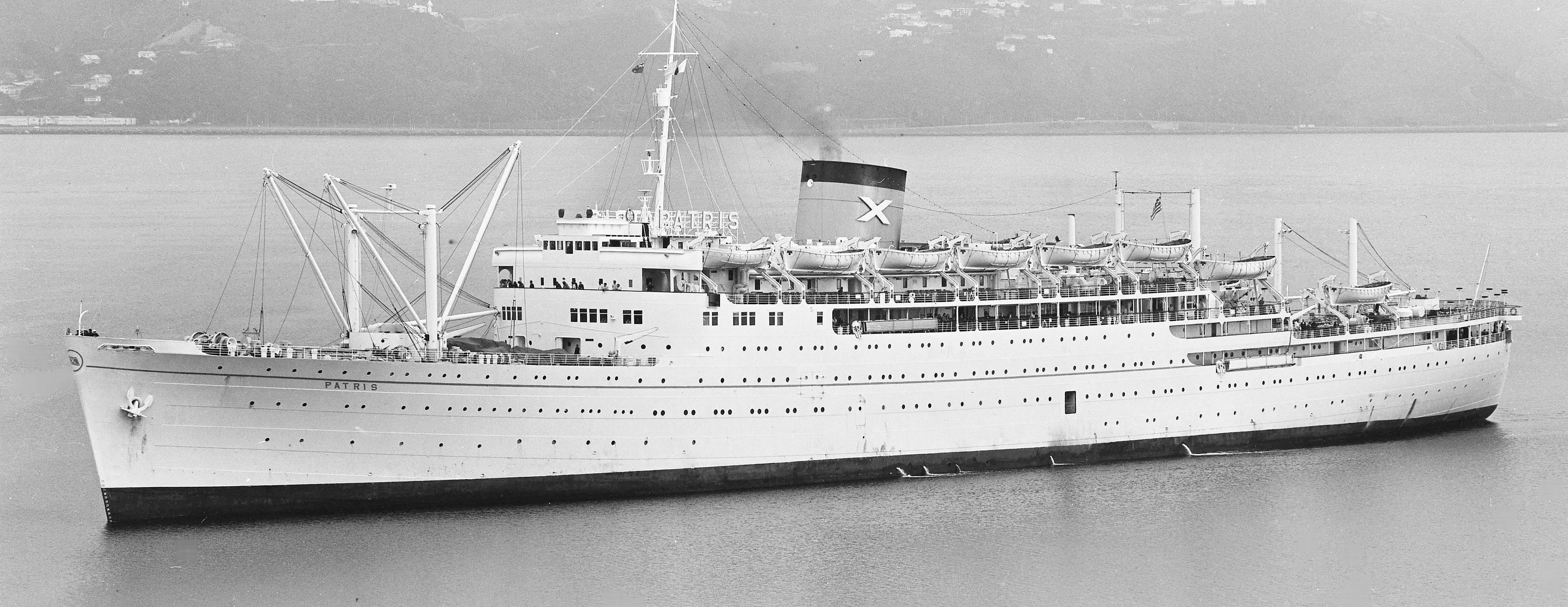
TSS Patris (1959)
Chandris Line · Australia migrant service from 1959 · Ship Guide
Overview
TSS Patris was the first major passenger liner of the Chandris organization and one of the ships most closely associated with postwar Greek migration to Australia. She had begun life in 1950 as Union-Castle's Bloemfontein Castle, a one-class passenger liner built for Britain's service to South and East Africa.
Purchased by Chandris in 1959 and rapidly rebuilt for the Europe–Australia migrant trade, she sailed from Piraeus on her first Australian voyage that December. Over the next sixteen years she completed 91 voyages to Australia, later served as emergency accommodation in Darwin after Cyclone Tracy, and finished her working life as a Mediterranean ferry.
Key Facts
Built as Bloemfontein Castle
The ship was launched for Union-Castle on 25 August 1949 as Bloemfontein Castle. She was designed for the company's intermediate service to South and East Africa rather than the faster Cape Mail route.
Her most unusual feature within the Union-Castle fleet was her single-class passenger arrangement. The company hoped that a lower-fare, one-class ship would attract substantial postwar emigration to South Africa, but the anticipated volume did not fully materialize.
The Union-Castle Experiment
Bloemfontein Castle represented an attempt to serve a different market from Union-Castle's traditional first- and tourist-class mail ships. She combined substantial passenger accommodation with refrigerated and general cargo capacity appropriate to the African trade.
The experiment proved short-lived. After only nine years, the ship became surplus to Union-Castle requirements and was sold to Chandris in 1959. That sale would transform both the vessel and the future direction of the Chandris business.
The First Chandris Liner
For Chandris, the purchase of Bloemfontein Castle was foundational. The company had previously concentrated on cargo shipping; the newly renamed Patris became its first large passenger liner and the starting point for a major Greek-owned passenger fleet.
The name Patris means “homeland,” an especially resonant choice for a vessel intended to carry migrants leaving Greece and other parts of Europe for Australia.
Rapid Conversion for Australia
After purchase, the ship was refitted rapidly for migrant service. Museums Victoria records accommodation for 36 First Class and 1,040 Tourist Class passengers, soon merged into a single-class capacity of 1,076.
Compared with later Chandris vessels such as Ellinis and Australis, the accommodation was relatively austere. Yet passenger recollections consistently show that the ship acquired a strong emotional place in the memory of postwar migration.
First Voyage to Australia
Patris left Piraeus on 14 December 1959 for her first migrant voyage to Australia. She reached Fremantle on 2 January 1960, Melbourne on 7 January, and Sydney shortly afterward.
The voyage established the pattern that would dominate her next sixteen years: a long Europe–Australia passage carrying migrants, families, and travelers through the Mediterranean, Suez, the Red Sea, and Indian Ocean.
Ninety-One Australia Voyages
Museums Victoria records 91 voyages to Australia between 1959 and 1975. That number makes Patris far more than a transitional ship in the Chandris fleet; she became one of the recurring maritime links between postwar Europe and Australia.
The ship is especially prominent in Greek-Australian family histories. For many passengers, the name Patris is inseparable from the experience of migration itself.
Suez, Cape Routes, and Operational Change
The normal route used the Suez Canal, with calls that could include Port Said, Aden, Colombo, Fremantle, Melbourne, and Sydney. When the canal closed after the 1967 Arab-Israeli war, Patris was forced onto the much longer route around the Cape of Good Hope.
Museums Victoria notes that for roughly five years she called at Cape Town and Durban while making the detour. The change added a striking historical symmetry: the former Union-Castle Africa liner returned to South African waters while serving a completely different migration system.
Grounding and Sydney Harbour Collision
Patris experienced several notable operational incidents. She grounded in the Suez Canal early in her Chandris career but was refloated without serious damage.
In 1971 she collided in Sydney Harbour with the collier Rickie Miller. The incident became one of the best-remembered events of her Australian service, though it did not end her career.
From Migration to Cruising
As long-distance migration shifted increasingly to air travel, Chandris adapted Patris to more varied employment. By the early 1970s she was also used for cruising from Australia and for services linking Australia with Southeast Asia.
Like many postwar passenger ships, she survived by becoming less specialized. The route for which she had been rebuilt in 1959 was disappearing, but the vessel still had useful passenger capacity and commercial value.
Cyclone Tracy and Darwin
After Cyclone Tracy devastated Darwin on Christmas Day 1974, Patris was chartered by the Australian Government as emergency accommodation. Museums Victoria records that she served as a floating hostel during much of 1975.
This episode gave the ship an unusual civic role at the end of her migrant-liner career. Instead of carrying people across oceans, she temporarily provided shelter to residents whose homes had been destroyed.
Conversion to Ferry Service
After leaving the Australian trade, the vessel returned to the Mediterranean and was converted for ferry service, including the carriage of cars. She operated between Italy and Greece before passing from Chandris ownership.
Under later owners she was renamed Mediterranean Island and then Mediterranean Star. Sources vary slightly on the exact transfer dates, but agree that she remained in regional ferry service into the 1980s.
Final Years
By the late 1980s the former Bloemfontein Castle had reached the end of an exceptionally varied career. She was sold for demolition and briefly carried the name Terra during the disposal process.
Her working life had encompassed Union-Castle's African passenger service, Greek-Australian migration, cruising, disaster relief, and Mediterranean ferry operations.
Why Patris Matters
Patris matters both institutionally and socially. Institutionally, she was the first major Chandris passenger liner and the ship from which a much larger passenger-shipping enterprise grew.
Socially, her importance lies in the thousands of migration stories attached to her 91 Australian voyages. She belongs not merely to fleet history but to the personal history of postwar Australia and especially its Greek diaspora.
Collecting Profile
Surviving material includes Chandris brochures, accommodation plans, menus, passenger lists, sailing schedules, postcards, tickets, photographs, and migrant souvenirs. Museums Victoria preserves particularly valuable Chandris ephemera and ship plans tied to the Australian route.
Items from the Bloemfontein Castle, Patris, Mediterranean Island, and Mediterranean Star periods should be cataloged separately, because each identity corresponds to a materially different operating context.
Interpretive Notes
The ship is often styled RHMS Patris as well as TSS Patris: Chandris secured a Greek government mail contract, giving the vessel a Royal Hellenic Mail Ship association. This guide uses TSS in the page title to match the archive naming convention while recognizing the RHMS usage.
Some late-career dates differ among secondary sources: the sequence of ferry conversion, sale, and renaming is secure, but individual years are not reproduced consistently. Where the evidence conflicts, the guide uses broader dating rather than false precision.
Cyclone Tracy occurred in December 1974: Patris's accommodation role belongs primarily to 1975, despite occasional secondary-source date errors.
Evidence-first ship guide