Bremen, Europa & Liberté: A Liner Across Two National Identities
The Olympic class was a design family, not a set of identical copies. Across Olympic, Titanic, and Britannic, White Star and Harland & Wolff refined passenger spaces, absorbed operating experience, responded to disaster, and altered the third ship under wartime conditions.
Basic answer
Were Bremen and Europa really interchangeable sisters?
No. They were conceived as a paired express-liner system for Norddeutscher Lloyd, sharing the same strategic purpose: restore German North Atlantic prestige through high sustained speed, modern engineering, and a two-ship weekly service. But even before they entered service, their histories began to diverge.
The paired program
Two ships built to make one schedule
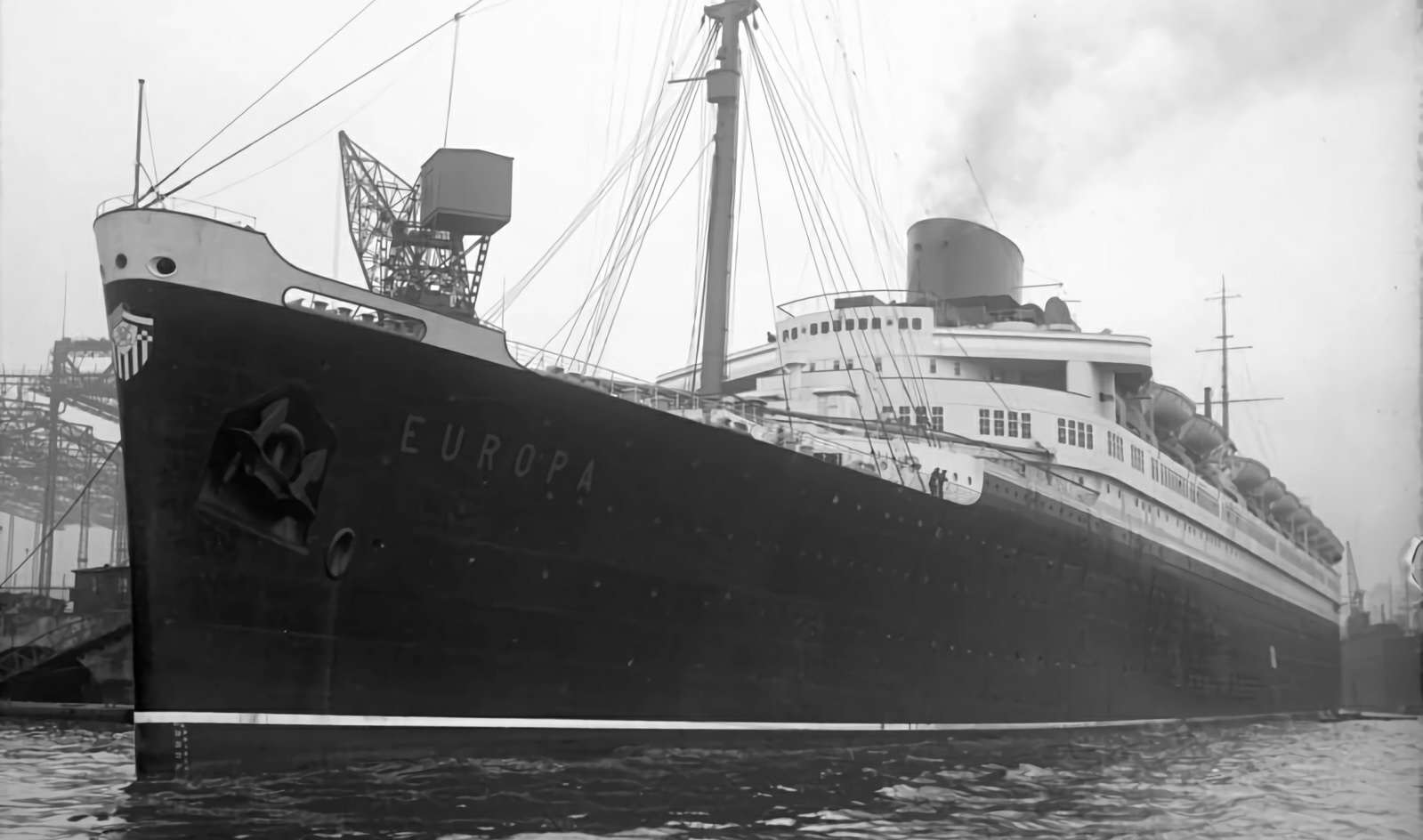
Norddeutscher Lloyd did not need a single fast ship; it needed a reliable express system. Bremen and Europa were designed together to sustain very fast North Atlantic schedules with only two principal ships. Speed was therefore operational as well as promotional: a weekly pattern depended on both sisters being able to maintain high service speed.
The visual language reinforced that strategy. Their low, streamlined profiles, turbine machinery, and modern interiors deliberately broke with the older four-funnel prestige tradition. The pair advertised a new German Atlantic identity after the First World War.
First divergence
Bremen arrives first; Europa is delayed by fire
Bremen
Entered service in July 1929 and immediately captured the westbound Blue Riband on her maiden voyage, establishing the pair’s speed credentials before her sister was ready.
Europa
A severe fitting-out fire on 26 March 1929 delayed completion until 1930. Her own maiden voyage then captured the westbound Blue Riband, confirming that the two-ship program was technically competitive rather than dependent on a single exceptional vessel.
That delay mattered. Bremen entered service at the opening of the program; Europa arrived into a worsening global economic climate. The sisters therefore shared a design moment but not precisely the same commercial moment.
Engineering identity
Shared machinery, different careers
Both ships used geared steam turbines driving four screws and were intended for sustained high-speed service. Their machinery was not simply about headline records; it made the paired timetable possible and supported innovations such as catapult mail that linked ship speed with communications speed.
Because their engineering identities were so closely matched, the later divergence is especially revealing. The difference between the sisters became less about what was installed in the engine room and more about what history allowed each hull to become.
Wartime rupture
The sister ships cease to be a pair
The Second World War destroyed the original two-ship system. Bremen returned to Germany in 1939 and was destroyed by an arson fire at Bremerhaven on 16 March 1941. Her damaged hull remained in the Weser before final disposal.
Europa survived the war and came under Allied control in 1945. She briefly entered U.S. Navy service as USS Europa, repatriating American personnel. That survival created a possibility that no longer existed for Bremen: one sister could be reinterpreted by a different nation and a different shipping line.
From Europa to Liberté
Rebuilding created a second design identity
Assigned to France as postwar compensation for the loss of Normandie, the former Europa did not simply receive a new name. Her transition into Liberté involved prolonged rebuilding, repair, altered interiors, French Line visual identity, and a new place within a national fleet rebuilding after wartime destruction.
German phase
Europa represented interwar German speed, modernity, technical prestige, and the paired NDL express system.
French phase
Liberté became a postwar French flagship on Le Havre–Southampton–New York, carrying a new decorative, corporate, and cultural identity.
Continuity
The hull, turbine machinery concept, and underlying engineering lineage remained those of the German express liner.
Transformation
Interiors, branding, passenger experience, publicity, and national symbolism changed enough that “same ship, new name” understates what happened.
A difficult rebirth
The rebuilding itself became part of the story
The postwar conversion was neither quick nor straightforward. On 8 December 1946, while being prepared for French service at Le Havre, the former Europa broke her moorings in a storm and was driven onto the submerged wreck of the liner Paris. The resulting flooding required major salvage and additional rebuilding.
Further repair and fire damage prolonged the process. When Liberté finally entered French Line service in 1950, she was not a temporary stopgap in any simple sense. She became one of the company’s principal postwar Atlantic ships and remained a major public symbol until the arrival of the new France.
Design afterlife
When does a rebuilt liner become something new?
Liberté is a useful test case for historical identity. Structurally and mechanically she remained the former Europa, yet her interiors, operator, route culture, national symbolism, and collectible material belonged to a distinctly French postwar context.
For curatorial purposes, the most accurate approach is layered identity: Europa and Liberté are the same physical ship, but not the same historical phase. Objects, plans, photographs, menus, and publicity should be dated and attributed to the correct identity rather than merged into one undifferentiated biography.
Timeline
From paired sisters to separate histories
Bremen enters service
She establishes the new NDL express program and captures the westbound Blue Riband on her maiden voyage.
Europa suffers fitting-out fire
The fire delays completion and makes the second sister’s path different before she carries a single paying passenger.
Europa joins the service
Her maiden voyage also captures the westbound Blue Riband, completing the intended high-speed two-ship system.
War ends the paired system
Bremen returns to Germany and is destroyed by arson fire in 1941; Europa survives the war.
Europa becomes Allied transport
The surviving sister enters U.S. control and briefly serves as USS Europa.
France rebuilds the ship
Assigned to France, damaged again during conversion, and extensively reconstructed before entering French Line service.
Liberté becomes a French flagship
The former German speed queen serves a new national fleet and acquires a distinct postwar French cultural identity.
Read the identities separately
Three guides, one intertwined history
Related interpretation
Continue the story
Evidence note
Identity follows configuration
Material from Europa and Liberté should not be treated as interchangeable simply because the hull was the same. Funnel colors, interiors, cabin plans, printed ephemera, route information, and operator marks can all identify a specific phase. When dating is uncertain, “former Europa / later Liberté” is more responsible than assigning a confident national identity without supporting evidence.
Selected sources