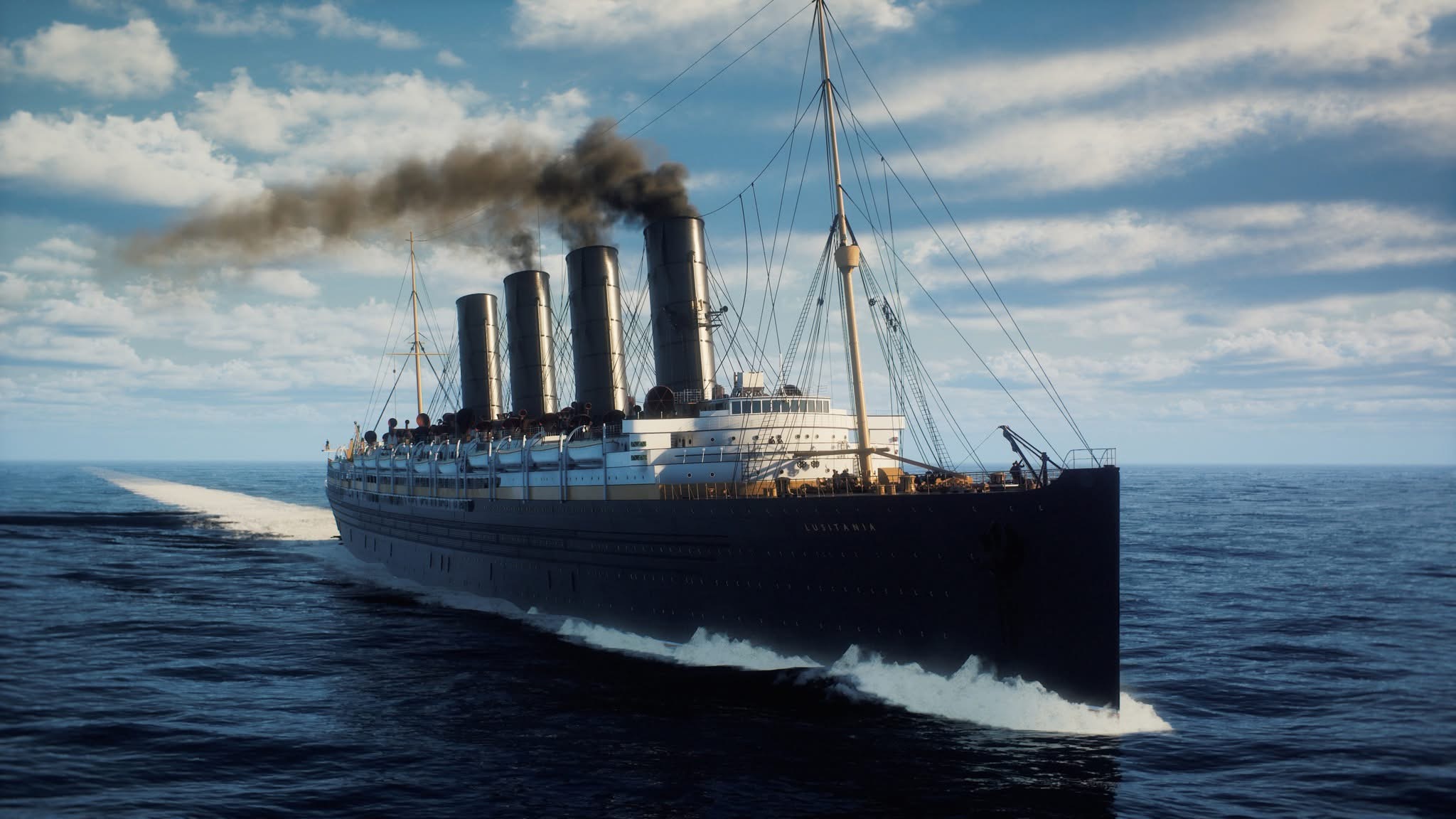
This page is a focused chronology rather than a complete biography. It follows
Lusitania from her final departure from New York through the warning environment of the First World War, the attack by U-20, the rapid sinking off the Old Head of Kinsale, the rescue response from the Irish coast, and the public reaction that followed.
Time note: many accounts give the torpedo strike at about 2:10 p.m. and the sinking at about 2:28 p.m. on May 7, 1915. Some event times are approximate because witness recollections, shipboard clocks, wartime reporting, and later reconstructions do not always align to the minute.
Curator’s note: Lusitania is often compressed into a single phrase — “sunk in eighteen minutes.” That phrase is useful, but the historical meaning comes from the surrounding sequence: wartime warnings, neutral passengers, the submarine campaign, rescue delays, casualty reporting, and later debate over cargo, responsibility, and memory.
Filters
Toggle categories to narrow the page by voyage phase, wartime warnings, attack and sinking, rescue activity, or aftermath.
⌕
Tip: Search matches day, time, title, description, and category tags.
A German Embassy warning appears in New York newspapers
WarningsVoyage
A notice from the Imperial German Embassy warns travelers that ships flying the British flag are entering a declared war zone at their own risk. The warning appears near Cunard sailing notices in some papers, making the voyage politically charged even before departure.
Curator note
The warning matters historically, but it should not be treated as a simple “passengers were fully informed” conclusion. Readers still need context: neutrality, passenger assumptions, Cunard confidence, wartime law, and the fact that many civilian travelers did not expect a passenger liner to be attacked without warning.
About noon
Lusitania departs New York for Liverpool
Voyage
Lusitania leaves New York on what becomes her final eastbound crossing. She is still a prestigious Cunard express liner, but the voyage now takes place within the pressures of the First World War and the German submarine campaign.
After departure
Passengers settle into a wartime Atlantic crossing
VoyageWarnings
The ship proceeds eastward with passengers, crew, mail, and cargo. Later debate often narrows the voyage to cargo and warning questions, but for those aboard it remains a real passenger crossing with families, emigrants, business travelers, children, and crew members.
Thursday, May 6, 1915
Daytime
Lusitania approaches the declared war zone
Warnings
As the liner nears British and Irish waters, the voyage enters its most dangerous phase. The German submarine campaign has made this region more hazardous than a normal peacetime approach to Liverpool.
May 6
U-20 is active off the Irish coast
Warnings
The German submarine U-20, commanded by Kapitänleutnant Walther Schwieger, is operating in the area. Other ships are attacked or sunk in the wider sequence, reinforcing that Lusitania is approaching a genuinely active submarine zone.
Evening
Routine shipboard life continues
Voyage
Aboard Lusitania, passengers continue the routines of a transatlantic crossing. This contrast — ordinary liner life on the edge of a war zone — is one reason the sinking later carried such emotional and political force.
Friday, May 7, 1915
Morning
The final approach to Ireland
VoyageWarnings
Lusitania is nearing the southern coast of Ireland on the approach toward Liverpool. Visibility, speed, Admiralty advice, navigation choices, and submarine danger later become central to inquiry discussion and historical debate.
Late morning–early afternoon
Danger increases near the Old Head of Kinsale
Warnings
The ship is off the Irish coast, near waters where submarine attack is possible. The later public narrative often treats the attack as sudden, but the broader strategic environment had been developing for months.
About 2:10 p.m.
U-20 fires a torpedo and Lusitania is struck
Attack
A torpedo fired from U-20 strikes Lusitania on the starboard side. A second internal explosion is reported by many accounts shortly afterward, and the ship rapidly begins to list and settle.
Curator note
The torpedo strike is clear; the nature of the subsequent explosion has been debated for generations. A careful page should distinguish the documented sequence from later interpretations about what the second explosion means.
Minutes after impact
The ship develops a severe list and evacuation becomes chaotic
Attack
The rapid list makes lifeboat launching extremely difficult. Some boats cannot be handled properly, some are lowered badly, and others are crushed or spilled. The problem is not simply a shortage of boats, but the speed and angle of the sinking.
Shortly after 2:10 p.m.
Wireless distress messages are sent
AttackRescue
Distress calls are transmitted as the liner’s condition deteriorates. The emergency is unfolding close to shore compared with many Atlantic disasters, but the speed of the sinking leaves very little time for organized outside help.
About 2:15–2:25 p.m.
Passengers and crew struggle to leave the ship
Attack
The evacuation becomes a compressed crisis. Families are separated, lifeboats are difficult to lower, and many people end up in the water with debris, collapsible craft, or damaged boats around them.
About 2:28 p.m.
Lusitania sinks
Attack
Lusitania disappears beneath the surface roughly eighteen minutes after being struck. The short interval between attack and sinking becomes one of the central facts of the disaster and shaped both survival chances and later public memory.
Afternoon
Survivors wait in the water and damaged boats
Rescue
After the ship sinks, survivors are scattered among boats, wreckage, and cold water. The disaster is now a rescue problem, but many people are already exposed, injured, or unable to hold on long enough for help.
Later afternoon
Local vessels and rescue craft reach the scene
Rescue
Fishing boats, tugs, patrol vessels, and other craft from the Irish coast begin recovering survivors and bodies. The rescue is deeply local: Queenstown and Kinsale become central to the human aftermath.
Evening
Survivors and bodies are brought to Queenstown and Kinsale
Rescue
The disaster comes ashore in Ireland. Survivors require medical care, shelter, food, clothing, and communication. The dead create an immediate identification, burial, and documentation crisis.
Saturday, May 8, 1915
Morning
News of the sinking dominates newspapers
Aftermath
Newspapers report the loss in dramatic terms. Early casualty figures, passenger lists, survivor reports, and diplomatic reactions are uncertain and evolving, making this a moment of grief, rumor, correction, and political interpretation.
May 8
Identification and burial work begins in earnest
AftermathRescue
Bodies recovered from the sea are brought ashore. Some are identified by papers, clothing, jewelry, or testimony; others are not. The material record of the disaster includes not only ship documents but the painful administrative work of death registration and burial.
May 8 onward
Public anger intensifies in Britain, the United States, and beyond
Aftermath
The sinking becomes a major international event. The loss of civilian passengers, including Americans, turns Lusitania into a powerful symbol in debates over submarine warfare, neutrality, and German responsibility.
Aftermath and Inquiry
May 1915
Casualty figures are clarified
Aftermath
Later summaries commonly give 1,198 deaths, including 128 Americans, though period reports and later tallies can vary slightly depending on how deaths after rescue and passenger/crew categories are counted.
Curator note
For publish-ready work, treat casualty figures as a source-dependent claim. State the figure you are using and the basis for it rather than implying that every contemporary and later list is identical.
1915
The sinking becomes a diplomatic crisis
Aftermath
The United States does not enter the war immediately, but the sinking sharply hardens opinion against Germany and becomes part of the larger diplomatic path toward American involvement in the First World War.
1915 onward
Inquiry, propaganda, and controversy reshape the record
Aftermath
British, American, and German arguments over responsibility, cargo, warning, route, armament claims, and submarine warfare become part of the long afterlife of the disaster. The evidentiary problem is not only what happened, but how wartime secrecy and propaganda shaped what people could know.
Long after 1915
Lusitania remains a contested memory object
Aftermath
The sinking remains historically important because it connects ocean liner travel, civilian vulnerability, wartime law, propaganda, public outrage, and the politics of evidence. It is not just a shipwreck; it is a case study in how a maritime disaster becomes international memory.
Continue Exploring Lusitania and Cunard
Follow the event sequence outward into ship biography, Cunard context, wartime interpretation, and related liner history.