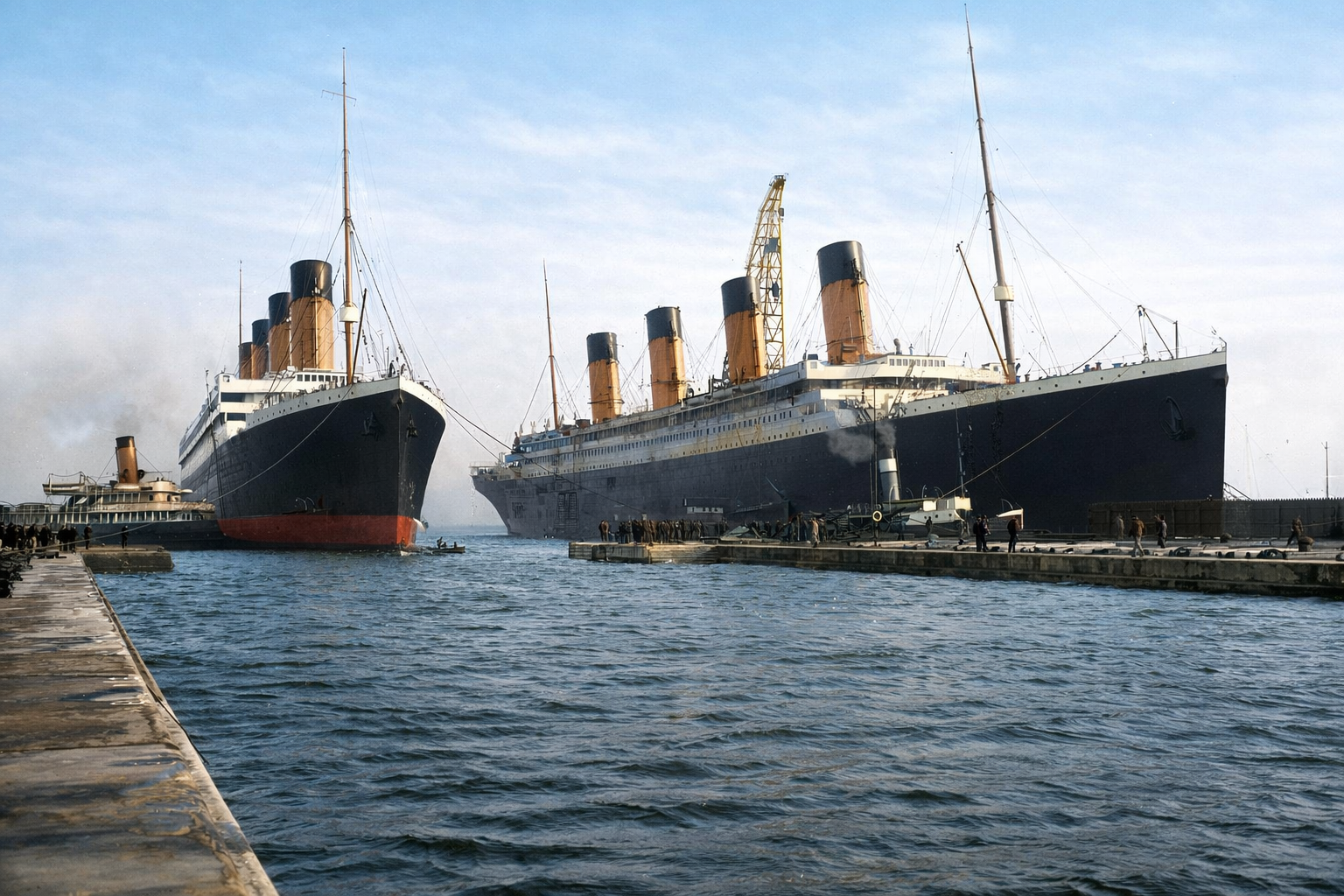
Olympic, Titanic & Britannic: How the Class Evolved
The Olympic class was a design family, not a set of identical copies. Across Olympic, Titanic, and Britannic, White Star and Harland & Wolff refined passenger spaces, absorbed operating experience, responded to disaster, and altered the third ship under wartime conditions.
Basic answer
Were the three Olympic-class ships really the same?
They shared the same broad hull form, machinery concept, silhouette, and commercial idea, but they were never exact duplicates. Olympic established the class in service. Titanic incorporated selected passenger-space refinements while still being completed. Britannic, laid down before the loss of Titanic but completed afterward, became the most visibly revised sister because safety changes were incorporated during construction and because war prevented her from entering the civilian service for which she had been designed.
First unit
Olympic: the working prototype
Olympic was the first complete expression of the class and therefore the ship from which real operating experience could be drawn. Her early voyages revealed how passengers used promenades, suites, dining spaces, reception areas, stairways, and circulation routes. They also provided practical information about docking, handling, machinery, and day-to-day operation at a scale White Star had not previously managed.
This matters because Titanic was still being fitted out while Olympic was already carrying passengers. The second ship therefore did not emerge from an untouched drawing board. She was finished while her sister was generating real-world feedback.
Second unit
Titanic: refinement without reinvention
B Deck promenade
Part of the open promenade arrangement was enclosed and repurposed, contributing to larger and more desirable first-class accommodations.
Premium suites
The second ship placed greater emphasis on high-end privacy and apartment-like first-class space rather than simply repeating the first unit.
Restaurant and café
The treatment of the à la carte restaurant and Café Parisien reinforced a more fashionable, socially differentiated first-class experience.
Class identity
Despite these changes, Titanic remained unmistakably an Olympic-class liner. The important story is selective refinement, not wholesale redesign.
These revisions are best understood commercially. They suggest that White Star valued additional premium accommodation and a more deliberately curated first-class experience. The differences were not dramatic enough to make Titanic a new design generation, but they are large enough to show that the company was learning from the first ship.
The 1912 divide
Titanic changed the design problem
After the loss of Titanic, the question was no longer merely how to improve passenger experience. The class now had to be reconsidered through the lens of survivability and evacuation. Olympic received major safety modifications in refit, while Britannic could absorb substantial changes while still under construction.
The post-disaster response included greater lifeboat provision and altered launching arrangements, stronger emphasis on subdivision and watertight protection, and changes intended to improve the ship's ability to survive damage. These changes should not be collapsed into a single simple claim that “Britannic was made unsinkable”; rather, she embodied a more conservative safety philosophy shaped by lessons from 1912.
Third unit
Britannic: the revised sister
Higher subdivision
Britannic incorporated extensive changes to watertight subdivision and related protective arrangements while construction was still underway.
Lifeboat handling
Her large gantry-style davits and expanded boat arrangements made the post-Titanic safety shift visually obvious.
Passenger design interrupted
Britannic was intended for civilian White Star service, but wartime requisition meant the passenger liner as commercially envisioned never entered regular service.
Hospital-ship conversion
Medical use altered spaces, circulation, fittings, and operational priorities, so surviving plans must be read by configuration and date.
Britannic is therefore both the third sister and a design counterfactual. She shows where the Olympic-class concept was heading after 1912, but wartime service prevents us from observing how those revisions would have worked in normal Atlantic passenger operation.
What changed—and what did not
The class remained coherent
The three ships retained the same essential design language: great length, four-funnel profile, similar machinery arrangement, shared public-room vocabulary, and White Star's preference for size and steadiness over a pure speed race. The changes accumulated within that framework.
That is what makes the class historically useful. It shows how a major passenger-ship design could be both standardized and adaptive. Commercial feedback refined the second unit; disaster reshaped the third; and refits allowed the surviving first ship to absorb lessons after delivery.
A class in motion
Timeline of design evolution
Olympic enters service
The class becomes operational reality, giving White Star direct evidence about passenger use, handling, machinery, and large-ship logistics.
Titanic is refined during completion
Promenade enclosure, suite expansion, and public-room adjustments demonstrate selective commercial revision while retaining the common class design.
Titanic is lost
The disaster transforms the design problem from passenger refinement to a broader reconsideration of evacuation and survivability.
Olympic is modified
The surviving lead ship receives substantial safety-related alterations, meaning even the first unit no longer remains frozen in its original configuration.
Britannic is revised during construction
The third sister incorporates safety changes at a stage where structural work can be altered more deeply than on an already completed ship.
Britannic enters service as a hospital ship
War prevents the revised third sister from revealing how her intended passenger configuration would have performed in ordinary Atlantic service.
Three ships, three historical roles
Read the sisters together
Related interpretation
Continue the design story
Evidence note
Plans must be dated
A plan labeled simply “Olympic class” can conceal important differences between ships and between service phases. The safest approach is to identify the specific vessel, date, and configuration before using a plan to support claims about cabins, lifeboats, subdivision, or public rooms. This is especially important for Britannic, whose intended passenger arrangement, completed condition, and hospital-ship configuration are not interchangeable.
Selected sources