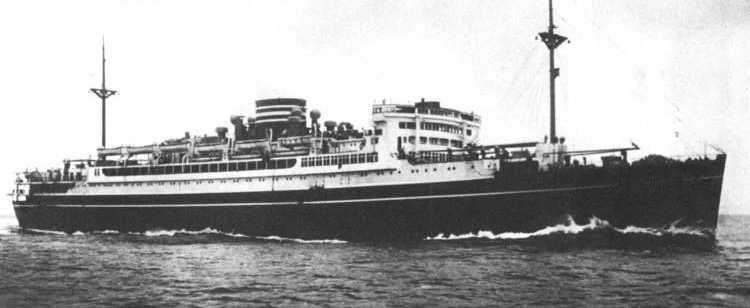
Chichibu Maru (1930)
Nippon Yusen Kaisha (NYK Line) · completed 1930 · Ship Guide
Overview
Chichibu Maru was an important interwar Japanese transpacific motor liner operated by Nippon Yusen Kaisha (NYK). Built in Yokohama and completed in 1930, she joined Asama Maru and Tatsuta Maru in the modern generation of Japanese passenger ships serving the Pacific routes between Japan and the American West Coast.
Renamed Kamakura Maru in 1939, the same ship entered a very different wartime role. She was eventually sunk in April 1943 while carrying military personnel and civilians. Her record deserves to be understood in separately dated commercial, diplomatic, and military contexts.
Key Facts
Construction and Design
Yokohama Dock Company laid down the ship in February 1928 and launched her on 8 May 1929. She entered service after completion in March 1930. The ship was a motor liner, equipped with twin screws and Burmeister & Wain diesel machinery.
While frequently grouped with Asama Maru and Tatsuta Maru, she was not identical to them. Her single-funnel appearance, propulsion arrangements, and design details help distinguish her in contemporary photographs and postcards.
A Japanese Transpacific Liner
Chichibu Maru served the Yokohama–San Francisco route, an important connection among Japan, Hawaii, and North America. Her passengers included tourists, business travelers, emigrant families, and returning residents in a network sustained by NYK's scheduled Pacific operations.
Contemporary newspaper coverage of her 1930 arrival in San Francisco describes the new vessel as combining passenger comfort, speed, and safety. Such promotional reporting is valuable evidence of public reception, but its statistics must be checked against technical registers rather than treated as final design specifications.
The Change to Kamakura Maru
The vessel was renamed Kamakura Maru in 1939, after a period when the original name was also rendered under revised Japanese romanization conventions. Records and image captions dating from before the change may therefore use different English spellings for the same ship.
For attribution, the original name and the wartime name should be indexed together without conflating the vessel's peacetime passenger career and subsequent military assignments.
Wartime Service and Personnel Exchange
With the outbreak of the Pacific War the vessel's commercial role came to an end. Under the name Kamakura Maru, she was used for wartime transport and was associated with exchange or repatriation voyages involving civilians and diplomatic personnel.
Evidence describing her wartime status is not always uniform across secondary accounts; the administrative distinction between commercial ownership, requisition, transport assignment, and any particular voyage should be established before assigning a blanket designation to all wartime photographs.
Sinking in April 1943
On 28 April 1943, Kamakura Maru was torpedoed and sunk by the United States submarine USS Gudgeon while sailing in the Sulu Sea. The sinking occurred during the ship's wartime transport service, not on her former civilian transpacific route.
The loss of life was severe. Often-repeated figures suggest approximately 2,035 deaths, but reported totals vary; published survivor and passenger counts should be attributed to specific wartime records rather than presented as perfectly settled.
Interpretive Notes
Different names, one hull: the 1939 renaming was an identity change, not the introduction of a replacement vessel.
Ship recognition: her single funnel distinguishes her visually from the related Asama Maru and Tatsuta Maru.
Passenger and casualty numbers require context: peacetime capacity figures should not be used to estimate wartime complement, and loss totals may be inconsistent between sources.
Primary evidence: the U.S. Naval History and Heritage Command preserves a photograph of the ship off Oahu on 4 January 1939, shortly before her renaming. It provides a useful fixed date for pictorial attribution.
Evidence-first ship guideRelated Guides
See Asama Maru and Tatsuta Maru for related NYK transpacific liners, and Hikawa Maru for a surviving Japanese passenger ship of the same period.
Sources (Selected)
- Ocean Liner Curator — master bibliography
- Naval History and Heritage Command — dated photograph and loss summary, NH 93894
- Japanese American News, 16 April 1930 — contemporary arrival report
- Chichibu Maru — secondary chronological overview (verify contested figures)
- NYK Hikawa Maru — official historical context for 1930s Japanese passenger shipping