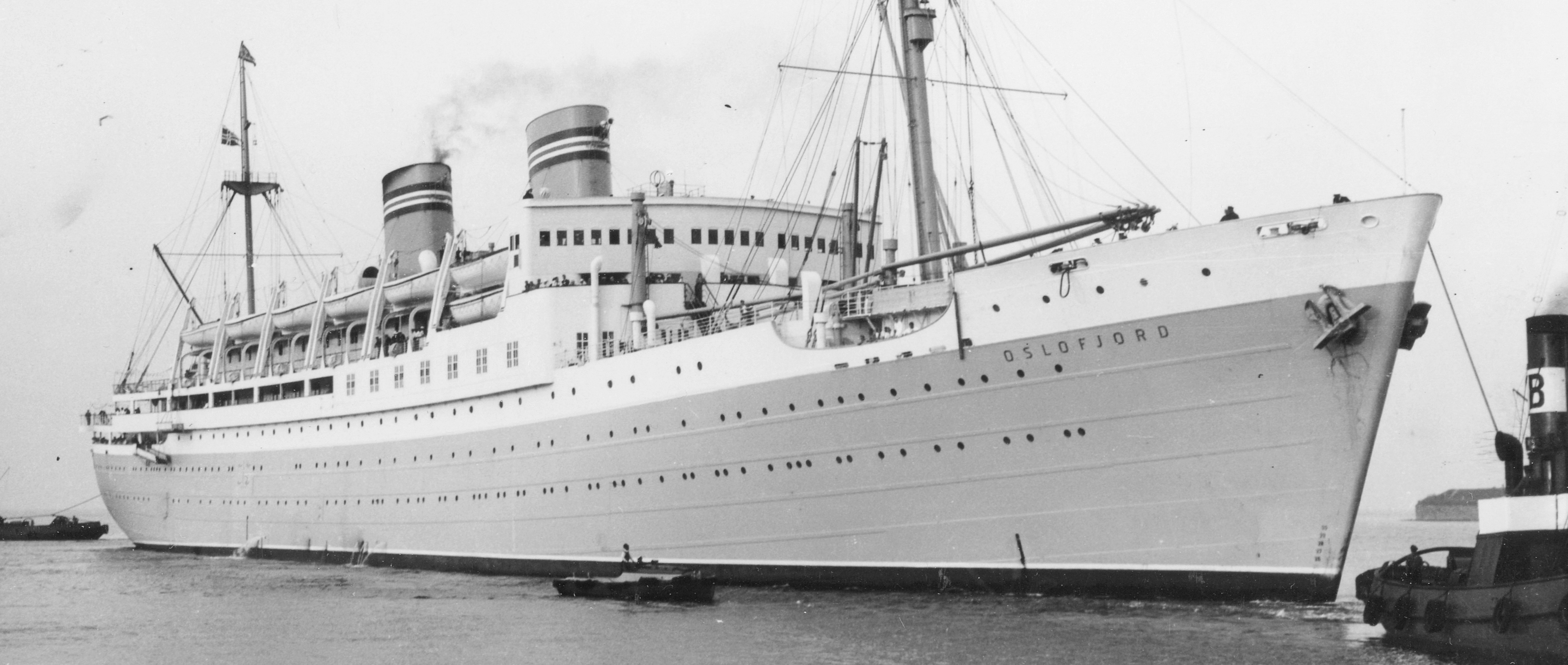
MS Oslofjord (1938)
Norwegian America Line · entered service 1938 · Ship Guide
Overview
MS Oslofjord was the Norwegian America Line’s fourth passenger ship and its first purpose-built motor liner. Built in Germany and introduced in 1938, she represented a new generation of Norwegian transatlantic travel: a ship designed for scheduled North Atlantic crossings but also intended to serve American winter cruising markets.
Her civilian career lasted barely two years. With the outbreak of the Second World War, she was laid up in New York, later placed under Norwegian wartime management, and adapted for military transport. In December 1940 a mine severely damaged her near the mouth of the River Tyne; the wreck was ultimately lost.
Key Facts
A Modern Motor Liner
Built at AG Weser in Bremen, Oslofjord was launched on 29 December 1937 and delivered in May 1938. Her maiden departure from Oslo for New York was on 4 June 1938. Unlike the company’s earlier steamships Bergensfjord and Stavangerfjord, she used diesel propulsion.
Her arrangements blended three-class transatlantic travel with spaces suited to cruising. Contemporary descriptions emphasize a characteristically Norwegian design approach, featuring restrained décor, native woods, and artwork by Norwegian artists rather than the ostentatious display associated with some prestige liners.
Accommodation, Art, and the Cruise Market
Oslofjord accommodated 860 passengers in cabin, tourist, and third class. On scheduled crossings these divisions mattered to fares and passenger experience, while cruise operations could combine cabin and tourist public rooms.
The ship’s interior swimming pool and versatile saloon arrangements marked a departure from earlier Norwegian America Line vessels. She undertook a Caribbean cruise in the winter of 1938–39, illustrating the company’s effort to diversify as long-distance migration patterns and ocean travel markets changed.
Service and a 1939 Collision
Oslofjord operated alongside the older Bergensfjord and Stavangerfjord on the Norwegian route to New York. Crown Prince Olav and Crown Princess Märtha traveled aboard her during their 1939 visit to the United States.
On 27 April 1939, in fog near New York, Oslofjord collided with the American pilot boat Sandy Hook, which sank. Those aboard the pilot boat were rescued. The episode is a reminder that navigational incidents should be distinguished from the later wartime loss of the liner.
War, Requisition, and Loss
With European war underway, Oslofjord was laid up in New York in January 1940. Following the German invasion of Norway, she came under Norwegian wartime shipping arrangements and was subsequently placed in service for the British Ministry of War Transport, with Norwegian officers and crew.
While heading to Newcastle after wartime conversion work, she struck a mine near the Tyne estuary on 1 December 1940. One crew member died. The damaged vessel was beached, but salvage could not save her: storms and structural failure in January 1941 ended recovery prospects. Sources may variously date her loss to the mine strike of 1940 or the destruction of the stranded wreck in 1941; these are distinct events.
Interpretive Notes
The designation matters: this is the first Oslofjord of Norwegian America Line, not the postwar motor liner of the same name introduced in 1949. Image captions, memorabilia, and references should distinguish the two.
A mixed commercial mission: she was a genuine scheduled ocean liner, but cruise-market requirements shaped her interiors and passenger facilities from the outset.
A precise loss chronology: mined on 1 December 1940; salvage abandoned after the stranded wreck deteriorated in January 1941. Treating both dates as synonymous can cause confusion.
Technical descriptions may differ by measurement convention: published length and dimensional figures may represent overall length, registered length, or other conventions; do not combine them without qualification.
Evidence-first ship guideRelated Guides
For the Norwegian America Line’s earlier steamship era, see SS Bergensfjord and SS Stavangerfjord.
Sources (Selected)
- Ocean Liner Curator — Sources (master bibliography)
- Store norske leksikon — M/S Oslofjord (I), Per Kristian Sebak / Museum Vest
- Oslo byleksikon — MS Oslofjord (I), construction, design, and operational chronology
- Krigsseilerregisteret — M/S Oslofjord, wartime loss and registry
- Bergens Sjøfartsmuseum — Norwegian America Line background
- Skipshistorie — technical particulars and loss chronology