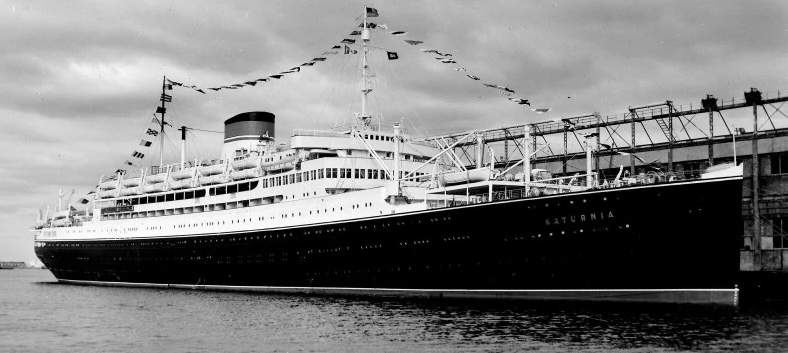
MS Saturnia
Cosulich Line · entered service 1927 · Ship Guide
Overview
MS Saturnia was one of the most important Italian motor liners of the interwar period. Built at Monfalcone for Cosulich Società Triestina di Navigazione, she combined large-scale passenger accommodation with diesel propulsion at a time when most prestige liners still relied on steam turbines.
Her long career crossed several distinct historical phases: River Plate and New York service, interwar modernization, Allied transport work, service as the U.S. Army hospital ship Frances Y. Slanger, and finally postwar migration traffic to Halifax and New York.
Key Facts
Why the Builder Label Needs Care
Modern references do not always use the same corporate name for the Monfalcone yard. Contemporary 1920s context points to Cantiere Navale Triestino, while later histories often identify the yard under the successor Cantieri Riuniti dell'Adriatico name. The physically useful facts are firmer: Monfalcone, yard no. 160, keel work beginning in May 1925, and launch in December of that year.
Rather than force one later corporate label backward onto 1925, this guide keeps the yard identity and corporate succession explicit.
Design and Interwar Identity
Saturnia and sister Vulcania represented a distinctly interwar Italian approach to long-distance passenger service. Their diesel propulsion set them apart from many contemporary prestige liners still relying on steam turbines, while their interiors and public presentation were repeatedly updated as tastes changed. The ships were not static design objects: modernization was part of their commercial identity.
That matters especially for surviving photographs and ephemera. A brochure from the late 1920s can document a very different decorative scheme from material produced after the 1935–36 rebuilding. Treating all interiors as one timeless “Saturnia style” risks collapsing several design phases into one.
Interwar Service and Modernization
Saturnia began on the River Plate route and soon shifted between South American and New York service as traffic required. Her diesel machinery and unusual external profile were part of the ship's public identity from the beginning.
In 1935–36 she received new engines and major interior renovation at Monfalcone. That refit is important when dating photographs and decorative material: a 1920s interior and a late-1930s interior may represent substantially different design schemes.
War Service and Frances Y. Slanger
After the 1943 Italian armistice, Saturnia escaped German seizure and came under Allied control. She was used for transport work before conversion in New York for the U.S. Army. In 1945 she became USAHS Frances Y. Slanger, named for the American Army nurse killed in Europe.
The hospital ship had capacity for roughly 1,600 patients and made several Atlantic evacuation voyages. By early 1946 she had reverted to transport work under the name Saturnia, carrying service personnel and dependents before return to the Italian government later that year.
From Military Transport to Migration Ship
The transition back to civilian use did not erase the wartime alterations overnight. Saturnia's postwar career grew out of a ship that had been repeatedly reconfigured for military requirements and then returned to commercial standards. Her later migration voyages therefore belong to a broader story of European liners being adapted again for mass family movement after the war.
Postwar Migration
Commercial service resumed in January 1947. From 1948 Halifax became a regular call before New York, making Saturnia especially prominent in postwar migration records and family histories. She remained in service until 1965.
Evidence-first ship guide