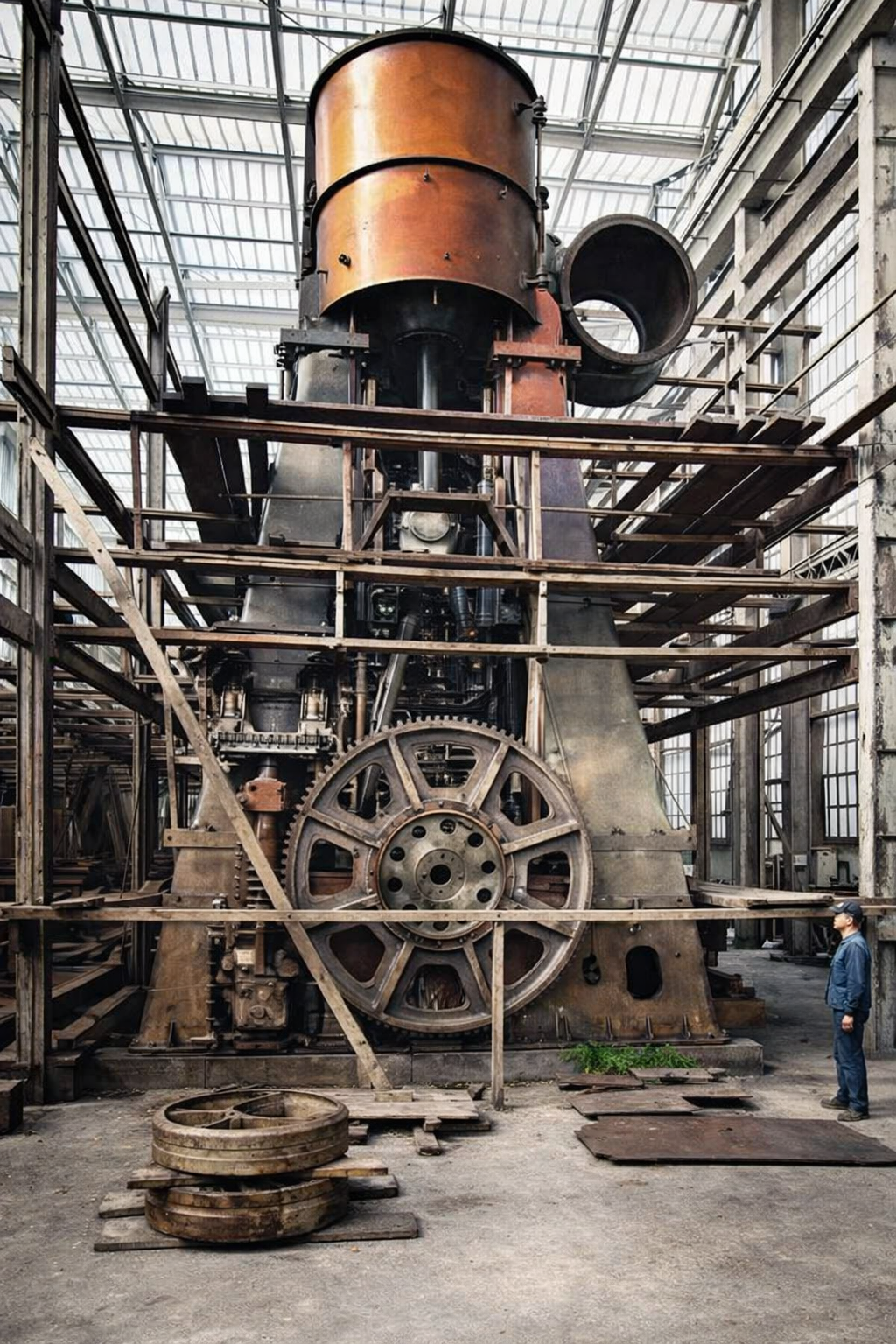
Overview
Ocean liners were not defined only by their scale or accommodations. They were also
shaped by the machinery below the decks: engines, boilers, shafts, propellers, fuel
systems, electrical infrastructure, navigation equipment, and the engineering logic
that made scheduled long-distance travel possible.
Changes in propulsion altered far more than headline speed. They affected fuel economy,
operating range, vibration, reliability, maintenance requirements, route suitability,
and the kinds of service a ship could perform profitably. A high-speed turbine liner on
the North Atlantic and a diesel motor ship on a long-distance passenger route were not
built to solve the same problem.
This page is interpretive by design. It does not attempt to catalog every engineering
variation, but instead outlines the major technological transitions that most clearly
shaped ocean liner history.
Primary focus
How propulsion and onboard technology changed what ocean liners could do.
Core progression
Paddle steamers, screw propulsion, compound and triple-expansion engines, steam turbines, diesel motor ships, and postwar navigation systems.
Main historical theme
Engineering choices reflected route pressure, economics, and operating demands as much as raw innovation.
Why it matters
Technology helps explain speed, endurance, prestige, crew structure, and the commercial lives of different ships.
Reviewed using curatorial standards
Timeline
1830s–1850s
Paddle steam propulsion establishes scheduled ocean service
Early steamships used side wheels or, less commonly, other paddle arrangements to
provide regular propulsion independent of wind. This was a foundational change:
schedule reliability improved, mail service became more dependable, and the idea
of routine steam passage across major routes became practical.
1850s–1870s
Screw propulsion becomes the more durable ocean-going solution
The screw propeller proved more efficient and seaworthy for large-scale ocean work.
It reduced some of the limitations associated with paddles, fit better with iron and
later steel hull development, and helped establish the technical basis for larger,
more practical ocean liners.
1860s–1880s
Compound engines improve efficiency
Marine steam engineering advanced through more efficient use of steam pressure.
Compound systems reduced fuel waste and extended the economic practicality of longer
services. This mattered on routes where endurance and operating cost could be more
important than absolute speed.
1880s–1900s
Triple-expansion engines define a mature steam era
Triple-expansion machinery became one of the most important engineering advances
in late nineteenth-century passenger shipping. Greater efficiency, better fuel
economy, and improved reliability supported long voyages, more predictable timetables,
and increasingly ambitious liner services.
1890s–1910s
Steam turbines emerge for high-speed prestige service
Turbine propulsion offered smoother running and, in the right context, higher speeds.
It became closely associated with prestige competition on major routes, especially where
speed, schedule, and public reputation carried unusual symbolic weight.
1910s–1930s
Turbine systems mature and diversify
Turbines were refined across the interwar period, often in combination with improved
hull forms, gearing, and more integrated engineering systems. The result was not merely
faster ships, but more sophisticated large liners built around route-specific performance goals.
1920s–1950s
Diesel motor ships become increasingly important
Diesel propulsion offered strong fuel-efficiency advantages and could be well suited
to long-distance or non-express services. Motor ships did not simply replace turbines
in a straight line; rather, they reflected a different balance of economy, endurance,
and operating need.
1930s–1950s
Electrical systems and hotel services grow in importance
As liners became more elaborate, engineering was increasingly about more than propulsion.
Electrical generation, ventilation, refrigeration, lighting, lifts, and hospitality systems
became a larger part of what made a passenger ship function as a modern environment at sea.
1940s–1960s
Radar and modern navigation change operational practice
The technological story of liners widened beyond propulsion. Radar, radio navigation,
and improved bridge instrumentation changed how ships operated in poor visibility,
congested waters, and adverse conditions. Safety and situational awareness became a larger part of the story.
1950s–1960s
Automation and systems integration reduce labor intensity
Postwar ships increasingly incorporated more automated engineering and operational systems.
This did not eliminate complexity, but it altered crew structure, maintenance practice,
and the economics of running large passenger vessels in a changing transportation landscape.
Major Technology Systems
Paddle, screw, reciprocating steam, turbines, and diesel engines each brought different
tradeoffs in efficiency, speed, vibration, maintenance, and route suitability.
Improvements in efficiency could make long routes viable, reduce operating cost, and
influence whether a ship succeeded outside the most prestigious express corridors.
Some ships were built to win or sustain high speeds; others were built for dependable
service over long distances where endurance and economy mattered more.
Radar, communications equipment, and bridge instrumentation became increasingly important
to how liners were operated, especially in the mid-twentieth century.
Propulsion should not be read as a simple ladder of “better” and “worse.” Different systems
answered different commercial and operational needs.
Why Technology Mattered Historically
Route demands shaped engineering
Technology followed commercial logic. Express Atlantic competition rewarded one set of choices;
long-distance or mixed-service routes could reward another.
Efficiency was as important as spectacle
The most famous fast ships do not tell the whole story. Fuel economy and practicality often mattered just as much.
Modernity extended beyond the engine room
Lighting, ventilation, refrigeration, navigation, and automation all became part of the liner’s technical identity.
Looking at propulsion also helps explain why ships with similar outward scale or luxury could perform
very differently in service. A liner’s machinery was part of its purpose. It shaped not only its speed,
but its economics, route structure, and the type of experience it offered at sea.
How to Read Technology in Ship History
A propulsion system is not just a technical footnote. It is evidence of design priorities.
It can suggest what service a ship was built for, what operating assumptions its owners accepted,
and how the vessel fit into a wider transport world.
It also helps correct a common distortion in liner history: the tendency to remember only the
fastest or most glamorous ships. Technical history restores structure. It reminds us that some
ships mattered because they were spectacular, while others mattered because they were economically
workable, durable, and suited to the routes they served.
Ask first
What kind of service was this machinery meant to support?
Then ask
Was the engineering optimized for speed, endurance, economy, or some balance of all three?
Then compare
How did propulsion and onboard systems shape the ship’s actual historical role?
Sources & Notes
This page is a synthesis page rather than a technical register. It is meant to provide a stable
interpretive framework for understanding ocean liner propulsion and onboard technology, not a
complete specification list for every vessel.
- General histories of marine engineering and passenger shipping technology.
- Published ship specifications, line histories, and engineering summaries.
- Secondary scholarship on steam propulsion, turbine adoption, diesel transition, and navigation systems.
- Contemporary technical descriptions and later historical syntheses where available.
Curator-minded synthesis page