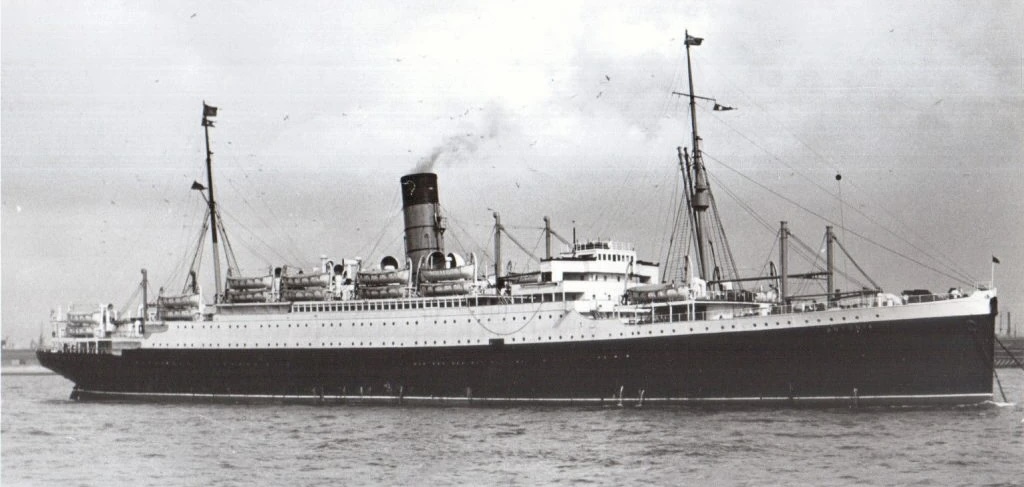
RMS Antonia (1922)
Cunard Line · entered service 1922 · Ship Guide
Overview
RMS Antonia was one of Cunard's original three 1922 A-class intermediate liners, built after the First World War to restore practical passenger and emigrant service between Britain and Canada. Together with Andania and Ausonia, she represented the first stage of a six-ship A-class program that emphasized dependable cabin- and third-class transportation rather than the prestige express trade.
Built by Vickers at Barrow-in-Furness, Antonia was launched on 11 March 1921 and began her maiden voyage from London to Quebec and Montreal on 15 June 1922. Her normal commercial world was the Canadian service: Montreal during the navigable season, with Halifax serving as the winter terminus when the St. Lawrence was closed by ice.
The ship's second life was radically different. Requisitioned by the Admiralty in October 1940, she was ultimately converted into a fleet repair ship rather than retained as an armed merchant cruiser. Commissioned in August 1942 as HMS Wayland, she supported naval operations in the Mediterranean and Indian Ocean before spending much of the later war at Trincomalee.
Antonia's career therefore links two less-glamorous but essential forms of maritime infrastructure: the interwar cabin liner that moved ordinary passengers and emigrants, and the mobile repair base that kept wartime fleets functioning far from major dockyards.
Key Facts
The Original 1922 A-Class Trio
Cunard's postwar A-class program is easiest to understand as two related three-ship groups. Andania, Antonia, and Ausonia formed the first 1922 trio. Aurania, Alaunia, and Ascania followed in the mid-1920s as a second closely related trio.
The first three were approximately 14,000-ton passenger-refrigerated-cargo ships designed around the Canadian trade. Their straight stems, single funnels, twin screws, oil-fired boilers, and geared turbines gave them a common family appearance, while their large third-class capacity reflected a market in which migration and family travel remained commercially important.
Canadian Service
Antonia's maiden voyage established the pattern that defined most of her civilian career. She sailed from Britain to Quebec and Montreal, with Halifax substituted during winter months when ice closed the St. Lawrence. Hamburg calls also allowed Cunard to embark continental European third-class passengers and cargo.
This route context matters for interpretation. Antonia was not a prestige Atlantic express liner and should not be read through the same commercial lens as Mauretania or Berengaria. She belonged to the intermediate fleet that carried the sustained everyday traffic on which Cunard's broader network depended.
The 1923 Fire
Early in January 1923, while Antonia was bound from New York toward Hamburg, fire broke out in a linen room near the third-class quarters. The crew detected and extinguished it before the incident became catastrophic, and repairs were carried out at Hamburg over the following days.
The episode is a useful reminder that the surviving chronology of working liners often consists of comparatively ordinary hazards: fires, weather, machinery trouble, and repairs that never became famous disasters but shaped day-to-day operation.
From Liner to Fleet Repair Ship
The Admiralty requisitioned Antonia in October 1940. Although armed-merchant-cruiser conversion was initially considered, the growing need for mobile repair facilities led to a more extensive transformation. The ship spent months at Portsmouth being rebuilt with workshops, additional electrical generating capacity, stores, and the infrastructure required to support naval repairs.
On 19 August 1942 she was commissioned into the Royal Navy as HMS Wayland. The new name marks more than a legal change: the former passenger liner had become a floating industrial support base whose value lay in skilled labor, machine tools, spare parts, and mobility rather than passenger accommodation.
Wartime Service as HMS Wayland
After conversion and trials, Wayland sailed toward the Indian Ocean. In 1943 she reached Kilindini at Mombasa, but her assignment was altered and she moved north through Suez to North Africa, supporting Allied operations around Tunisia and the Mediterranean.
In 1944 she proceeded to Trincomalee in Ceylon, where she remained for the later war supporting the Far East Fleet. The role was strategically important: major warships operating far from British home dockyards depended on floating repair capacity when damage or machinery failures could not wait for a return voyage to Europe.
Return and Disposal
Wayland left Trincomalee in October 1945 and underwent a major refit at Bombay after persistent machinery trouble. She returned to Britain in 1946 and was paid off at Chatham on 31 May.
There was no return to Cunard passenger service. The ship was laid up pending disposal and broken up at Troon in 1948, ending a career that had moved from Canadian emigrant service to mobile naval engineering support.
Why Antonia Matters
Antonia represents the working middle of interwar ocean travel. Ships like her rarely dominate popular liner histories, yet they carried large numbers of passengers, migrants, mail, and refrigerated cargo on routes that remained economically central to the major companies.
Her transformation into HMS Wayland adds a second layer of importance. She demonstrates how a commercial passenger hull could be repurposed into a technically sophisticated wartime support vessel—an industrial role as historically significant as the better-known use of liners as troopships.
Interpretive Notes
Antonia belongs to the first A-class trio: her immediate sisters were Andania and Ausonia; the later Aurania–Alaunia–Ascania trio belonged to the same broader program but a separate follow-on group.
The Canadian route is central: most civilian artifacts should be interpreted in relation to Britain–Quebec–Montreal/Halifax service and the migrant-oriented passenger market.
HMS Wayland is the same hull but a different operational identity: naval documents and wartime photographs should be cataloged under the repair-ship phase rather than folded casually into the civilian liner career.
Her wartime importance was logistical rather than glamorous: repair ships existed to keep fleets operational, making workshop capacity and technical personnel more important than speed or armament.
Evidence-first ship guideSources (Selected)
- Ocean Liner Curator — Sources (master bibliography)
- HMS Ausonia historical project — RMS Antonia / HMS Wayland chronology and photographs
- HMS Ausonia historical project — Cunard A-class fleet context
- HMS Ausonia historical project — Royal Navy fleet repair-ship organization and conversions
- GG Archives — Cunard fleet list and A-class technical summaries
- RMS Antonia — consolidated technical and service chronology