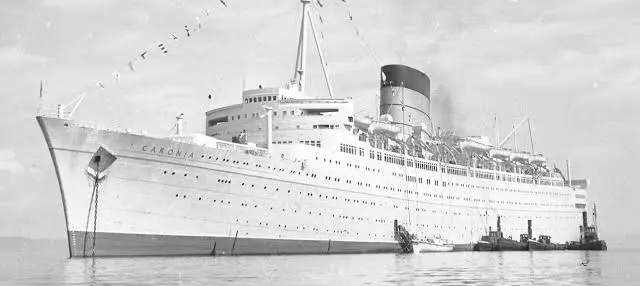
RMS Caronia (1947)
Cunard Line · entered service 1949 · Ship Guide
Overview
RMS Caronia was Cunard's distinctive postwar dual-purpose liner, conceived from the outset to combine selected transatlantic crossings with an unusually strong emphasis on cruising. John Brown & Co. launched her at Clydebank on 30 October 1947, Princess Elizabeth performing the ceremony, and the ship entered service on 4 January 1949 from Southampton to New York.
Her famous green livery later produced the nickname “Green Goddess,” but the color was only the most visible part of a broader commercial identity. Caronia was designed at a moment when Cunard could see that cruising was becoming more than a seasonal sideline, yet regular liner service still mattered. The result was neither a conventional express ship nor a pure modern cruise ship, but a vessel deliberately straddling both markets.
Key Facts
Designed for Two Markets
Caronia emerged from the immediate postwar rebuilding period, when traditional liner economics were already beginning to shift. Her design had to support two-class Atlantic crossings while also making long warm-weather cruises commercially attractive. That dual purpose affected public rooms, deck spaces, provisioning, and the way Cunard marketed the ship.
This is why describing her simply as “Cunard's first purpose-built cruise ship” is too neat. The shorthand points in the right direction, but the ship still had a genuine transatlantic role. A better description is a cruise-forward liner built with both crossing and cruising markets in mind.
The Green Goddess
The green hull was more than decorative. It visually distinguished Caronia from Cunard's black-hulled express fleet and became a branding signal for a ship sold increasingly through destination imagery, leisure, and itinerary romance rather than timetable prestige alone.
For collectors and researchers, that difference can be visible in surviving ephemera. Atlantic material may emphasize class arrangements and crossings, while cruise brochures focus on ports, climates, onboard leisure, and world itineraries. Dating those materials carefully can reveal how the commercial identity evolved.
World Cruising
By the early 1950s long cruises were central to Caronia's reputation. Her first world cruise in 1951 established a program that became closely associated with the ship. Over the decade, cruising occupied more of the schedule, and modernization increasingly reflected warm-weather operation.
Several incidents frequently recur in the ship's chronology, including a Suez Canal grounding in 1952, a grounding at Messina in 1956, and significant bow damage in Japan during the 1958 world cruise. These events are useful chronological markers, but they are best understood within a much longer career of repeated cruise programs rather than as isolated anecdotes.
Modernization and the Changing Market
By the mid-1950s Caronia's equipment and accommodation were being adapted more deliberately for the cruise role, including expanded air-conditioning. Such changes matter because the ship's physical configuration did not remain frozen at delivery.
During the 1960s, however, the market moved again. Jet aircraft had eroded the traditional crossing business, while newer cruise ships challenged older liners on operating cost and amenities. Rising costs and labor difficulties contributed to Cunard's decision to withdraw Caronia in 1967.
Columbia, Caribia, and Loss
After sale, the former Cunarder was briefly renamed Columbia and then Caribia. These identities belong to a post-Cunard period and should be cataloged separately. Years of operational and financial difficulties followed.
In 1974, while under tow for disposal, the ship broke free during severe weather and was wrecked at Apra Harbor, Guam. The dramatic ending can obscure the fact that the hull had already represented several different commercial ideas over a quarter century.
Interpretive Notes
Dating matters especially with Caronia. The same ship could appear in two-class Atlantic service, increasingly one-class cruise practice, and later non-Cunard identities. Route wording, class terminology, printer's imprint, livery, and deck configuration can all help place an artifact within the correct phase.
The “Green Goddess” nickname is historically useful because it points to how Cunard differentiated the ship, but it should not replace a fuller account of her dual-purpose design and changing commercial role. Models, brochures, photographs, and onboard documents are strongest when tied to a specific year or operating context.
Evidence-first ship guide