Cunard’s Postwar Fleet Strategy: Queens, Caronia, Canada, and QE2
Postwar Cunard did not rely on one ideal liner repeated across every route. It rebuilt a layered fleet: the two Queens sustained the prestige express system, Mauretania II filled a mid-sized workhorse role, Caronia pushed deliberately toward cruising, the Saxonia class served the Canadian and tourist-class market, and QE2 eventually combined liner speed with cruise flexibility in one jet-age flagship.
Basic answer
What was Cunard trying to do after 1945?
Rebuild regular passenger service without assuming that every traveler, route, or season needed the same ship. The postwar fleet therefore makes more sense as a portfolio of different commercial tools than as a simple hierarchy of flagships and lesser vessels.
The express core
Queen Mary and Queen Elizabeth restore the two-ship system
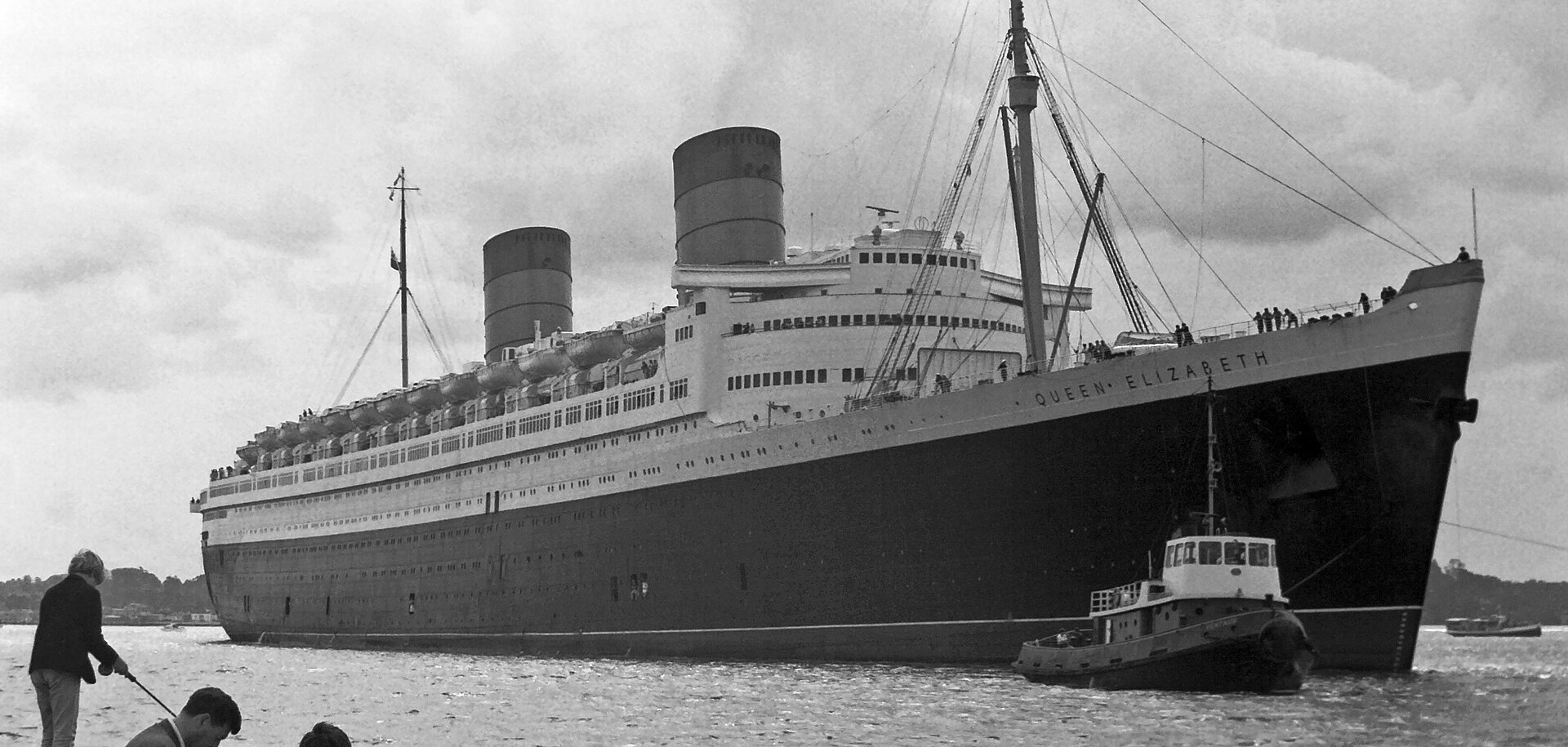
After wartime troop service and postwar refits, Queen Mary and Queen Elizabeth became the center of Cunard’s restored Southampton–Cherbourg–New York operation. Their significance was not simply that they were large or luxurious. Together they made a regular high-speed express pattern possible.
This two-ship logic had been conceived before the war, but its full commercial life belonged to the postwar period. Cunard could offer a repeatable flagship service built around scale, speed, schedule, and national prestige while other ships handled markets that did not require the same economics.
The workhorse layer
Mauretania II filled the space below the Queens
Mauretania II had entered service immediately before the war and returned to civilian work afterward as a large but substantially smaller liner than the Queens. Her roughly 23-knot operating profile and repeated refits made her useful for North Atlantic work and, increasingly, cruising.
She illustrates an important fleet principle: Cunard did not need every postwar ship to match the Queens. A mid-sized liner could absorb traffic, cover schedules, and move between crossing and cruise work at a different cost structure.
Cruise-forward design
Caronia was a different commercial experiment
When Caronia entered service in 1949, Cunard was already designing for more than the traditional Atlantic timetable. She was conceived as a dual-purpose ship able to make crossings but with a much stronger emphasis on long-distance cruising than the express fleet.
Her green livery made the distinction visible, but the deeper difference was operational. World cruises and warm-weather itineraries became central to her identity. Cunard was no longer treating cruising merely as spare-season employment; Caronia made it a core product.
A second geography
The Saxonia class was built for Canada, not New York prestige
Saxonia, Ivernia, Carinthia, and Sylvania formed a four-ship postwar class tailored to the St. Lawrence service. Their dimensions, draft, roughly 20-knot speed, and very large tourist-class complements reflected a different market from the Southampton express trade.
This matters because flagship-centered histories can make them look secondary. In fact, they show Cunard serving migration, family travel, tourism, and Canadian traffic through ships designed around route geography and broad passenger volume rather than record speed.
The market turns
By the late 1950s, every part of the system faced jet competition
The problem was no longer how to rebuild the prewar Atlantic. It was how to remain commercially useful while air travel rapidly reduced the time advantage of ships. The pressure did not hit every Cunarder in the same way: the Queens carried enormous fixed costs, the Canadian ships depended on seasonal scheduled traffic, and even cruise-forward Caronia faced newer competition and rising operating expense.
Cunard’s increasing use of cruising was therefore not one late panic measure. It developed through several parts of the fleet, but with different degrees of suitability and success.
The hybrid answer
QE2 collapses several fleet roles into one ship
QE2 entered service in 1969 after Queen Mary and Queen Elizabeth had left the traditional two-ship express system. Her design responded to a fundamentally different market: Cunard still wanted a fast North Atlantic liner, but could no longer justify a ship useful only for scheduled crossings.
The answer was intentional duality. QE2 could maintain a peak-season transatlantic schedule while also operating extensive cruises and special voyages. In that sense she did not merely replace one Queen. She absorbed lessons from the whole postwar fleet: express performance, cruise flexibility, broad passenger appeal, and the need to keep one expensive ship productive across multiple markets.
Four postwar answers
Different ships for different jobs
The Queens
High-speed prestige flagships operating as a paired express system on the Southampton–New York route.
Mauretania II
A mid-sized modern liner whose postwar usefulness came from flexible Atlantic and cruise deployment below the flagship level.
Caronia
A cruise-forward dual-purpose ship that made long itineraries and destination travel central to Cunard’s product strategy.
Saxonia class
Four route-specific Canadian liners emphasizing tourist-class capacity, seasonal St. Lawrence service, and broader middle-market travel.
Read the fleet
Representative ships
Timeline
From restoration to reinvention
Queen Elizabeth enters commercial service
With Queen Mary, she establishes the postwar two-ship express system.
Mauretania II returns and Caronia arrives
Cunard restores a middle layer of fleet capacity while simultaneously expanding into cruise-oriented design.
The Canadian quartet enters service
Saxonia, Ivernia, Carinthia, and Sylvania add route-specific tourist-class capacity to the St. Lawrence market.
Jet competition accelerates
Scheduled sea travel begins losing its central transportation role, forcing every segment of the fleet toward adaptation.
Older postwar ships leave Cunard service
Mauretania II, Caronia, the Queens, and the Canadian sisters progressively disappear from the traditional fleet structure.
QE2 enters service
Cunard replaces a layered express-era system with one flagship deliberately built for both Atlantic crossings and cruising.
Related interpretation
Continue the postwar story
Evidence note
Do not turn the postwar fleet into a single linear succession
Cunard’s ships overlapped because they served different routes, classes, seasons, and commercial purposes. The Queens, Caronia, the Canadian sisters, and QE2 belong to one company history, but they should not be treated as interchangeable stages in one design family. The useful comparison is strategic: what problem was each ship intended to solve?
Selected sources