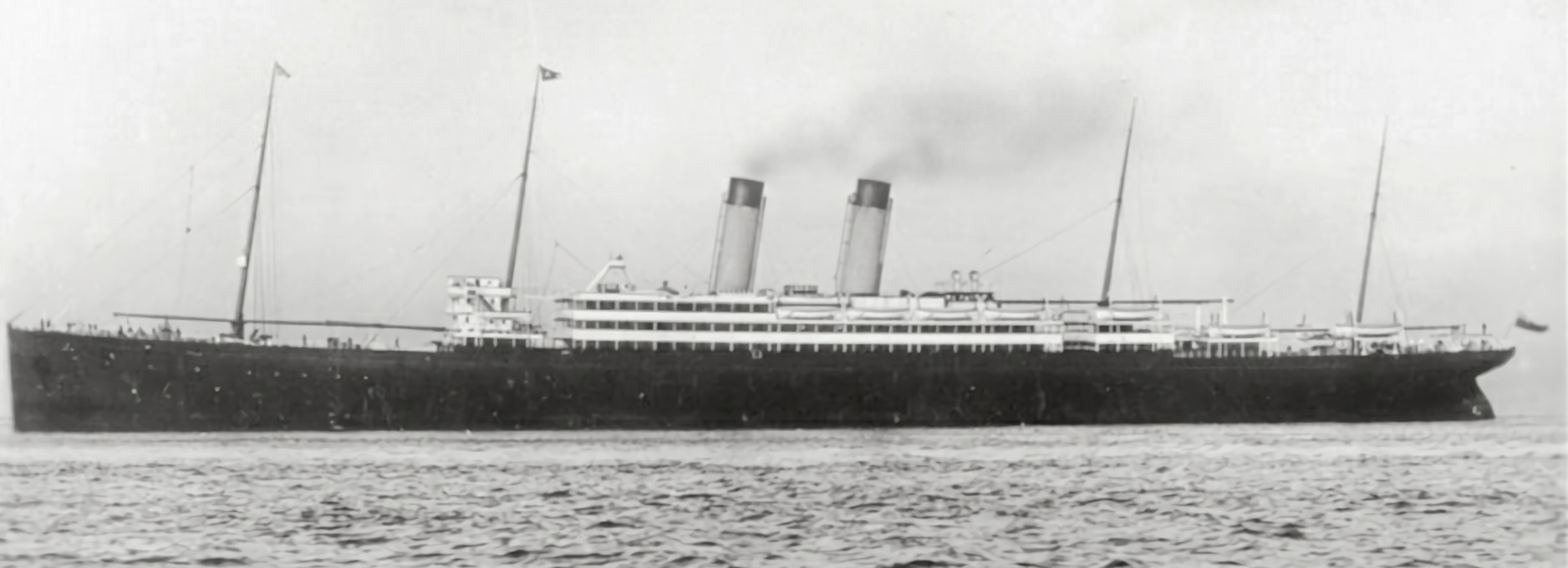
RMS Cedric
White Star Line · entered service 1903 · Ship Guide
Overview
RMS Cedric was the second of White Star Line's “Big Four,” following Celtic and preceding Baltic and Adriatic. Harland & Wolff built her at Belfast as yard no. 337. When completed in early 1903 she briefly represented the largest scale then available in regular Atlantic passenger service.
Like her sisters, Cedric was not an express liner. Her commercial purpose was dependable capacity: passengers, emigrants and cargo carried at moderate speed on White Star's Liverpool–New York system.
Key Facts
Big Ship, Moderate Speed
Cedric continued the strategy established by Celtic. White Star accepted a service speed well below the fastest Cunard and German express liners in exchange for a very large hull, heavy carrying capacity and relatively economical machinery. That distinction is important: the Big Four were competitive tools, not failed attempts at record breakers.
Harland & Wolff's records identify eight double-ended boilers and twin quadruple-expansion engines. The engineering was conservative by the standards of later turbine liners, but it matched the ships' intended operating pattern.
Peacetime Service
Cedric departed Liverpool on 11 February 1903 and reached New York on 20 February. Her prewar service centered on the North Atlantic, with occasional Mediterranean cruising and operational variations. In 1909 she became the first White Star liner to use the company's new Holyhead passenger call, giving travelers a faster rail connection toward London.
Her long routine career is historically useful precisely because it was routine. The ship helps document the enormous movement of ordinary passengers and emigrants that underwrote White Star's business before the First World War.
First World War
After the outbreak of war, Cedric was requisitioned and initially served as an armed merchant cruiser. Her size and fuel needs made that patrol role inefficient, and she was later employed as a troop transport—work more consistent with the capacity for which she had been designed.
She carried troops from the eastern Mediterranean and later participated in transatlantic transport associated with the American war effort. After hostilities she returned to civilian White Star service in 1919.
Final Years
Cedric remained in service through the 1920s as newer liners transformed passenger expectations and migration restrictions altered the Atlantic market. She was withdrawn in 1931 and sold to Thos. W. Ward for dismantling at Inverkeithing, where breaking proceeded in 1932.
Her nearly three-decade career demonstrates the durability of the Big Four formula: she remained useful long after ships that were faster or more fashionable had entered the trade.
Evidence-first ship guide