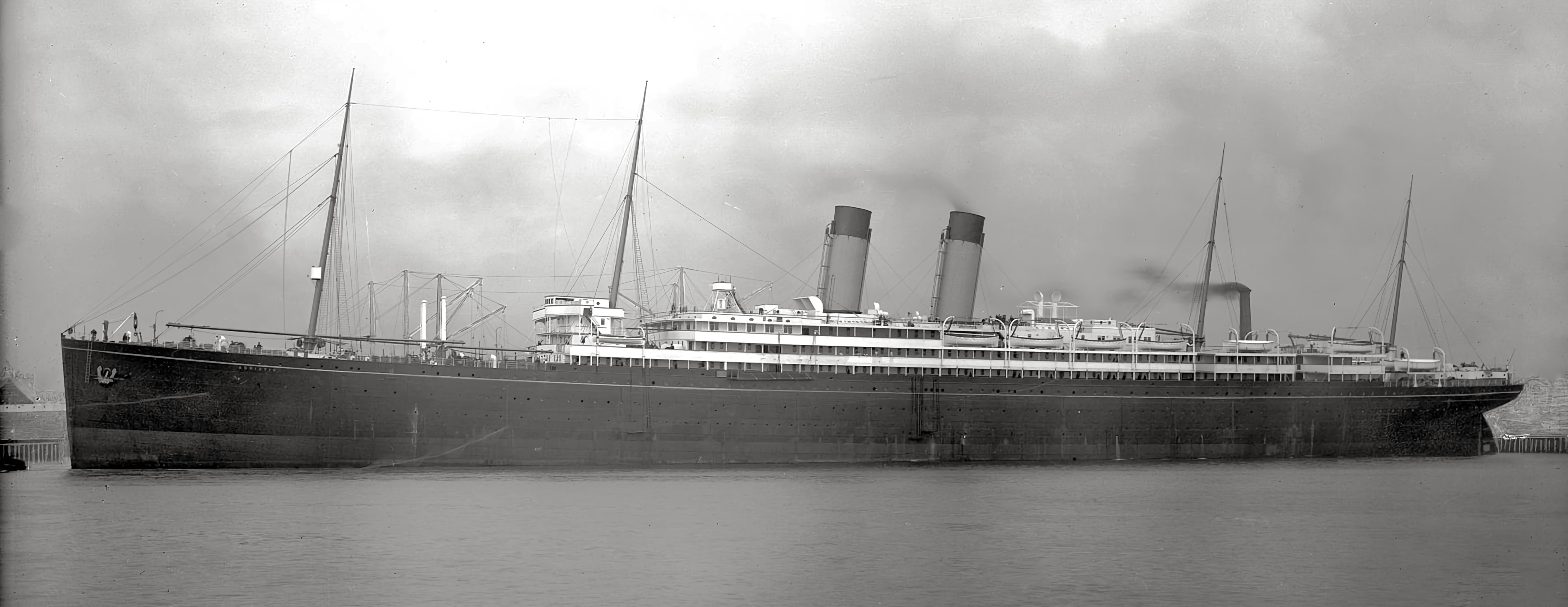
White Star’s Intermediate Liners and the Olympic-Class Strategy
White Star’s early twentieth-century fleet makes more sense when Celtic, Cedric, Baltic, and Adriatic are not treated merely as ships waiting for Olympic. Their moderate speed, enormous capacity, cargo space, and broad passenger appeal performed a different commercial job from the later express flagships.
Basic answer
Why did White Star deliberately build slower giant ships?
Because speed was only one way to make an Atlantic liner useful. The Big Four were designed around roughly 16–17-knot service rather than record-breaking passages. That allowed White Star to devote more of the ships’ size to passengers and cargo while avoiding the machinery burden required by the fastest contemporary liners.
The Big Four model
Large did not have to mean express
Celtic, Cedric, Baltic, and Adriatic pushed White Star into unprecedented size while remaining moderate-speed twin-screw reciprocating liners. Contemporary Harland & Wolff material placed the group around 16–17 knots, while later propulsion studies emphasize the economy of that conventional arrangement compared with high-powered express machinery.
The commercial logic was volume. These ships could carry very large passenger complements—including substantial third-class traffic—along with heavy cargo loads. That combination made them useful transportation machines even without speed-record prestige.
Passenger market
Intermediate did not mean second-rate
The word “intermediate” describes fleet role and speed, not a lower standard of ship. Celtic was explicitly marketed as a lower-fare alternative to White Star’s faster first-class vessels, while the quartet developed increasingly elaborate passenger accommodation over the decade.
Their large third-class capacity is especially important. Migration traffic was not an incidental use of spare berths; it was part of the economics that allowed very large ships to operate profitably without relying only on premium travelers.
The hinge ship
Adriatic points toward Olympic
Adriatic is the most revealing member of the group because she preserves the Big Four’s moderate-speed commercial formula while introducing passenger amenities later associated with White Star’s Olympic-class ships. Her gymnasium, Turkish baths, electric baths, lift, and other first-class improvements show that passenger experience was evolving before Olympic entered service.
This is a better way to understand design succession than calling Adriatic a prototype. She remained a Big Four intermediate liner, but she also demonstrated how White Star could carry ideas about comfort forward into a new flagship generation.
Olympic changes the top of the fleet
A new flagship role, not one universal ship type
Olympic entered service in 1911 at about 21 knots—faster than the Big Four, but still less speed-focused than Cunard’s turbine express liners. White Star therefore continued its preference for scale and comfort while moving its premium Southampton service into a faster, much larger category.
The important point is structural: the fleet now contained ships doing different jobs. Olympic carried the line’s flagship prestige and premium express role; the older intermediate ships could continue carrying passengers and cargo on schedules where their lower speed remained commercially acceptable.
Overlap in practice
Adriatic and Olympic could serve the same company without being substitutes
Postwar service makes the relationship especially visible. Adriatic helped restore White Star’s Southampton–New York service before Olympic returned from refit, and the two ships then overlapped on the route before Adriatic eventually returned to Liverpool service. Their coexistence shows why fleet history should not be written as a simple sequence in which one generation instantly replaces another.
Companies needed schedules, capacity, route coverage, cargo space, and seasonal flexibility as well as headline flagships. A ship could become secondary in publicity while remaining useful in the operating system.
Two fleet jobs
Intermediate liner and flagship compared
Big Four intermediate
Moderate speed, large passenger complement, substantial cargo capability, heavy third-class traffic, and an operating model built around volume rather than the fastest passage.
Olympic-class flagship
Greater speed, much larger scale, stronger premium-service identity, and a Southampton express role designed to compete at the highest end of the North Atlantic market.
Shared White Star logic
Both emphasized size and passenger comfort more than a pure pursuit of the Blue Riband.
Different commercial work
One fleet could rationally contain both. The relevant question is not which ship was “better,” but what traffic and schedule each was intended to serve.
Four ships, evolving formula
The Big Four were not frozen copies
Timeline
From capacity strategy to mixed fleet
Celtic enters service
White Star demonstrates that extraordinary size can be paired with moderate speed and high carrying capacity.
Cedric and Baltic expand the model
The strategy becomes a repeatable fleet program rather than a one-ship experiment.
Adriatic closes the Big Four sequence
Passenger amenities become more elaborate while the underlying intermediate-liner economics remain intact.
Olympic enters service
White Star adds a faster and far larger premium flagship without erasing the operating usefulness of the older ships.
Postwar overlap
Adriatic and Olympic both contribute to White Star’s restored Southampton service before fleet deployment settles into a new pattern.
The intermediate ships age into new roles
Migration changes, fleet modernization, and cruising gradually reduce their centrality, but only after decades of useful service.
Related interpretation
Continue the White Star fleet story
Evidence note
Do not mistake fleet succession for instant replacement
The arrival of a new flagship does not prove that older ships had become commercially pointless. Route assignment, passenger mix, cargo, seasonal demand, wartime interruption, refits, and available tonnage all shaped how liners were deployed. The strongest interpretation therefore treats the Big Four and Olympic class as overlapping fleet tools with different emphases rather than as a simple “obsolete versus modern” sequence.
Selected sources