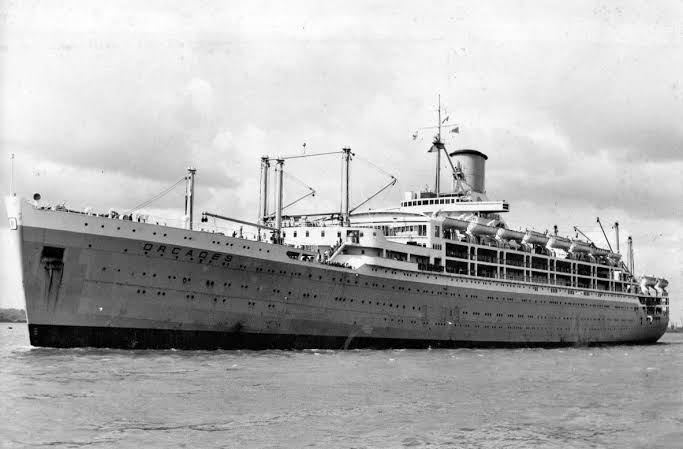
RMS Orcades (1948)
Orient Line · entered service 1948 · Ship Guide
Overview
The 1948 Orcades was the third Orient Line vessel to carry the name and the company’s first major new passenger liner after the Second World War. Ordered before the war had ended and built by Vickers-Armstrongs at Barrow-in-Furness, she was intended to restore the Britain–Australia service after the loss of several important ships during the conflict.
When she entered service late in 1948, Orcades was among the largest and fastest passenger ships on the Australian trade. Her career then evolved with the market itself: traditional Suez-route line voyages gave way to Pacific sailings, round-the-world itineraries, extensive modernization, one-class operation, and increasingly cruise-oriented service under P&O.
Key Facts
Tonnage and capacity note: surviving technical and promotional sources give slightly different gross-tonnage and original passenger-capacity figures. P&O’s later fact sheet records 28,472 GRT and 770 first / 742 tourist, while other contemporary and museum sources preserve figures around 28,164 GRT and roughly 1,545 total passengers. This guide preserves the discrepancy rather than flattening it.
The First Major Postwar Replacement
Orient Line ordered the new Orcades in March 1945, several months before the Second World War ended. Her name deliberately commemorated the 1937 Orcades, which had been sunk by U-172 in 1942. The choice linked the postwar rebuilding program directly to the company’s wartime losses.
Construction also reflected changing shipbuilding practice. Large prefabricated sections and welded assemblies were used extensively, techniques that had become far more familiar during wartime mass production. The result was a ship that looked modern without abandoning the practical requirements of the long Australia route.
A Close Technical Relative of Himalaya
P&O’s technical history records that Orcades shared essentially the same hull and machinery concept as P&O’s Himalaya, although their superstructures and internal arrangements differed. That makes the two ships especially valuable for comparison: they were near-contemporaries built by the same yard for closely related services but expressed different company identities.
Orcades’ bridge, mast, and funnel were concentrated amidships, with the bridge positioned notably far aft. The arrangement gave her a distinctive profile and helped establish the visual language that would be refined in later Orient ships.
Trials and Maiden Voyage
On trials off Arran on 13 November 1948, Orcades reached 24.74 knots, comfortably above her normal 22-knot service speed. She was handed over three days later at a cost of about £3.4 million.
Her maiden voyage began on 14 December 1948 under Captain Charles Fox, who had commanded the previous Orcades. The new ship reduced the prewar schedule substantially and reached Melbourne in about twenty-six days. Passengers included Australian political and cultural figures, and the voyage immediately positioned the ship as a symbol of restored postwar communication between Britain and Australia.
Migration, Mail, and the Australia Route
Orcades carried government and business travelers, tourists, mail, and large numbers of emigrants. Museums Victoria identifies her as a major postwar migrant ship, and this human movement is central to understanding her significance. For many passengers, the voyage was not a holiday but a permanent relocation.
Her large refrigerated cargo capacity also mattered on the Australia service. Passenger liners on this route were part of a wider transport system that moved mail and high-value cargo alongside people, helping justify regular scheduled operation over immense distances.
Pacific and Round-the-World Voyages
By 1954 Orcades was making trans-Pacific voyages, broadening the traditional Britain–Suez–Australia pattern. In 1955 she operated westabout round-the-world service through the Panama Canal, Pacific ports, Australia and New Zealand, and the Suez route back to Europe.
These itineraries foreshadowed the later transformation of long-distance liners into cruise ships. The voyage itself became increasingly marketable as a leisure experience, while the same vessel still carried scheduled passengers and migrants.
1959 Modernization
A major refit at Harland & Wolff in Belfast in late 1958 and early 1959 transformed the ship. Full air conditioning was installed throughout, passenger spaces were rearranged, and a new funnel cap improved smoke dispersal over the after decks.
The refit also reflected intensifying competition. By the end of the 1950s, a premium long-distance liner could no longer rely on prewar standards of ventilation or accommodation. Comfort improvements were necessary simply to remain commercially credible against newer ships and rapidly improving air travel.
P&O Ownership and One-Class Service
Management transferred to P&O-Orient Lines in 1960, while the vessel initially remained registered to the Orient Steam Navigation Company. Full ownership passed to P&O on 21 September 1962.
In 1964 Orcades was converted to one-class operation for 1,635 passengers. Traditional class divisions had become less useful in a market increasingly oriented toward leisure voyages, and parts of the ship were converted into more overtly entertainment-focused spaces.
Final Years
By 1970 Orcades was operating primarily as a one-class cruise ship in British and Australian waters. Her final years illustrate how far the original liner market had shifted since 1948: jet aircraft had captured much of the point-to-point traffic, while passenger ships survived increasingly by selling the experience of the voyage.
She left active service in 1972 and sailed for Taiwan with a skeleton crew in December. Orcades reached Kaohsiung in February 1973, where demolition followed.
Why Orcades Matters
The 1948 Orcades is one of the key ships in the postwar rebuilding of the Britain–Australia liner trade. She links the destroyed prewar fleet to the later Oronsay, Orsova, and Oriana, while also standing beside P&O’s Himalaya as part of a parallel technical generation.
Her twenty-four-year career captures nearly the full arc of the postwar passenger liner: reconstruction, migration, scheduled long-distance service, Pacific expansion, modernization, corporate consolidation, one-class conversion, cruising, and finally displacement by a fundamentally different travel economy.
Related Liners
Sources
- P&O Heritage, Ship Fact Sheet: Orcades (1948).
- Royal Museums Greenwich, Orient Steam Navigation Company archive, OSN/13/3–4: Orcades III maiden voyage, general information, decorative features, and 1959 reconditioning material.
- Royal Museums Greenwich, P&O Collection photographic records for Orcades (1948), including Sydney, Tilbury, Malta, and Pacific service.
- Museums Victoria, Post World War II Migrant Ship History: Orcades, 1948–1972.