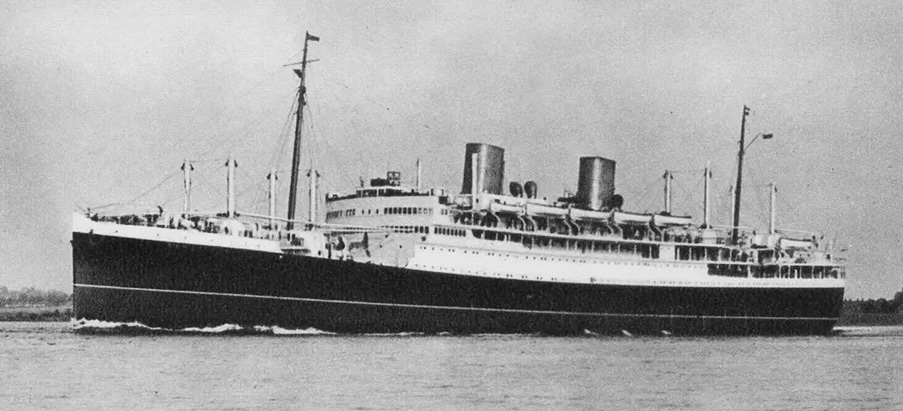
RMS Rangitane (1929)
New Zealand Shipping Company · entered service 1929 · Ship Guide
Overview
RMS Rangitane was the third of three large motor passenger-and-cargo liners built by John Brown & Company at Clydebank for the New Zealand Shipping Company's Britain–New Zealand service. She joined sisters Rangitiki and Rangitata on the long route through the Panama Canal and spent the 1930s carrying passengers, mail, and refrigerated cargo between Britain and New Zealand.
Her career ended abruptly during the Second World War. On 27 November 1940, three days out of Auckland on a voyage toward Britain, Rangitane was intercepted east of New Zealand by the German auxiliary cruisers Orion and Komet, accompanied by the supply ship Kulmerland. After a brief exchange and abandonment, the liner was sunk. Fifteen people were killed according to New Zealand History's event account, while a Merchant Navy timeline gives sixteen; this guide preserves that discrepancy rather than forcing a false single total.
Key Facts
The Third Rangitiki-Class Sister
Rangitane completed the trio of John Brown motor liners ordered to modernize the New Zealand Shipping Company's long-distance passenger service. Like her sisters, she combined comfortable passenger spaces with the cargo capacity needed to make the Britain–New Zealand route commercially practical.
The three ships were close sisters but should not be treated as interchangeable. Their service histories diverged sharply. Rangitiki and Rangitata survived the war and continued into the 1960s; Rangitane became the sister whose life was cut short by surface raider warfare in the South Pacific.
Britain to New Zealand via Panama
The sisters operated in a route world defined by distance rather than prestige competition. Their work linked Britain directly with New Zealand through the Panama Canal, carrying emigrants, returning residents, tourists, officials, mail, and refrigerated produce.
This dual passenger-and-cargo role is essential to understanding the class. A ship like Rangitane was not simply a passenger vessel with cargo space attached; refrigerated freight was central to the economics of the New Zealand trade.
Passenger Life and Surviving Records
The National Library of New Zealand holds a substantial body of material associated with Rangitane, including company records and an engineer officer's published account of the sinking. That archival survival gives the ship an unusually strong documentary footprint despite a career of only eleven years.
Shipboard ephemera, photographs, passenger documentation, and New Zealand Shipping Company records can help reconstruct individual voyages and passenger experience. As with the other sisters, dated material is especially valuable because it can separate ordinary peacetime service from the wartime period.
War Comes to New Zealand Waters
By 1940 German surface raiders were operating in the Pacific. The raider Orion had already laid mines near New Zealand and sunk the New Zealand Shipping Company freighter Turakina. Orion later joined Komet and the supply ship Kulmerland in a raiding group that attacked Allied shipping around New Zealand and the central Pacific.
On 25 November the group captured and sank the small steamer Holmwood near the Chatham Islands. Two days later the same force encountered Rangitane.
The Encounter, 27 November 1940
Rangitane had left Auckland on 24 November and was bound toward Britain via Panama. At about 3:40 a.m. on 27 November, lookouts sighted the raiders in darkness. A later New Zealand commission of inquiry concluded that the captain and bridge team acted promptly and rejected sensational suggestions that the ship had been deliberately led into an ambush.
The liner transmitted a distress signal. The raiders opened fire, and Rangitane was hit. Fires broke out and the ship was eventually abandoned. The German ships then completed her destruction.
Passengers, Crew, and Captivity
New Zealand History records 201 crew and 111 passengers aboard. The passengers included Fleet Air Arm recruits, radar specialists travelling to Britain, and a group of British women who had accompanied child evacuees to New Zealand and were returning home.
Most survivors were taken prisoner by the German ships. Many were later among hundreds of captives released by the raiders on Emirau Island in the Bismarck Archipelago in December 1940.
How Many Died?
The final death toll is a good example of why source precision matters. New Zealand History's dedicated event page states that fifteen people were killed. Its Merchant Navy timeline gives sixteen passengers and crew killed. Rather than silently choosing one, this guide records the discrepancy and identifies it as unresolved at the summary-source level.
Evidence-first note: where authoritative summaries conflict by a single casualty, the disagreement itself is historically relevant. A future revision should prefer a named casualty list or primary inquiry record if one can be verified.
Largest Allied Merchant Ship Sunk by a German Surface Vessel
At roughly 16,700 gross tons, Rangitane was the largest Allied merchant ship sunk by a German surface vessel during the Second World War. That distinction belongs specifically to surface-raider warfare; submarines and aircraft sank larger merchant ships elsewhere.
The sinking therefore occupies an important place in both New Zealand maritime history and the broader history of German commerce raiding. It demonstrated that even waters close to New Zealand were not insulated from global naval war.
Why Rangitane Matters
Rangitane matters because she connects everyday long-distance liner service with an often-overlooked theatre of maritime war. Her prewar identity was that of a working Britain–New Zealand passenger and cargo ship; her loss reveals how quickly such civilian systems could become exposed to global conflict.
Placed beside Rangitiki and Rangitata, her story also shows why sister ships should be studied together. Nearly identical vessels can have radically different historical lives.
Collecting Profile
Surviving material includes New Zealand Shipping Company ephemera, passenger records, photographs, postcards, and wartime accounts. The National Library's holdings include Geoffrey Alan Barley's published engineer-officer account, Caught by a Nazi Raider, produced by the New Zealand Shipping Company in 1942.
For provenance, distinguish prewar passenger material from post-loss commemorative or wartime publications. Both are historically valuable, but they document different layers of the ship's story.
Interpretive Notes
The attackers were surface raiders, not submarines: Orion and Komet were German auxiliary cruisers disguised for commerce raiding.
The ambush theory was rejected by the contemporary inquiry: the commission found that the encounter could be explained by the movements of the ship and raiders and praised the captain's prompt response.
Fatality totals conflict: this guide preserves the 15-versus-16 discrepancy found in current New Zealand government historical summaries.
Evidence-first ship guideSources (Selected)
- Ocean Liner Curator — Sources (master bibliography)
- National Library of New Zealand — Rangitane archival topic and New Zealand Shipping Company records
- New Zealand History — Rangitane sunk off East Cape, 27 November 1940
- New Zealand History — Merchant Navy wartime timeline
- Papers Past — 1941 Commission of Inquiry report on the loss of Rangitane