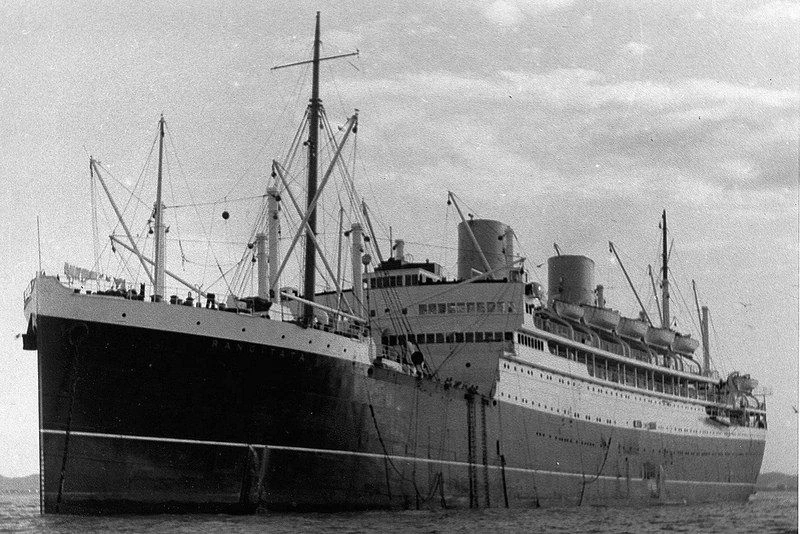
RMS Rangitata (1929)
New Zealand Shipping Company · entered service 1929 · Ship Guide
Overview
RMS Rangitata was the second of three large motor passenger-and-cargo liners built by John Brown & Company at Clydebank for the New Zealand Shipping Company's Britain–New Zealand service. Launched in March 1929 and entering service later that year, she joined sisters Rangitiki and Rangitane on the long route through the Panama Canal.
Her career lasted more than three decades. In peacetime she combined passenger accommodation with substantial refrigerated cargo capacity; during the Second World War she served as a government transport, carried New Zealand troops, and transported child evacuees; after the war she was completely re-engined and returned to civilian service. She remained in operation until 1962.
Key Facts
The Second of Three Sisters
Rangitata followed Rangitiki as part of a three-ship modernization program. The sisters were designed around the particular economics of the New Zealand trade: passengers mattered, but so did refrigerated cargo, dependable long-distance operation, and passage through the Panama Canal.
The ships were not North Atlantic speed competitors. Their value lay instead in sustained service across one of the world's longest scheduled passenger routes, linking Britain directly with New Zealand through a chain of ocean passages and canal transit.
A Contemporary Tour of the Ship
One of the most useful surviving descriptions of Rangitata appeared in late 1929, when a correspondent toured the ship shortly before her first New Zealand voyage. The account describes machinery spaces, passenger cabins, public rooms, stores, and the practical organization of life aboard a new long-distance motor liner.
It also records a design improvement over Rangitiki: by reducing the engine casing, alleyways in Rangitata could be made straighter. That small detail is a useful reminder that near-sister ships were not necessarily exact duplicates; builders and owners learned from the first ship and incorporated refinements into later members of a class.
Passenger Life
First-class cabins were arranged as one- and two-berth rooms with proper bedsteads, dressing furniture, wardrobes, seating, and hot and cold running water. Some cabins could be combined into suites with private bathroom arrangements. Second-class rooms used comparable spaces more densely, while third class provided practical two-, four-, and six-berth cabins.
Contemporary provisioning figures underline the length and scale of the voyage. Food, drink, tobacco, fresh produce, and refrigerated stores had to support hundreds of passengers and crew across weeks at sea. The ship was effectively a temporary self-contained community operating between widely separated ports.
The Panama Route
Rangitata sailed between Britain and New Zealand through the Panama Canal, a route that transformed the geography of the New Zealand passenger trade. Stops and operational patterns varied over time, but Panama remained central to the service.
Her maiden voyage included a call at Pitcairn Island in December 1929, and the ship continued to call there periodically over the following decades. Such calls added another distinctive layer to a route already very different from the better-known Southampton–New York corridor.
War Service
War service began in December 1939. In January 1940 Rangitata sailed with the first echelon of the 2nd New Zealand Expeditionary Force, joining a convoy of transports carrying New Zealand troops toward the Middle East.
Later that year she also participated in the Children's Overseas Reception Board evacuation program. In August 1940 she left Britain carrying 113 children bound for New Zealand. The voyage passed safely through a period in which other evacuation transports faced very real submarine danger.
These two roles—troop transport and child evacuation—show how adaptable a large passenger liner became under wartime conditions. The same accommodation that had carried tourists and emigrants now served military and civilian emergency needs.
Postwar Re-Engineering
Rangitata's postwar return was more than a cosmetic refit. In 1949 she was completely re-engined with Brown-Doxford diesel engines rated at about 15,000 horsepower. The new machinery raised her service speed to about 16 knots.
Passenger accommodation was also reorganized into first and tourist classes only. Contemporary New Zealand reporting explicitly promoted the refitted ship as returning with a higher standard of accommodation and entirely new machinery.
A Long Second Career
The rebuilt Rangitata continued on the New Zealand run through the 1950s and into the early 1960s. By then long-distance air travel was increasingly competitive, but ships like Rangitata continued to carry migrants, families, tourists, and cargo on established routes.
Her survival into 1962 also placed her in sharp contrast with sister Rangitane, which had been sunk by German surface raiders in 1940. Together with the long-lived Rangitiki, the three sisters illustrate dramatically different wartime and postwar outcomes for ships of the same original design.
Retirement
Rangitata made her final calls in 1962 and was sold for demolition. She arrived at Split in Yugoslavia for breaking up later that year, ending a career of more than thirty years.
By the time she disappeared, the transport world for which she had been designed had changed profoundly. The Panama-route passenger liner was no longer the dominant way to move between Britain and New Zealand, but Rangitata had lasted long enough to span both the height and the decline of that system.
Why Rangitata Matters
Rangitata is particularly useful because her history shows continuity rather than catastrophe. Unlike many famous liners remembered mainly for a single dramatic loss, she spent decades doing exactly what she had been designed to do: moving people and cargo across an immense route.
Her wartime service, child evacuation voyage, and major 1949 re-engining add layers to that story without erasing the underlying identity of a New Zealand passenger-and-cargo liner.
Collecting Profile
Surviving material is unusually strong. The National Library of New Zealand holds material associated with the ship, while private collections preserve postcards of first-class cabins, public rooms, deck views, and exterior photographs from different periods.
For attribution, dating is valuable. Prewar material documents the original three-class ship and Brown-Sulzer machinery era; post-1949 material belongs to the re-engined first-and-tourist-class configuration. A dated postcard or passenger document therefore carries significantly more historical information than an undated generic company item.
Interpretive Notes
Passenger figures vary: institutional and contemporary sources give different totals depending on date and class arrangement. The guide therefore avoids presenting one passenger-capacity figure as universal across the ship's entire career.
Rangitata was not an exact duplicate of Rangitiki: contemporary reporting records practical design refinements between the first and second sisters.
The 1949 refit changed the ship materially: machinery, speed, and passenger-class organization all differed from the 1929 configuration.
Evidence-first ship guideSources (Selected)
- Ocean Liner Curator — Sources (master bibliography)
- National Library of New Zealand — Rangitata record and related collections
- Papers Past — contemporary 1929 tour of Rangitata
- Papers Past — contemporary report on the 1949 re-engining and return to service
- New Zealand History — Merchant Navy wartime timeline
- Clydeships — John Brown builder record, yard no. 517