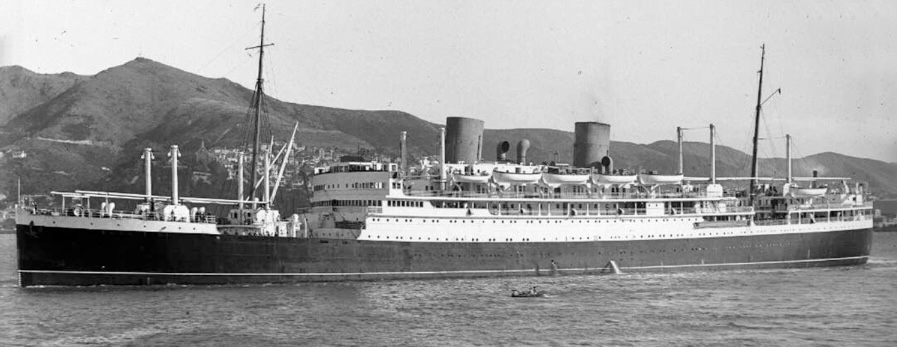
RMS Rangitiki (1929)
New Zealand Shipping Company · entered service 1929 · Ship Guide
Overview
RMS Rangitiki was the first of three large motor passenger liners built by John Brown & Company at Clydebank for the New Zealand Shipping Company's direct service between Britain and New Zealand. Delivered at the beginning of 1929, she entered a route world defined less by North Atlantic prestige competition than by distance, refrigerated cargo, migration, and the Panama Canal.
Her career lasted more than three decades. In peacetime she carried first-, second-, and third-class passengers between Britain and New Zealand; during the Second World War she survived dangerous convoy service, including the destruction of the armed merchant cruiser HMS Jervis Bay while defending Convoy HX 84; after the war she returned to emigrant and passenger work and remained in service until 1962.
Key Facts
A New Generation for the New Zealand Trade
Rangitiki, Rangitata, and Rangitane were conceived as a coordinated three-ship modernization of the New Zealand Shipping Company's passenger fleet. Contemporary New Zealand reporting emphasized their scale, diesel propulsion, passenger comfort, and large refrigerated-cargo capacity. Their design reflected the economics of the route: a liner had to carry people well, but it also had to move valuable refrigerated produce efficiently over immense distances.
The use of the Panama Canal was central. The New Zealand Shipping Company had embraced the canal route after the First World War, and Rangitiki was purpose-built for a direct Britain–New Zealand service that made Panama part of the normal geography of long-distance liner travel.
Passenger Life
When new, Rangitiki offered three classes of passenger accommodation. Contemporary descriptions stressed the first-class dining saloon, lounge, smoking room, drawing room, children's room, verandah cafe, dancing space, and private bathrooms. The surviving record is unusually rich because passenger lists, menus, concert programmes, sports programmes, and promotional booklets have been preserved in New Zealand collections.
Those survivals are especially valuable because they show the ship not merely as machinery and tonnage, but as a lived environment. Passenger lists document who travelled; menus and programmes reconstruct routines aboard ship; and route-specific ephemera can anchor an artifact to a particular voyage rather than merely to the company.
Early Stability Alterations
Rangitiki's first voyage revealed handling and stability characteristics that prompted modifications when she returned to her builders. Contemporary reporting in late 1929 recorded reductions in upperweight, shortening of the funnels, removal of the elevated navigating bridge, and other structural adjustments intended to improve steadiness at sea.
This is an important design note because photographs from different moments in 1929 can show visible differences. A pre-alteration image and a later service photograph should not automatically be treated as contradictory evidence; they may document the ship before and after genuine structural changes.
Ten Years of Interwar Service
Through the 1930s Rangitiki became a familiar link between Britain and New Zealand. The route carried tourists, migrants, families, officials, students, and returning residents while the refrigerated holds carried the commercial traffic that helped make such a long passenger service economically viable.
Contemporary accounts credited the ship at different times with fast passages and unusually heavy passenger movements. Such claims are best treated as voyage-specific records rather than broad statements that she was a speed-record liner; at about 15 knots, her importance lay in dependable long-distance service rather than outright speed.
War and Convoy HX 84
During the Second World War, Rangitiki was employed in government and troop transport work while continuing to face the hazards of long ocean passages. Her best-known wartime episode came on 5 November 1940 as part of Convoy HX 84.
The German heavy cruiser Admiral Scheer attacked the convoy in the North Atlantic. HMS Jervis Bay, an armed merchant cruiser serving as the convoy's escort, turned toward the German ship and fought a hopeless delaying action that allowed much of the convoy to scatter. Rangitiki escaped. Contemporary postwar reporting later noted the confusion ashore when she was initially feared lost before arriving safely.
The episode should be framed carefully: Rangitiki's survival was part of the larger HX 84 story, in which the sacrifice of Jervis Bay bought time for merchant ships to disperse. It was not a conventional ship-to-ship action fought by Rangitiki herself.
Postwar Return and Refit
After the war, Rangitiki returned to passenger service at a moment when ocean travel was again central to migration and family reunion. She carried returning servicemen, war brides, emigrants, and ordinary commercial passengers between Britain and New Zealand.
A substantial postwar refit included replacement machinery and revised passenger accommodation. The ship thereafter continued in a market that was slowly changing: air travel was becoming increasingly important, but sea travel still carried large numbers of migrants and long-distance passengers through the 1950s.
The Final Years
National Library collections preserve passenger lists for Rangitiki voyages as late as 1959, documenting a mature service pattern through Curacao and the Panama Canal. By then the ship had already served for roughly three decades, spanning the interwar period, global war, and the postwar migration era.
Rangitiki was withdrawn in July 1962 and sold for demolition. She was broken up at Valencia later that year. Her longevity contrasts sharply with sister Rangitane, lost to German surface raiders in 1940, while sister Rangitata also survived into the early 1960s.
Why Rangitiki Matters
Rangitiki expands ocean-liner history geographically. She was not built for Southampton–New York, not designed around the Blue Riband, and not primarily a floating statement of national prestige. She was a working long-distance passenger-and-cargo liner built around the realities of Britain–New Zealand trade.
Her career also makes visible several themes that are easy to miss in a North Atlantic-centered archive: refrigerated cargo, the Panama route, settler migration, imperial and Commonwealth connections, wartime convoy survival, and the postwar movement of people to and from New Zealand.
Collecting Profile
Rangitiki is exceptionally strong for evidence-first collecting because surviving shipboard material is abundant and often date-locked. Passenger lists, menus, tickets, sports programmes, concert programmes, children's events, brochures, and photographs can frequently be associated with a specific voyage.
For attribution, prefer objects that actually name Rangitiki or can be tied to a dated sailing. New Zealand Shipping Company material that lacks a ship name remains useful company history, but it should not be upgraded to ship-specific provenance without supporting evidence.
Interpretive Notes
Passenger counts vary slightly by source: contemporary and later references do not always agree on the exact second- and third-class totals. This guide follows the company/P&O heritage data set for the as-built figures.
Early photographs require dating: visible alterations made after the first voyage changed the height and upper profile of the ship.
Wartime survival claims need context: the HX 84 episode belongs to the wider story of the convoy and HMS Jervis Bay, not to an independent combat action by Rangitiki.
Evidence-first ship guideSources (Selected)
- Ocean Liner Curator — Sources (master bibliography)
- National Library of New Zealand — Rangitiki collections and shipboard ephemera
- National Library of New Zealand — passenger lists for Rangitiki and related vessels, 1957–1962
- Papers Past — contemporary report on Rangitiki's maiden voyage and arrival in New Zealand, April 1929
- Papers Past — contemporary report on post-maiden-voyage alterations, November 1929
- P&O Heritage — Rangitiki ship fact sheet