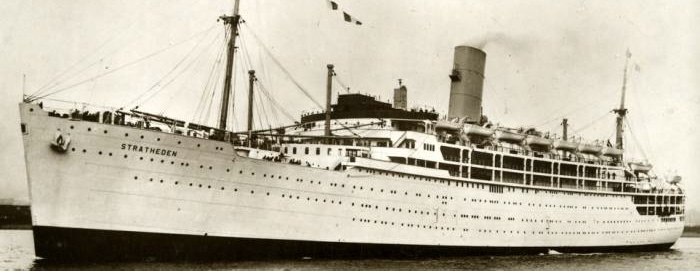
RMS Stratheden (1937)
P&O · entered service 1937 · Ship Guide
Overview
RMS Stratheden was the fourth of five notable P&O Strath liners of the 1930s, built at Barrow-in-Furness and delivered in December 1937. Her regular passenger work connected Britain with India, Ceylon (now Sri Lanka), and Australia by way of the Mediterranean and Suez Canal.
The ship combined large-scale passenger accommodation with substantial cargo provision. Her operational history crossed several maritime worlds: late-1930s scheduled travel and seasonal cruising, troop transport during the Second World War, postwar long-distance migration and passenger traffic, and finally later ownership under different names.
Key Facts
Design and Construction
Stratheden was launched on 10 June 1937 and handed over to P&O on 16 December. Building contracts survive in the P&O records held by Royal Museums Greenwich, providing a valuable primary-document trail for technical and design research.
She followed the general arrangement of the earlier Strathmore, but contemporary P&O heritage accounts identify differences in the promenade-deck uprights and a funnel roughly nine feet taller. She was also the first P&O vessel fitted to carry chilled beef, showing how cargo equipment mattered alongside passenger accommodation.
The Britain–Australia Route
Stratheden departed Tilbury on her maiden voyage to Australia on Christmas Eve 1937, serving a long-distance route that connected British ports with Bombay, Colombo, and Australian destinations. On these crossings the ship functioned as a passenger and freight carrier rather than a North Atlantic speed competitor.
She could also be used for Mediterranean cruising. Her last prewar cruise of the season ended in August 1939; normal Australia-line service resumed shortly before the outbreak of war. A cruise brochure and a regular passage timetable therefore document different uses of the same ship.
Wartime Troop Transport
Requisitioned on 19 March 1940, Stratheden entered troopship service. Her wartime work included carrying Canadian troops across the Atlantic, and preparations for amphibious operations during 1942.
Troopship photographs, armament changes, and military embarkation figures should not be read as evidence for her prewar passenger condition. The vessel's commercial ownership and wartime operating arrangements need to be distinguished in archive captions.
Postwar Return and Adaptation
Following wartime service, the ship was reconditioned and resumed P&O passenger operations in July 1947. Published postwar accommodation figures differed from her original 1937 complement as the company rebalanced first- and tourist-class demand.
The surviving record also describes another reconfiguration to all-tourist accommodation in the early 1960s. This evolution is important when dating interior photographs, passenger plans, or promotional materials.
Greek Ownership and Disposal
Sold in 1964 to interests associated with John S. Latsis, she was renamed Henrietta Latsi, then Marianna Latsi in 1966. Her last years were distinct from the classic P&O route on which she had originally served.
The ship was eventually scrapped at La Spezia in 1969. Material issued under her later names should not be attributed to P&O without examining dates and ownership.
Interpretive Notes
Technical numbers need context. Sources sometimes give registered length versus overall length; the measurements should not be silently treated as interchangeable.
Passenger-class figures changed. Her 1937 first/tourist accommodations should not be projected onto the postwar or all-tourist configuration.
Wartime sources describe another function. Troopship capacity and naval equipment belong to the requisition period.
Related liners are not identical. The Strath sisters were a coherent design group, but there were individual construction and operational differences.
Evidence-first ship guideRelated Guides
For companion histories, see RMS Strathmore and SS Strathaird.