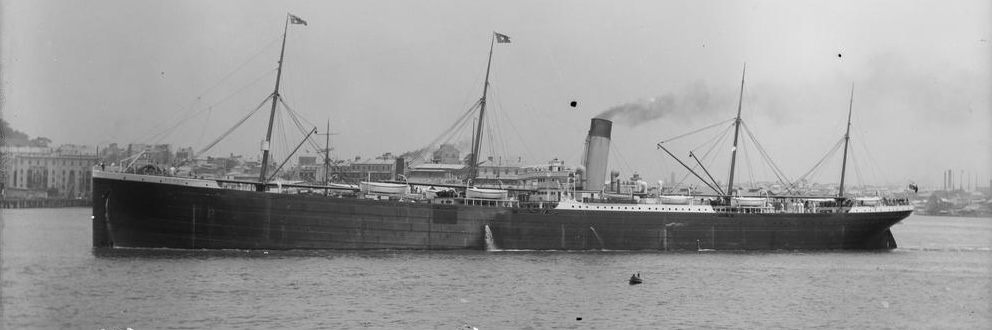
SS Afric
White Star Line · entered service 1899 · Ship Guide
Overview
SS Afric was a White Star Line cargo-passenger liner built by Harland & Wolff for the company's long-distance Australian trade. Launched at Belfast on 6 November 1898, she first sailed on a trial passenger voyage from Liverpool to New York in February 1899 before settling into the Liverpool–Cape–Australia service that defined most of her peacetime career.
The previous guide contained two important technical errors. Afric was fitted with quadruple-expansion engines, not triple-expansion machinery, and the submarine that sank her in February 1917 was UC-66, not U-66. Those distinctions are well documented in specialist shipping and wartime-loss records.
Her career illustrates a part of White Star history often overshadowed by North Atlantic prestige liners: refrigerated cargo, emigrant and colonial passenger traffic, imperial logistics, and wartime transport.
Key Facts
White Star's Australian Trade
Afric belonged to a fleet designed around a commercial logic very different from the Liverpool–New York express service. Speed mattered, but so did cargo volume, refrigeration, regularity, and the ability to sustain long voyages through the Cape route. Frozen meat and other perishables were central to the economics of the service.
That mixed role helps explain why ships like Afric deserve attention alongside celebrated passenger flagships. White Star's global business depended on vessels that could carry people and commercially valuable cargo over long distances without the publicity surrounding record-breaking Atlantic liners.
Commercial Context
Afric belongs to the less glamorous but economically essential side of White Star's business. Refrigerated cargo capacity allowed ships of her type to connect Australian produce markets with Britain while still carrying emigrants and other passengers. That combination of freight and passenger work helped sustain a global network that cannot be understood only through the company's famous North Atlantic flagships.
The surviving record can also distort emphasis. Wartime requisition generated official files, casualty reports, and naval documentation in greater volume than routine commercial voyages, so military evidence may appear disproportionately prominent today. For interpretation, it is important to keep nearly two decades of civilian trade and passenger service in view alongside the better-documented wartime episodes.
Service History
1899: after her February trial voyage to New York, Afric entered the Australian route in September.
Boer War: she was used for military transport, reflecting the ease with which large cargo-passenger liners could be drawn into imperial logistics.
1900s–1914: she returned to commercial Australia service, carrying passengers and refrigerated cargo between Britain, South Africa, and Australian ports.
First World War: Afric again performed transport work. On 12 February 1917, while off Eddystone in the English Channel approaches, she was torpedoed by German minelaying submarine UC-66 and sank. Twenty-two lives were lost.
Interpretive Notes
Route context matters: White Star branding alone does not make an object North Atlantic. Cape and Australian ports are important evidence for identifying Afric-era material.
Refrigerated cargo is part of the ship's identity: the vessel was not simply a smaller passenger liner. Her cargo systems were fundamental to why she existed.
Use UC-66, not U-66: those were different German submarines. The distinction should be preserved in cataloging and historical writing.
Evidence-first ship guide