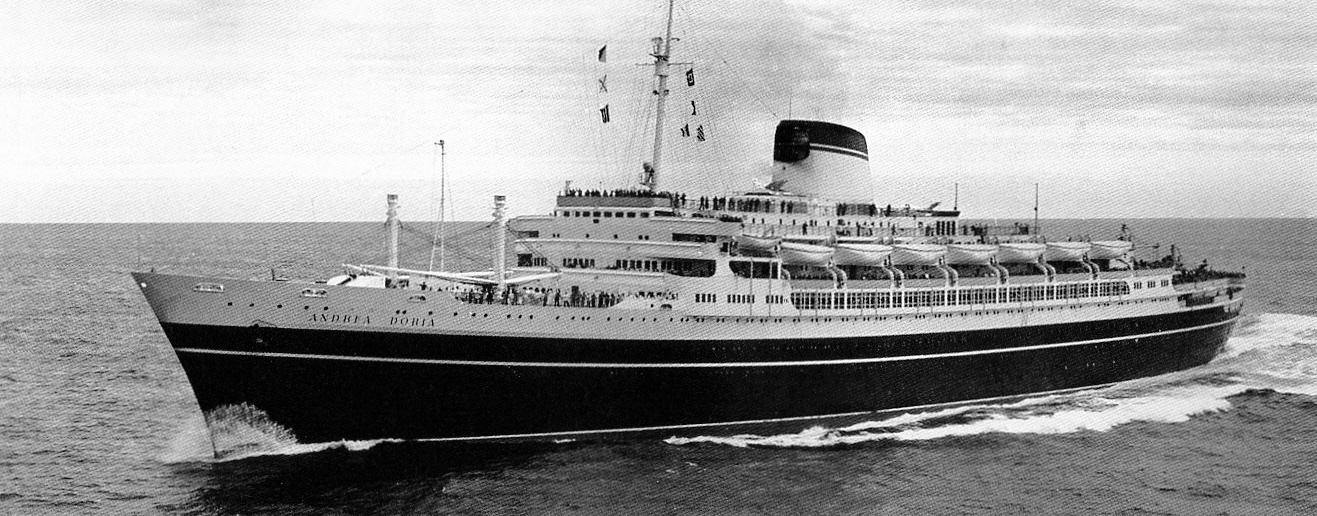
SS Andrea Doria
Italian Line · entered service 1953 · Ship Guide
Overview
SS Andrea Doria was Italian Line’s celebrated postwar transatlantic liner—built to help reassert Italy’s commercial and cultural presence on the Genoa–New York route. Put into service in 1953, she embodied the mid-century “national flagship” idea: a ship intended to be seen, photographed, and talked about, as much as it was meant to carry passengers and mail.
Her place in public memory is dominated by one event: on the night of 25 July 1956, Andrea Doria collided with the Swedish American Line’s Stockholm in fog off Nantucket. Despite a severe list that quickly rendered many lifeboats unusable, the ship remained afloat for more than 11 hours—long enough for a remarkably large rescue. The loss of life (51 total across both ships) was tragic, but the scale of survival (about 1,660 rescued) shaped the story into a reference case for modern maritime emergency response.
Evidence-first note: published figures for tonnage, length, and capacity vary by source and by what’s being measured (registered tonnage vs “as built” vs later documentation). If you publish precise numbers, cite the measurement context.
Key Facts
Design & Construction (Context)
In the early 1950s, transatlantic liners were doing double duty: they were still working ships, but they were also national showcases. Andrea Doria was designed and fitted out accordingly, with a strong emphasis on public rooms, passenger comfort, and an interior program that projected “modern Italy” to the North Atlantic travel market.
For collecting and documentation, that matters. A mid-century flagship generates a dense material trail—menus, passenger lists, baggage labels, onboard stationery, postcards, and press imagery—often tied to particular class structures and particular sailings. Those specifics are the difference between a decorative souvenir and a reliably attributable evidence object.
Service History (Summary)
1953–1956: Genoa–New York service. From her maiden voyage on 14 January 1953, Andrea Doria served as a prominent Italian Line liner on the North Atlantic. In this short career, she became widely photographed and frequently described in contemporary travel writing and reporting—useful for cross-checking how the ship presented itself to the public at a given moment.
25–26 July 1956: collision and sinking. On 25 July 1956, in fog off Nantucket, Andrea Doria collided with the eastbound passenger liner Stockholm. The impact created severe structural damage and a rapidly increasing list. The list is a key mechanical fact: it limited the use of lifeboats on one side, forcing rescue to depend on nearby ships and improvisation. The vessel remained afloat for more than 11 hours, sinking on 26 July 1956. The widely cited loss was 51 lives total across both ships, while roughly 1,660 people were rescued.
Interpretive Notes
Andrea Doria is frequently framed as a “lesson ship,” and that’s fair—so long as the lesson is not simplified into a single moral. Fog, radar interpretation, bridge decisions, and ship-handling dynamics all matter, and they are precisely the kinds of details that get flattened in retellings. If you’re publishing a claim about “what caused” the disaster, treat the official investigations and primary testimony as the spine, and treat later narratives as commentary.
For attribution work, resist two temptations: (1) letting any Italian Line ephemera slide into “Andrea Doria” by default, and (2) letting any “shipwreck artifact” claim stand without chain-of-custody clarity. The ship’s fame makes it a magnet for vague provenance. Date, route context, printer/imprint, and documentary corroboration are your friends.
More than the collision: Andrea Doria belonged to Italy’s postwar effort to re-establish a modern passenger fleet after the destruction and disruption of the Second World War. Her interiors, machinery, route role, and national symbolism therefore matter independently of the 1956 collision that came to dominate public memory.
The loss should also be handled with source discipline. Casualty totals can vary slightly depending on whether later deaths or different accounting conventions are included. The collision, evacuation, and rescue operation are well documented, but a guide should distinguish firmly established sequence from figures that differ across reputable sources rather than forcing one apparently exact total.
That broader context keeps the ship from being reduced to its final voyage alone.
Evidence-first ship guide