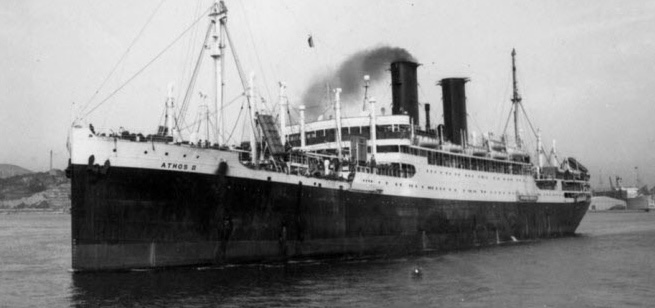
SS Athos II (1927)
Messageries Maritimes · entered service 1927 · Ship Guide
Overview
SS Athos II was a Messageries Maritimes passenger-and-cargo liner built by AG Weser at Bremen for France's postwar merchant fleet. Her first Far East departure from Marseille came on 25 March 1927. She connected France with Asian ports before war transformed her into an Allied troop transport, and she survived to work through the upheavals of the 1950s.
Her story extends well beyond the conventional liner timetable: an inconclusive sabotage investigation, a punishing Atlantic storm, repatriation voyages, refugee transport, and the movement of crews needed to rebuild French merchant shipping. These successive roles make her an especially revealing example of how a passenger ship could remain useful long after its original commercial world had changed.
Key Facts
Date note: References disagree over the launch year. The commonly recorded date is 12 November 1925, while the Encyclopédie des Messageries Maritimes gives 12 November 1926. MARAD also catalogues the ship under 1925. This guide uses 1927 in its title and archive entry to identify her documented entry into Far East service, rather than treating launch and service dates as interchangeable.
A German-Built Liner for French Service
Athos II was supplied to France as part of First World War reparations. Her construction at Bremen is an important distinction within a fleet strongly associated with French shipyards. At about 15,276 gross register tons, she combined substantial passenger accommodation with cargo capacity. Gross tonnage describes enclosed volume; it should not be confused with displacement or cargo deadweight.
Her turbine machinery also distinguishes her from superficially similar steam liners. Two funnels and a familiar passenger-ship silhouette do not establish identical machinery or sister-ship status. The builder, propulsion system, and arrangement plans provide firmer evidence than appearance alone.
The Far East Route and Modernization
The liner's service linked Marseille with Malaya, Indochina, Hong Kong, Shanghai, Kobe, and Yokohama. She carried passengers and cargo across an extended route rather than concentrating on a single express Atlantic crossing. Her commercial identity belongs to that network of repeated port calls and long-distance connections.
Modernization in 1936–37 included a white hull and machinery improvements, with an additional Velox boiler contributing to higher speed. On 10 February 1939 she collided with the Japanese cruiser Izumo at Shanghai. The incident belongs to the final peacetime phase of a career soon redirected toward military transport.
From French to Allied Transport
Wartime duties included French troop movements before the ship was immobilized at Algiers. The Allied landings in North Africa in November 1942 changed her position. In March 1943 she passed into U.S. War Shipping Administration control at Casablanca and subsequently operated as an Army-allocated troop transport through French Lines, Inc.
The distinction matters when reading photographs labelled USAT Athos II. Service carrying American soldiers does not by itself mean commissioning into the U.S. Navy. The Naval History and Heritage Command's account of USS Clay specifically describes her WSA operation and records a turbine-bearing problem that slowed their January 1944 convoy to 11 knots.
The 1944 Sabotage Inquiry
On 20 February 1944, a report from the Galápagos brought the ship to the attention of the Counter Intelligence Corps' Panama detachment. She was carrying about 1,500 American technicians bound for India when machinery trouble prompted suspicion of deliberate interference. Investigators travelled out to meet the ship as she returned toward Balboa for repairs.
Some aboard suspected a pro-Vichy officer. The investigating agent also found reason to question earlier repair work in New York. According to the U.S. Army Intelligence Center of Excellence's historical account, the resulting board of inquiry did not establish the cause. The breakdown and investigation are documented; a proven act of sabotage, or the guilt of a particular officer, should not be inferred from suspicion.
That uncertainty is central to the episode. Political divisions among wartime French personnel made an allegation plausible to contemporaries, but plausibility is not a finding. The repaired ship continued her transport work.
The Atlantic Storm of December 1945
Peace brought no immediate end to hazardous service. In December 1945, Athos II left Le Havre and Southampton carrying American personnel home. Severe weather and machinery failure subjected the crowded ship to extreme rolling. Lifeboats and davits were damaged, fittings broke loose, and the crossing became a struggle to keep people safe and the vessel under control.
The ship diverted to the Azores. Her passengers were transferred to USS Enterprise, a connection confirmed in the carrier's U.S. Navy history. Athos II herself reached New York on 17 January 1946. Inspection revealed serious damage to the rudder's support, explaining steering difficulties whose full significance had not been apparent at sea.
The French account records formal redelivery on 23 March 1946. Repairs and rearrangement of accommodation kept her in New York until July; administrative return and physical return to France were separate events.
Repatriation and Reconstruction in 1946
The homeward voyage took the liner through the French Caribbean. On 16 August 1946 she finally reached Marseille, but another Atlantic assignment followed almost immediately. She was to carry merchant officers and seamen to the United States to take over Liberty ships, alongside civilian passengers, many of them Jewish emigrants.
Claude Petrelluzzi's account, drawing on the captain's and purser's reports, describes rushed preparation, disputed berths, improvised sleeping places, and overcrowding. Spaces arranged for disciplined military contingents were poorly suited to families, elderly passengers, and children. These records illuminate the practical strain behind the abstract phrase “postwar reconstruction”: surviving ships had to move people before comfortable commercial routines could be restored.
The U.S. Army's historical account also records the ship carrying Jewish refugee children to America in 1946. This civilian role deserves attention alongside her better-known troopship employment.
Indochina, Pilgrimage Voyages, and Final Service
Athos II subsequently carried French troops for Indochina and Korea. Reconditioned in 1949–50, she also undertook pilgrim voyages from North Africa to Jeddah. Military work continued during the 1956 Suez operation and on the France–Algeria route. Her final service ended in July 1959, followed by sale for demolition at La Spezia in August.
Her longevity should not be mistaken for an uninterrupted luxury-liner career. The changing mix of passengers, soldiers, and pilgrims is precisely what makes the later years historically significant.
Collecting and Interpretation
A useful research approach is to establish the voyage and role before interpreting an object. A company menu, a troopship photograph, and a family migration record may all concern the same hull while describing very different experiences. Date, route, issuing organization, and passenger status matter as much as the ship's name.
For photographs, compare hull colour, armament, accommodation changes, and dated port records. For written accounts, distinguish an eyewitness description from a later explanation of its cause. The sabotage inquiry and storm provide different lessons: one remains unresolved, while the other can be reconstructed through damage reports and the independently documented involvement of Enterprise.
Sources (Selected)
- Ocean Liner Curator — Sources (master bibliography)
- U.S. Maritime Administration — Athos II vessel record and Coast Guard photographs
- Encyclopédie des Messageries Maritimes — specifications, service chronology, and photographs; launch date differs from other references
- SS Athos II — secondary overview and bibliography, including Lloyd's Register and Roland W. Charles's Troopships of World War II
- Naval History and Heritage Command — USS Clay, January 1944 convoy and WSA operating arrangement
- Erin E. Thompson, U.S. Army Intelligence Center of Excellence — the inconclusive 1944 sabotage inquiry and later refugee transport
- Claude Petrelluzzi — the December 1945 storm, repairs, and return to French service
- U.S. Navy — USS Enterprise war history, including the final Azores repatriation voyage
- Claude Petrelluzzi — August–September 1946 voyage, based on captain's and purser's reports