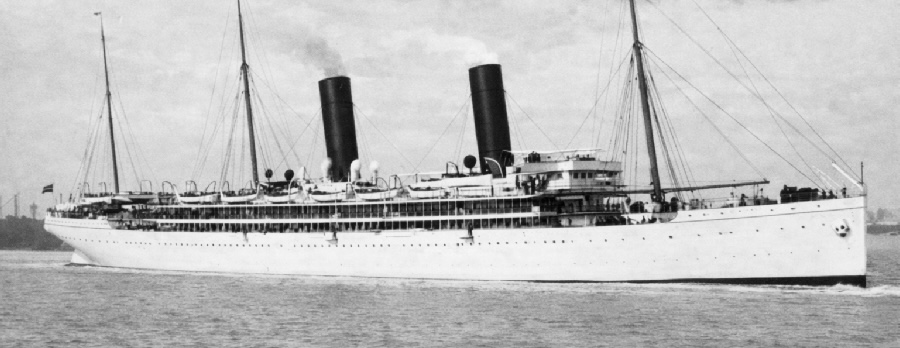
SS Briton
Union Steam Ship Company / Union-Castle Line · 1897 · Ship Guide
Overview
SS Briton was a large British mail and passenger liner built by Harland & Wolff at Belfast for the Union Steam Ship Company. Launched in June 1897 and entering service that December, she was designed for the principal route between Southampton and South Africa. At the time of her completion she was the first Union vessel to exceed 10,000 gross tons and the largest ship employed between Britain and any British colonial route.
Her long career connected the final years of the independent Union Line with the Union-Castle merger of 1900. She carried mail, passengers, and cargo on the Cape route, served as a troopship during the South African War, returned to military transport work during the First World War, and remained in commercial service until the mid-1920s.
This page treats Briton as the 1897 Harland & Wolff liner, sometimes identified in fleet histories as Briton (3) or Briton (II). Earlier ships also carried the name, so builder, date, dimensions, and route should always be checked before attribution.
Key Facts
Note on accommodation: passenger-capacity figures may vary among contemporary and compiled sources. Cabins and public spaces could be altered, and wartime troopship configurations should not be confused with peacetime passenger totals.
Design & Construction Context
Briton represented a major increase in scale for the Union Steam Ship Company. Built of steel and propelled by twin screws, she combined relatively high speed for the Cape mail route with substantial passenger and cargo capacity. Her completion demonstrated the growing importance of the South African service at the end of the nineteenth century.
Harland & Wolff photographs preserve details of her interiors, including the first-class dining saloon with its decorated ceiling dome and frieze. These spaces reflected the status of the Cape mail route, but they represented only one part of a working ship that also carried second- and third-class passengers, refrigerated and general cargo, and official mail.
The Cape Mail Route
Briton entered service between Southampton and Cape Town in December 1897. The route formed a vital communications link between Britain and southern Africa, carrying government correspondence, business travelers, migrants, military personnel, and commercial goods.
Scheduled mail service demanded regularity as well as speed. Weather, port conditions, machinery performance, and the coordination of connecting rail and coastal services all shaped the ship’s practical role. Voyage notices and dated passenger lists are therefore essential for reconstructing her movements accurately.
Union-Castle Merger
In 1900 the Union Steam Ship Company merged with the Castle Mail Packets Company to form the Union-Castle Mail Steamship Company. Briton passed into the combined fleet and adopted the new company’s visual identity and operating system.
The change should be preserved in cataloging. Material from 1897–1900 belongs to her Union Line phase, while later menus, postcards, schedules, and documents may carry Union-Castle branding even though the vessel herself remained unchanged.
South African War Service
The outbreak of the South African War in 1899 brought an early interruption to Briton’s civilian career. She was converted for troop transport and used to carry military personnel and equipment between Britain and southern Africa.
Troopship service imposed different demands from commercial mail work. Passenger spaces were adapted for large military complements, and the surviving documentary record may include embarkation rolls, regimental histories, military correspondence, and transport schedules rather than ordinary passenger ephemera.
Passenger Experience
The voyage to South Africa was longer and operationally different from a North Atlantic crossing. Cabin travelers experienced formal dining, promenade spaces, and scheduled social routines, while passengers in less expensive accommodation encountered more constrained quarters and fewer amenities.
Promotional illustrations tend to emphasize first-class rooms. A balanced interpretation should also use passenger lists, crew records, diaries, letters, and official regulations to recover the experiences of travelers outside the most privileged spaces.
Mail, Cargo & Imperial Communication
Briton was not merely a passenger ship. She carried mail and commercial cargo within a route structured by imperial administration, colonial trade, migration, and military strategy. Her significance lies partly in the regularity with which she connected distant ports rather than in any single dramatic voyage.
This context should be handled directly. The Cape mail service supported ordinary travel and family movement, but it also operated within the political and economic structures of the British Empire. Interpreting the ship requires attention to both functions.
First World War
During the First World War, Briton again entered government transport service. She carried troops and military passengers as part of Union-Castle’s broad contribution to wartime shipping.
Wartime references should be tied to a specific voyage wherever possible. The term “troopship” can describe several different operational arrangements, and a photograph of a transport may show temporary paint, altered lifeboat arrangements, or other changes not present in peacetime.
Wartime Chronology in Detail
Briton’s First World War service was not one continuous requisition. Compiled Union-Castle records place an initial troopship period from 11 August to 25 September 1914, followed by return to commercial work. She was requisitioned again on 16 December 1915, thereafter serving mainly in the Mediterranean.
In 1918 she carried Nigerian troops from Mombasa to Lagos and later transported American troops between Liverpool and the United States. These distinct assignments are more useful for object attribution than the generic label “WWI troopship.”
1898 Grounding
In June 1898, only months after entering service, Briton briefly grounded on the Shambles near Portland Bill. She was refloated and returned to service. The incident is important as a documented early casualty, but it should not be exaggerated into a defining feature of an otherwise long career.
Postwar Return
After the war, Briton returned to the South African service. By then she was an older liner operating in a fleet that was beginning to receive larger and more modern ships.
She nevertheless remained useful into the 1920s. Fleet records place her under several masters during this period and show intervals of layup, reflecting the reduced commercial value and increasingly intermittent employment of an aging mail steamer.
Retirement & Disposal
Briton was withdrawn in 1926 after nearly three decades of service. Her retirement formed part of the replacement of the oldest former Union Line vessels by a newer generation of Union-Castle mail ships.
She was sold for scrapping rather than preserved. Her surviving record therefore depends on photographs, plans, fleet documentation, passenger records, military sources, postcards, and personal papers.
Collecting Profile
Material associated with Briton may include Union Line and Union-Castle postcards, passenger lists, menus, schedules, mail-service ephemera, troopship records, photographs, and Harland & Wolff construction images.
Because several vessels carried the name, attribution should rely on the date, operator, profile, and dimensions. The 1897 liner’s two-funnel, twin-screw mail-steamer appearance and Harland & Wolff construction record provide useful identifying anchors.
Interpretive Notes
Briton is historically important because she joined passenger travel, mail service, cargo transport, warfare, and imperial administration within one long career. She was neither purely a luxury liner nor merely a troopship; her meaning changed with each operating context.
Her history also offers a reminder that ocean-liner networks extended far beyond the North Atlantic. The Southampton–Cape route was one of the most important long-distance passenger and communications systems of its era, and ships such as Briton formed its working foundation.
Evidence-first ship guideSources (Selected)
This list is intentionally conservative.
- Ocean Liner Curator — Sources (master bibliography)
- The Yard — Harland & Wolff ship no. 313, Briton
- National Museums NI — Harland & Wolff photograph of Briton’s first-class dining saloon
- British & Commonwealth Staff Register — Briton (3)
- Great Ships — Briton (II)
- The National Archives — Passenger lists research guide