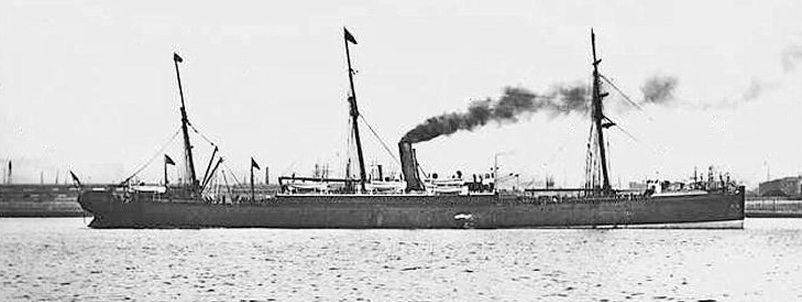
SS Catalonia
Cunard Line · 1881 · Ship Guide
Overview
SS Catalonia was a late nineteenth-century Cunard passenger and cargo steamship built on the Clyde by J. & G. Thomson and launched in 1881. She belonged to the practical, route-serving side of Cunard’s fleet: an iron screw steamer intended for regular North Atlantic work rather than for the publicity role later occupied by record-breaking express liners.
Her career was centered chiefly on Liverpool, Queenstown, New York, and Boston service, with later wartime transport use before she was broken up in 1901. In research and collecting terms, Catalonia is especially useful as evidence of Cunard’s passenger and emigrant network in the 1880s and 1890s: manifests, sailing notices, newspaper references, photographs, postcards, and fleet-list entries can all help place her within the working machinery of transatlantic travel.
This page treats Catalonia as the Cunard Line steamship launched in 1881 and scrapped at Genoa in 1901. Because ship names were often reused or shared, any object or document should be checked against builder, date, operator, route, and context before attribution.
Key Facts
Note on tonnage and capacity: contemporary registers, passenger-list sources, and later summaries may use different measurement conventions or rounded figures. Treat each figure as a source-specific clue unless it can be tied to a particular register or dated publication.
Design & Construction Context
Catalonia was an iron screw steamer with three masts, built during the period when steam had become the dependable basis of transatlantic service but when auxiliary sail-era forms still remained visible in ship profiles. Her size and arrangement place her between the smaller mid-Victorian steamers and the larger, more publicly celebrated Cunard liners that followed later in the century.
She should therefore be read as a working passenger-cargo vessel rather than as a floating palace. Her historical importance lies in the regularity of her service: moving people, baggage, cargo, mail, and military transport obligations across a network that depended on many such ships, not only on the famous flagships.
Service History (Summary)
After her launch in May 1881, Catalonia began Cunard service with an August 1881 Liverpool–Queenstown–New York maiden voyage. She soon appears in Liverpool–Boston service, a route that became central to her identity in surviving sailing references.
Her career also included transport use during imperial and wartime contexts. Clyde-built vessel records note Egyptian campaign transport service in 1882 and Boer War transport service around 1900, while fleet summaries also identify her as a Boer War troopship before scrapping. Those service notes should be handled carefully: they are significant, but any detailed claim about specific voyages, troops, prisoners, or passengers needs a dated supporting source.
Passenger Lists & Migration Evidence
Catalonia is especially valuable in passenger-list research because she served during a period of heavy transatlantic movement. The ship’s reported third-class capacity points to the emigrant and steerage dimension of her work, while first-class accommodation reflects the mixed passenger economy of many Cunard vessels of the era.
For cataloging and interpretation, passenger records should be preserved in their document context. Route phrasing, port sequence, date, master, class categories, and spelling all matter. A manifest that identifies Catalonia on a Liverpool, Queenstown, New York, or Boston voyage is stronger evidence than an undated reference that merely names the ship.
Incidents & Rescue Context
Later summaries associate Catalonia with an 1888 grounding or damage incident near Mizen Head and with the rescue of the crew of the French fishing vessel La Vague in 1897. These episodes are useful reminders that ordinary service histories often include hazards, repairs, and humanitarian actions that do not fit neatly into glamour-liner narratives.
Any artifact linked to such incidents should be described cautiously. “Associated with the ship’s service history” is a safer wording than “from the incident” unless there is a clear chain of evidence, such as a contemporary newspaper report, official wreck or casualty record, medal citation, log entry, or family provenance.
The 1888 Mizen Head Casualty
On 7 May 1888, Catalonia struck a rock near Mizen Head and damaged her stem. The ship was repaired and returned to service after roughly eight days. The official wreck-report tradition makes this episode unusually well documented for an otherwise routine Cunard career.
For collections, newspaper reports and casualty documents from May 1888 should be treated as a distinct evidentiary phase rather than generalized into a claim that the ship was chronically unsafe.
The 1897 Rescue of La Vague
On 20 October 1897, Catalonia rescued all 21 crew members of the French fishing schooner La Vague during heavy weather on the Grand Banks. Captain Thomas Stephens later received a silver medal from the Liverpool Shipwreck and Humane Society for the rescue.
This episode is one of the clearest examples of the humanitarian work performed by ordinary liners during normal commercial voyages, and it deserves to be separated from later Boer War transport duty.
Why Catalonia Matters
Catalonia is valuable because her record joins migration, routine Boston service, imperial transport duty, a documented casualty, and a documented rescue without ever becoming a prestige flagship. She shows how much historical evidence can accumulate around a dependable working liner.
Collecting Profile
Material connected with Catalonia is likely to be documentary or printed rather than luxurious: passenger lists, period sailing notices, fleet-list entries, postcards, photographs, newspaper mentions, and military transport references. Because she was not a later celebrity liner, object attribution should rest on explicit evidence rather than period atmosphere.
A generic Cunard document from the 1880s or 1890s should not be assigned to Catalonia merely because the dates overlap. Stronger attribution requires the ship’s name, a dated voyage, a passenger or crew connection, a route match, or a source trail that places the item directly within her service record.
Interpretive Notes
Catalonia helps show Cunard as an operating system, not just a gallery of famous liners. She carried passengers and cargo, served repeated North Atlantic routes, took on transport duties, and ended her life in the breaker’s yard. That makes her historically useful precisely because she was part of the dependable background infrastructure of ocean travel.
Evidence-first ship guideSources (Selected)
This list is intentionally conservative.