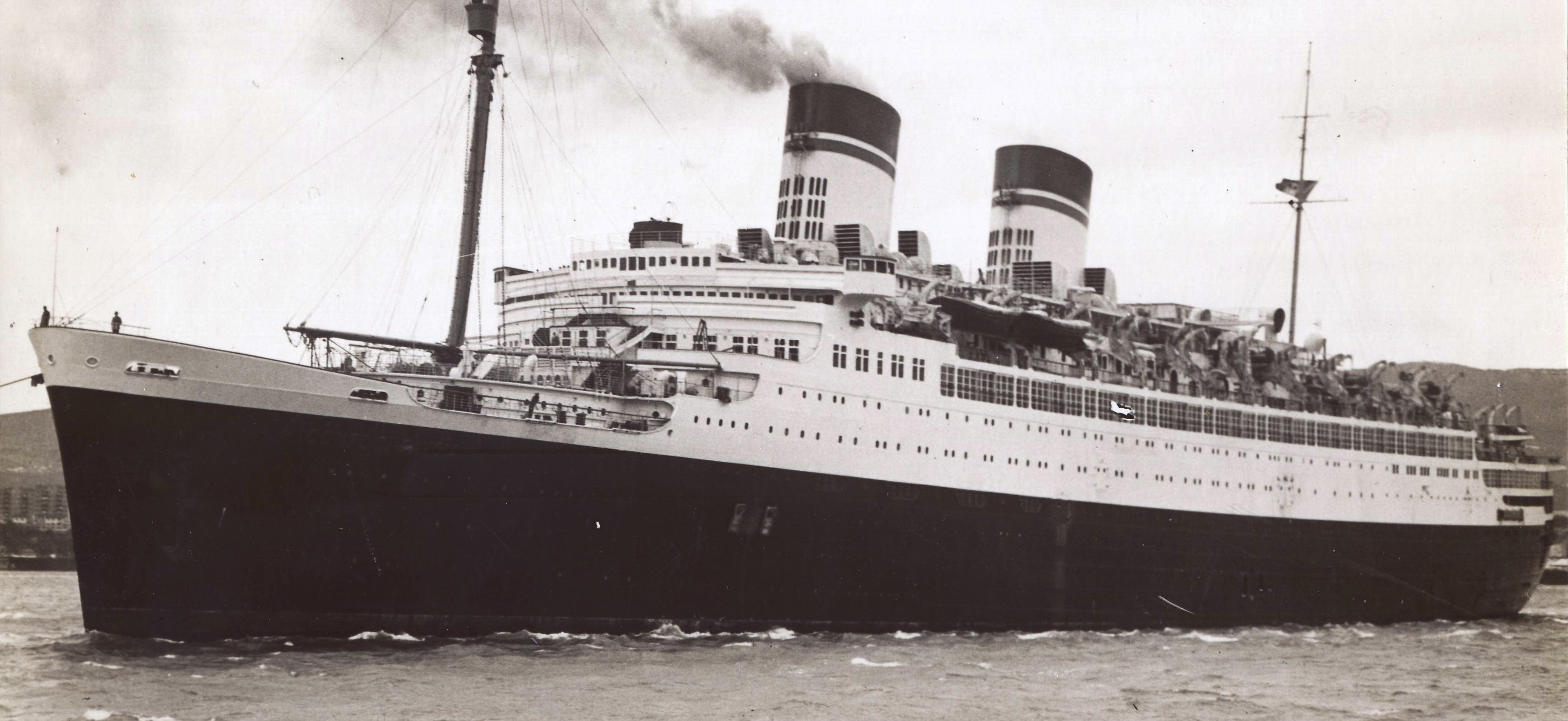
SS Conte di Savoia
Italia Flotte Riunite / Italian Line · entered service 1932 · Ship Guide
Overview
SS Conte di Savoia was one of Italy’s two great interwar prestige liners—built for North Atlantic service in the same national “statement” moment as Rex, but with a notably more modern technical storyline. Entering service in late 1932, she operated the Genoa–New York run (with intermediate calls commonly reported), representing a deliberate Italian bid for visibility on the world’s most public passenger route.
What makes Conte di Savoia particularly useful for curator-minded collecting is a single, unusual feature that shows up again and again in period advertising and technical description: she was fitted with large gyroscopic stabilizers intended to reduce rolling on the North Atlantic. Whether the system “worked” to passenger satisfaction is secondary; the evidence is that it was heavily promoted—creating a trail of brochures, press items, and technical language that can help date and attribute ephemera with more precision than generic “Italian Line” material.
Evidence-first note: operator names shift in summaries (Lloyd Sabaudo / Italia Flotte Riunite / “Italian Line”). When cataloging artifacts, record the name as printed on the object first, then add the corporate context in notes.
Key Facts
Design & Construction (Context)
In the Italian “two-flagship” narrative, Rex often carries the speed-and-record story, while Conte di Savoia carries the modernity-and-comfort story. That distinction is visible in period material culture: Conte di Savoia publicity frequently foregrounds technical novelty (stabilization) and the promise of a smoother passage—an especially marketable claim for a ship expected to cross the rough North Atlantic on schedule.
The stabilizer system is also a curatorial hook: it gives you a concrete feature to trace across brochures, technical press, and onboard descriptive text. If an item mentions stabilizers explicitly, it is often closer to ship-specific attribution than generic “Italian Line” souvenirs that could fit multiple vessels.
Service History (Summary)
1932–late 1930s: Prestige liner service. From late 1932, Conte di Savoia operated transatlantic service between Italy and New York. She did not take the Atlantic speed record, but she achieved strong schedule performance and was promoted as a modern, comfortable ship—an alternative prestige proposition to pure “fastest ship” marketing.
1940–1943: War service and loss. With Italy’s entry into the war, her peacetime role ended. Accounts consistently describe wartime requisitioning and later destruction/sinking in 1943; the postwar hull was later raised and assessed, but rebuilding proved impractical.
1950: Disposal. The ship was ultimately sold for scrap and broken up in 1950—an ending that, like many laid-up flagships, produced a secondary paper trail (press, disputes over disposal, and later retrospective material).
Interpretive Notes
Conte di Savoia is an “attribution discipline” ship. Italian Line material can be ship-specific, but it can also be generic—especially in agent brochures and company-branded stationery. Prioritize objects that carry: (1) the printed ship name, (2) a dated sailing and route chain, (3) onboard location identifiers (dining room, class, cabin), or (4) imagery detailed enough to match her silhouette (two funnels) and era.
Watch for a common cataloging blur: “Italia Line” is often used loosely to describe multiple corporate forms across the 1930s. In your records, preserve what the object literally says (company name, ports, dates), then add corporate history only as a secondary note.
Engineering innovation without mythology: Conte di Savoia’s Sperry gyroscopic stabilizer installation was a serious engineering system intended to reduce rolling, but later retellings can turn it into a near-magical claim about eliminating motion altogether. The more useful interpretation is to treat the gyroscopes as part of an ambitious attempt to improve passenger comfort through machinery rather than through decorative prestige alone.
That makes the ship a useful comparison with Rex: the two Italian prestige liners pursued overlapping goals but expressed them differently through design, machinery, and public presentation.
For visual and technical research, the stabilizer installation should also be dated and described as equipment within a specific engineering arrangement rather than used as a generalized claim about the ship’s comfort under all sea conditions.
Evidence-first ship guide