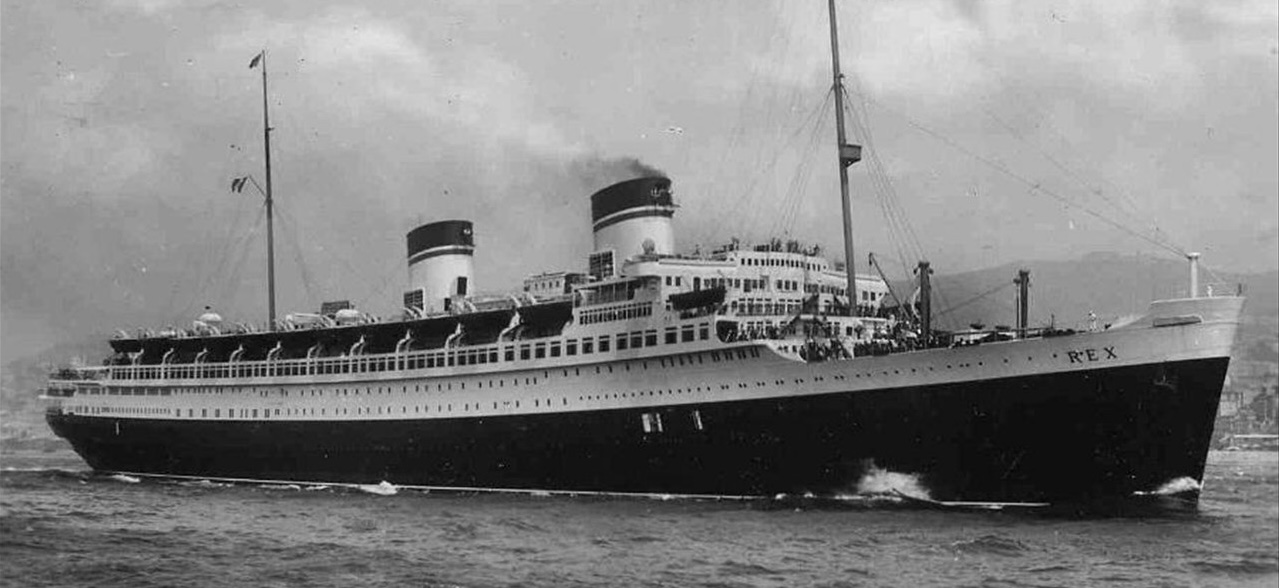
Rex & Conte di Savoia: Two Answers to the Italian Flagship Problem
The Olympic class was a design family, not a set of identical copies. Across Olympic, Titanic, and Britannic, White Star and Harland & Wolff refined passenger spaces, absorbed operating experience, responded to disaster, and altered the third ship under wartime conditions.
Basic answer
Were Rex and Conte di Savoia sister ships?
No. They are often discussed together because they entered service in the same Italian prestige moment and later operated within the same consolidated national fleet, but they were not a conventional sister-ship pair built to one common design. They came from different builders and represented different technical emphases.
The shared problem
Italy wanted a modern Atlantic statement
By the early 1930s, the North Atlantic had become a stage for national prestige as much as a transportation market. Britain, Germany, France, and Italy all used large passenger ships to advertise industrial competence, design culture, engineering confidence, and national ambition.
Rex and Conte di Savoia belonged to that same Italian campaign. Both were large turbine liners, both entered service in 1932, and both served the Italy–New York route. Their importance lies precisely in how differently they expressed the same national goal.
Rex
Speed as national prestige
Rex, built by Ansaldo at Sestri Ponente, became the more famous of the two for a measurable reason: in August 1933 she captured the westbound Blue Riband, averaging about 28.92 knots over the recognized Gibraltar–New York record course.
That achievement gave Italian Line publicity a clear, exportable claim. Rex could be marketed not merely as large or luxurious, but as demonstrably fast. Her long, clean profile and high-powered geared turbines reinforced that image of forward motion and industrial modernity.
Conte di Savoia
Comfort as technical innovation
Conte di Savoia, built at Cantiere San Marco in Trieste, did not acquire the same speed-record identity. Instead, her publicity centered on a different engineering promise: three large Sperry gyroscopic stabilizers intended to reduce rolling.
This was not merely a technical curiosity. Stabilization could be marketed directly to passengers because motion affected sleep, dining, social life, and perceptions of safety and comfort. In that sense, Conte di Savoia turned machinery into a passenger-facing luxury claim.
Same broad machinery family
Different priorities within turbine propulsion
Rex
Four sets of geared steam turbines driving four screws, with service speed around 26 knots and a public identity anchored in high-speed Atlantic performance.
Conte di Savoia
Also used four sets of geared steam turbines driving four screws, but her distinctive technical story lay in roll reduction through gyroscopic stabilization.
Shared logic
Both belonged to the mature oil-fired turbine era and used powerful machinery to support fast scheduled North Atlantic service.
Different messaging
Rex translated machinery into speed prestige; Conte di Savoia translated machinery into a promise of greater comfort.
Design identity
Prestige did not require one formula
The pair is valuable precisely because it undermines the idea that a national flagship program had to produce one standardized answer. Italy could pursue prestige through speed, through technical novelty, through interiors, through route visibility, and through the spectacle of scale.
Rex and Conte di Savoia were complementary rather than redundant. Their coexistence gave the Italian fleet two different stories to tell about modern passenger travel.
Speed versus comfort
A useful comparison—but not a caricature
It is tempting to reduce the two ships to a simple formula: Rex equals speed, Conte di Savoia equals comfort. That shorthand is useful only up to a point. Both were fast, luxurious, heavily engineered prestige liners, and neither was designed around a single attribute.
The better distinction is one of public emphasis. Rex possessed a record that could dominate headlines. Conte di Savoia possessed a stabilization system that could dominate technical and promotional copy. Those emphases shaped how each ship entered historical memory.
War and loss
Two prestige ships, two wartime endings
Neither ship survived the Second World War into renewed passenger service. Conte di Savoia was burned and disabled after German air attack in September 1943; her remains were later demolished. Rex was laid up and was bombed and burned off Capodistria on 8 September 1944, with the wreck later broken up in place.
The loss of both ships matters to postwar Italian liner history. The prestige program they represented could not simply resume after 1945; Italy had to rebuild with a new generation of ships, including Andrea Doria and Cristoforo Colombo.
Timeline
Two parallel flagship careers
Both projects take shape
Rex is laid down at Ansaldo; Conte di Savoia is laid down at Cantiere San Marco for Lloyd Sabaudo.
Both are launched
The pair emerges publicly as part of Italy’s new generation of large Atlantic passenger ships.
Rex enters service
Her maiden voyage begins the Italian prestige offensive on the North Atlantic.
Conte di Savoia follows
The second flagship enters service with gyroscopic stabilization as a major technical and promotional feature.
Rex wins the westbound Blue Riband
The record becomes the defining headline of her public identity.
Conte di Savoia is disabled
German air attack ends her effective career; postwar rebuilding is judged impractical.
Rex is destroyed
Air attack and fire end the career of Italy’s most famous interwar liner.
Read the ships together
Two flagships, two technical narratives
Related interpretation
Continue the story
Evidence note
Do not turn publicity into performance data
The stabilizers aboard Conte di Savoia are well documented, but period claims about how dramatically they improved comfort should be distinguished from the fact of their installation. Likewise, Rex’s Blue Riband is a specific record claim and should not be inflated into vague statements such as “fastest ship ever.” The strongest comparison preserves the difference between measured performance, installed technology, and marketing language.
Selected sources