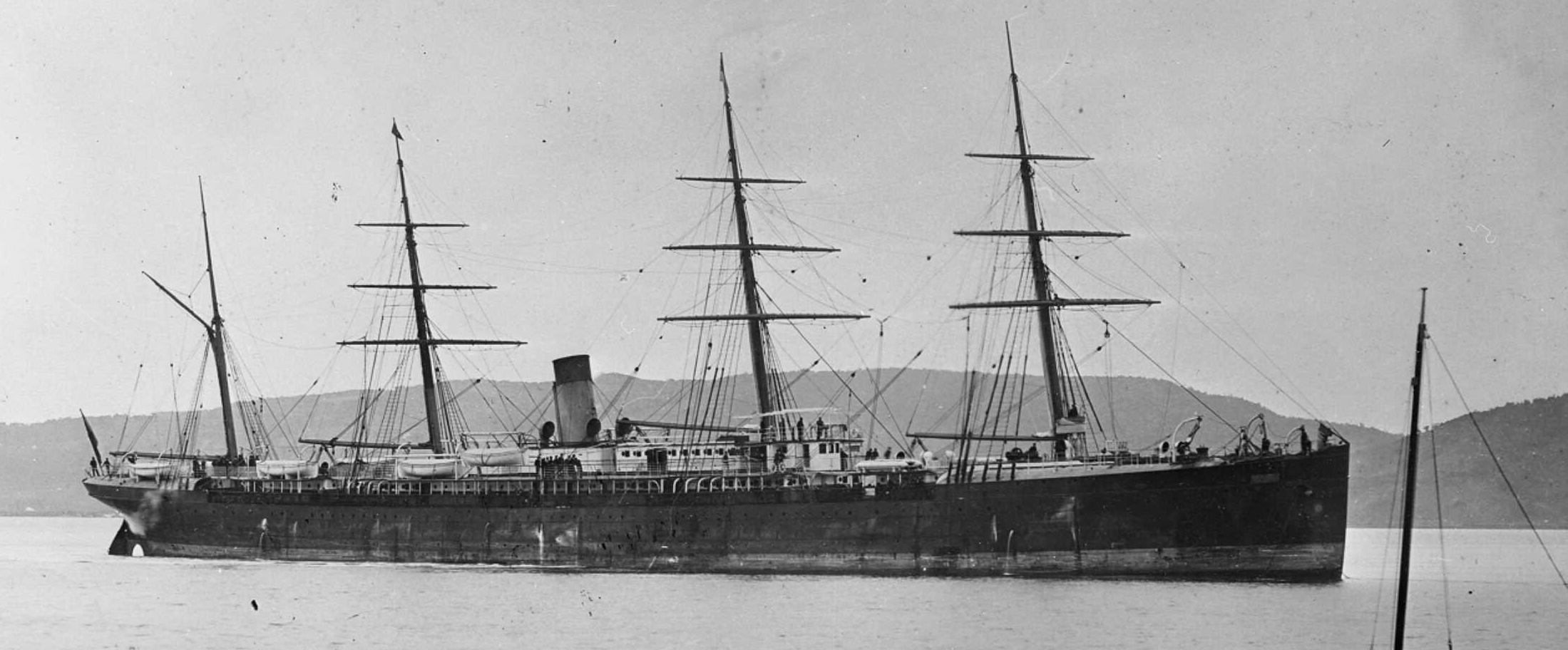
SS Coptic
White Star Line · 1881 · Ship Guide
Overview
SS Coptic was a White Star Line passenger-cargo steamship launched by Harland & Wolff on 10 August 1881. Her career is important not because she dominated one prestigious route, but because the same hull moved repeatedly between the North Atlantic, Pacific, New Zealand, American, and Japanese commercial worlds.
She later became Persia for Pacific Mail in 1906 and Persia Maru under Japanese ownership in 1915. Her forty-four-year career ended with scrapping at Osaka in 1926.
Key Facts
A Working White Star Liner
Coptic was a working passenger-cargo ship rather than a prestige express liner. After an initial Liverpool–New York voyage, she quickly moved into Pacific and New Zealand employment. Refrigerated holds fitted in 1884 made her useful in the developing trade that carried Australasian produce to distant markets.
This mixed passenger-and-cargo role is central to her significance. White Star’s global business cannot be understood solely through the famous Liverpool–New York ships.
Machinery and the 1894–95 Modernization
The machinery record deserves caution. Harland & Wolff’s current yard database lists triple-expansion engine particulars while also noting that new engines were fitted in 1895. White Star specialist histories instead describe the original engines as compound machinery replaced by triple-expansion equipment in late 1894, together with new boilers and accommodation work.
Rather than silently harmonizing those sources, the guide preserves the disagreement and treats the 1894–95 work as a definite modernization breakpoint. Photographs and performance claims should be dated accordingly.
Pacific Service and Notable Incidents
After modernization, Coptic again worked the San Francisco–Asia route. Her Pacific career included a 1897 collision at Kobe, severe typhoon damage in 1898, repairs at Yokohama and Hong Kong, and a grounding at Shimonoseki in 1900.
The ship also intersects with wider history. Wong Kim Ark returned to San Francisco aboard Coptic in 1895 before the landmark U.S. Supreme Court citizenship case, and U.S. Navy Captain Charles V. Gridley died aboard the ship at Kobe in 1898 after the Battle of Manila Bay.
Persia and Persia Maru
Coptic made her final voyage for Occidental & Oriental in October 1906 and was sold in December to Pacific Mail, becoming Persia. She remained on the trans-Pacific trade under American ownership.
In 1915 the vessel passed to Japanese interests and became Persia Maru. She continued on Pacific routes through 1922, later moved to a Japan–Netherlands East Indies service, and was laid up at Yokohama in December 1924 before final scrapping at Osaka in 1926.
New Zealand Refrigeration and Route Flexibility
The 1884 fitting of refrigerated holds is one of the most important commercial changes in Coptic’s career. Refrigerated cargo helped make regular long-distance export of meat and other produce from New Zealand commercially viable, linking agricultural production to British markets. Passenger accommodation and cargo technology therefore belonged to the same economic system rather than to separate stories.
This versatility explains why the ship could move between White Star, chartered Pacific work, and later American and Japanese ownership. She was valuable not because she dominated one route, but because a durable hull could be repeatedly adapted to new commercial networks.
Why Coptic Matters
Coptic is a particularly good example of hull continuity across changing commercial identities. White Star, charter operators, Pacific Mail, and Japanese ownership each generated different documentary worlds around the same ship.
For collectors, the correct primary label depends on date: Coptic, Persia, or Persia Maru. Refrigeration, machinery modernization, and route changes are equally important because they help date objects whose printed name alone may not reveal the ship’s physical configuration.
Evidence-first ship guideSources (Selected)
This list is intentionally conservative.