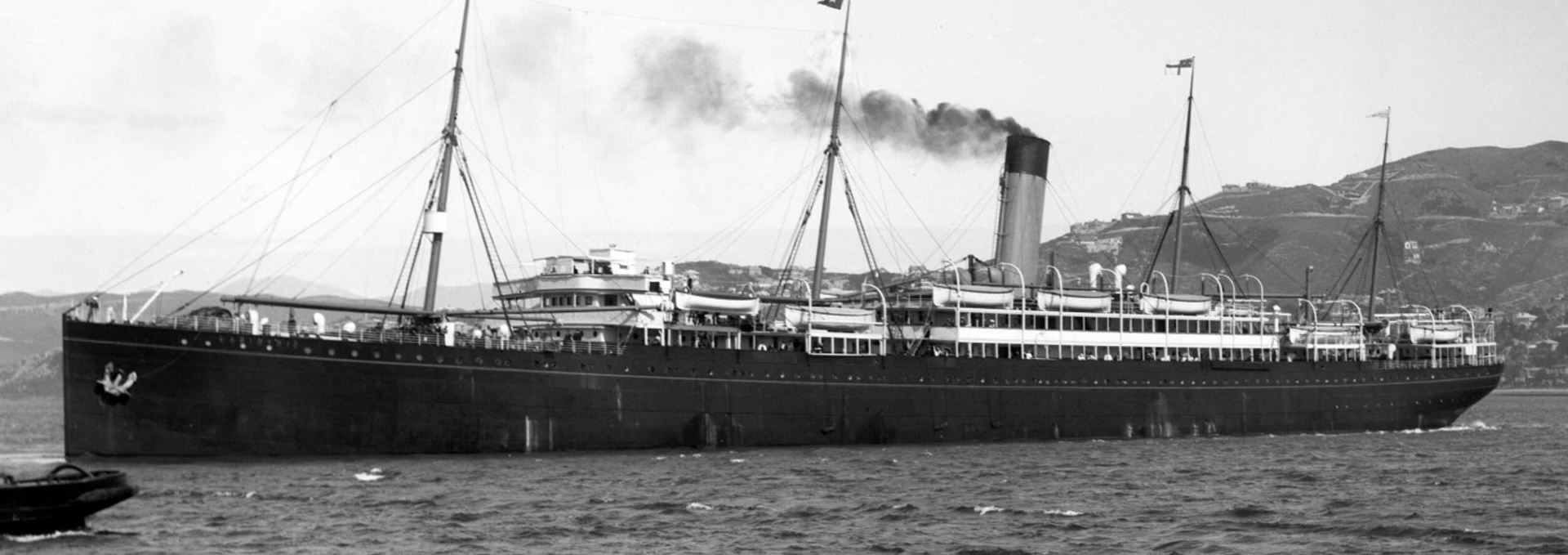
SS Corinthic
White Star Line · 1902 · Ship Guide
Overview
SS Corinthic was the second of White Star’s three Athenic-class passenger-cargo liners built for the Britain–New Zealand service in association with Shaw, Savill & Albion. Launched by Harland & Wolff on 10 April 1902 and completed that July, she was designed for migration, refrigerated cargo, mail, and long-distance passenger work rather than North Atlantic speed competition.
Her first voyage is now dated more precisely: she left London on 19 November 1902, called at Plymouth on 22 November, and reached Wellington on 6 January 1903 after the long route through Cape Town and Hobart.
Key Facts
Built for New Zealand, Not New York
Corinthic belongs to the part of White Star history that disappears when the company is reduced to Titanic-era North Atlantic prestige. Her commercial purpose was the much longer Britain–New Zealand route, where passenger accommodation had to coexist with large freight capacity and refrigerated cargo.
The ship’s four-mast, single-funnel profile and moderate speed reflect that working role. Reliability and cargo economics mattered more than headline crossing records.
The Maiden Voyage
Corinthic left London on 19 November 1902, then called at Plymouth on 22 November before proceeding south. Contemporary New Zealand reporting places her route through Cape Town and Hobart, with arrival at Wellington on 6 January 1903.
The first voyage carried a large emigrant contingent, particularly in third class. The precise class totals printed in later summaries are not internally consistent across all sources, so this guide avoids implying a false exactness while retaining the central fact that migration traffic dominated the passenger profile.
Passenger-Cargo Economics
The Athenic-class ships were mixed-traffic vessels. Refrigerated holds tied British consumers to New Zealand agricultural production, while passenger accommodation carried emigrants, visitors, officials, and returning residents across a route measured in many weeks.
For curatorial work, cargo and migration records are therefore not secondary to “liner” history—they are the core of what the ship was built to do.
A Long, Stable Career
Corinthic continued in the Britain–New Zealand trade through the 1900s and 1920s. Unlike some contemporaries, her later history is not defined by a dramatic renaming or second career. She remained identifiable with the route system for which she had been designed until withdrawal in 1931.
That stability makes her especially useful for studying continuity: company branding, migration patterns, route geography, cargo practice, and changes in passenger expectations across nearly three decades can all be traced without a major break in hull identity.
Migration and Dominion Service
The first voyage is especially revealing because third-class emigrants formed the largest passenger group. That pattern was not incidental to the service: White Star and Shaw, Savill & Albion linked Britain with a settler society that needed both people and goods moving over enormous distances.
Passenger records from Corinthic should therefore be read alongside migration policy, assisted passages, family movement, and the economic development of New Zealand. The ship’s significance lies as much in ordinary mobility as in naval architecture.
Refrigerated Cargo and the Working Liner
Refrigerated capacity was central to the Athenic-class business model. Meat, dairy produce, and other perishables could travel in the same hull that carried hundreds of passengers, allowing the route to connect New Zealand agriculture with British consumers while maintaining regular passenger service.
This mixed role also explains why surviving ephemera can look less glamorous than North Atlantic material. Freight documents, immigration papers, route schedules, and company notices may be more representative of the ship’s real work than prestige advertising.
Why Corinthic Matters
Corinthic broadens White Star history beyond the Atlantic celebrity ships. She demonstrates that the company’s global importance depended equally on practical dominion services carrying people and refrigerated produce over much longer routes.
For attribution, the most revealing fields are date, route, class, and associated Shaw Savill/White Star context. A surviving object that looks modest beside first-class Atlantic material may document a more representative part of the company’s everyday global business.
Evidence-first ship guideSources (Selected)
- Ocean Liner Curator — Sources (master bibliography)
- SS Corinthic (1902) — chronology and contemporary-source bibliography
- Lyttelton Times, January 1903 — first-voyage passenger and arrival context