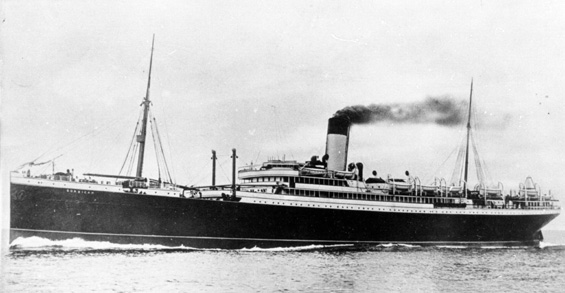
SS Corsican
Allan Line · entered service 1907 · Ship Guide
Overview
SS Corsican was an Allan Line passenger-cargo liner built by Barclay, Curle & Co. at Glasgow and launched on 29 April 1907. Entering Liverpool–Saint John service later that year, she belonged to the practical Canadian Atlantic world of migration, mail, freight, and seasonal passenger movement rather than to the glamour-centered express-liner race.
Her history is especially valuable because it crosses corporate boundaries. Repeated Canadian Pacific charters began before the formal absorption of Allan Line operations, and the ship later passed fully into Canadian Pacific service. Renamed Marvale in 1922, she was wrecked off Newfoundland the following year.
Key Facts
Built for Working Canadian Service
Corsican was designed for mixed passenger and cargo work across the Canadian Atlantic. Her substantial third-class capacity reflects the continued importance of migration traffic, while first- and second-class accommodation served travelers with different means and purposes.
This mixed commercial role helps explain why surviving material can look comparatively modest: passenger lists, landing cards, tickets, baggage labels, sailing notices, menus, postcards, and immigration-linked documents often preserve more historical information than decorative souvenirs.
Route Geography
Liverpool and Saint John formed an important part of the ship's early service, with Canadian routing shaped by season, weather, and commercial demand. Like other ships on this trade, Corsican belonged to a network rather than one immutable port pairing.
Dated passenger documents are therefore stronger evidence than generic route summaries. A port sequence printed on an original list can help place the ship more precisely within its service cycle.
Allan Line to Canadian Pacific
Norway-Heritage documents Canadian Pacific charters from 1908 onward, making the later corporate transition less abrupt than a simple ownership date might suggest. Corsican effectively moved between two great Canadian passenger systems before formal consolidation was complete.
This overlap is important for provenance. An Allan-branded object and a Canadian Pacific object may both be correct for the ship, but they belong to different administrative moments. Catalog records should preserve the company name actually printed on the item.
The 1912 Iceberg Collision
In 1912 Corsican collided with an iceberg near Belle Isle and sustained only limited damage. The incident is notable because iceberg encounters in this period are often read backward through the Titanic disaster, but Corsican's experience should be kept within its own operational context.
It was a survivable navigation casualty, not the defining event of the ship's career. Treating it proportionately preserves the broader story of routine service.
War and Corporate Consolidation
The First World War transformed Canadian shipping networks and accelerated changes already underway among major companies. Allan Line operations were absorbed into Canadian Pacific, and Corsican emerged from the period within a new corporate framework.
Wartime and immediate postwar records may therefore use company names or management language differently from prewar material. This is another reason why date and original imprint matter.
Marvale
In 1922 the ship was renamed Marvale. That is a hard documentary boundary. Material under the new name belongs to the final Canadian Pacific phase and should not be retroactively cataloged simply as Corsican.
The rename also matters visually and commercially. Even when the hull remained recognizable, branding, paperwork, and public identity changed.
1923 Newfoundland Wreck
In May 1923 Marvale ran aground off Newfoundland in fog and became a total loss. Accounts indicate that those aboard were saved, making the event a ship loss rather than a mass-casualty disaster.
Wreck-associated material deserves careful provenance. A seller's statement that an object was “recovered from Corsican” is not equivalent to documented salvage from Marvale. Strong evidence would include contemporary ownership, salvage records, institutional history, or another traceable chain.
Collecting Profile
A useful practical method is to divide surviving material into three categories: Allan Line Corsican, Canadian Pacific Corsican, and Canadian Pacific Marvale. Then test each object against date, route, company typography, paper stock, and named passenger or voyage context.
When evidence is incomplete, restrained labels such as “associated with” or “attributed to” are preferable to stronger claims. The ship's layered corporate history makes precision especially important.
Passenger Market and Migration
The ship's capacity—208 first, 250 second, and roughly 1,000 third class in GG Archives' summary—shows clearly that migration was central to the business. Corsican was not simply a cabin liner with emigrants added at the margins; lower-cost transatlantic passage formed a major part of her commercial purpose.
This helps explain why landing cards, passenger lists, immigration papers, and baggage material are so historically valuable. They can reveal the ordinary movement of people through the Canadian Atlantic network more directly than the better-known imagery of prestige liners.
Canadian Route Context
Saint John, Quebec, Montreal, and related Canadian ports belonged to a seasonal system shaped by ice, railway connections, and demand. Route descriptions should therefore be read as dated operating patterns rather than as fixed identities. A winter Saint John voyage and a summer St. Lawrence voyage can both belong legitimately to the same ship's career.
The route system also connected ocean travel to inland movement. For many passengers, disembarkation was not the end of the journey but the transfer point into a Canadian rail network.
That route flexibility also helps explain why regional newspapers, immigration records, and Canadian port archives can preserve evidence absent from better-known liner collections.
Interpretive Notes
Corsican's importance lies in ordinary Atlantic function: migration, cargo, seasonal Canadian routing, and corporate consolidation. She should not be forced into a prestige-liner narrative she was never built to occupy.
At the same time, the later Marvale identity deserves to stand on its own. One hull can carry several authentic historical identities without those identities becoming interchangeable.
Evidence-first ship guide