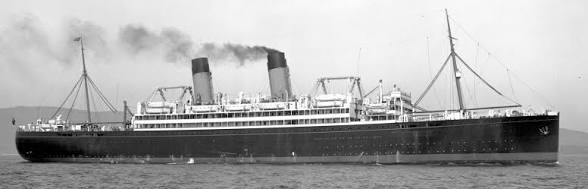
SS Doric
White Star Line · launched 1922 · entered service 1923 · Ship Guide
Overview
SS Doric was a medium-sized White Star Line passenger liner built by Harland & Wolff for the Canadian service. Laid down in November 1921, launched on 8 August 1922, and delivered on 29 May 1923, she began her maiden voyage from Liverpool for Quebec and Montreal on 8 June.
Unlike many earlier White Star liners, Doric used geared steam turbines driving two propellers. She is commonly described as White Star's second and last turbine-powered liner. Her career illustrates how the company adapted after the First World War: regular St. Lawrence service in the 1920s gave way increasingly to leisure cruising as Depression-era line traffic weakened.
This is the later White Star Doric, launched in 1922. The company had operated an earlier Doric launched in 1883; date, route, silhouette, and passenger-class terminology are important for attribution.
Key Facts
Canadian Service
Doric belonged to White Star's less glamorous but commercially important Canadian network. During the navigable season she served Quebec and Montreal via the St. Lawrence; in winter, Halifax became the practical Canadian terminus. Passenger lists show calls through Belfast, Glasgow, and Cobh at different dates, so the route should be treated as a pattern rather than a single immutable itinerary.
Her passenger mix also changed. The ship was designed around cabin and third-class traffic, but tightening immigration law and the growth of tourist travel pushed White Star toward more flexible class arrangements during the 1920s.
From Liner to Cruise Ship
After her last regular Atlantic sailing to Montreal in May 1932, Doric was increasingly used for cruising. This was not an isolated experiment: older and intermediate liners throughout the industry were being redeployed into Mediterranean and leisure cruises as scheduled passenger demand weakened.
The change is important for collectors because later Doric material may be cruise-specific rather than Canadian-line ephemera. Programs, menus, route maps, and entertainment material from the early 1930s therefore represent a distinct commercial phase of the same ship.
The 1935 Formigny Collision
On 5 September 1935, in dense fog off Cape Finisterre, Doric collided with the French steamer Formigny. The impact opened the starboard bow near the waterline and caused flooding and a pronounced list. An SOS was sent, and passengers were ultimately transferred without loss of life.
The Orient Line's new Orion and P&O's Viceroy of India responded to the distress call. After temporary repairs at Vigo, Doric reached Britain under her own power. Surveyors concluded that repairing the twelve-year-old liner was uneconomic, and she was declared a constructive total loss.
She left Tilbury for the breakers in October 1935 and was dismantled at Newport. The collision—not ordinary age or Depression-era lay-up—was therefore the immediate reason her career ended.
Interpretive Notes
Canadian route does not mean one fixed schedule: Montreal, Quebec, Halifax, Belfast, Glasgow, and Cobh references can all be authentic depending on date and season.
Cruise-era material should be dated separately: by the 1930s the commercial identity of Doric had shifted substantially from the migration-oriented Canadian liner of the 1920s.
Two White Star Dorics: the 1883 and 1922 ships require strict date and route disambiguation. A ship name alone is insufficient evidence.
Evidence-first ship guide