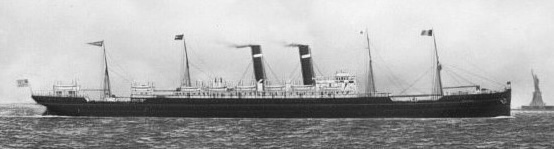
SS Finland
Red Star Line · entered service 1902 · Ship Guide
Overview
SS Finland was a Red Star Line ocean liner built in 1902 by William Cramp & Sons of Philadelphia for the International Navigation Company / International Mercantile Marine system. She was part of the practical, immigrant-and-cabin passenger world of the early 20th-century North Atlantic, serving chiefly between New York and Antwerp under the Red Star Line name.
Finland is especially useful for interpretation because she sits at the intersection of several identities: Red Star Line liner, American-built Atlantic passenger ship, International Mercantile Marine vessel, U.S. Army transport, U.S. Navy transport, and later chartered service under related lines. A good cataloguing approach should therefore ask not only “is this from Finland?” but “which Finland period does this object belong to?”
This page treats Finland as the 1902 Red Star Line vessel. The name was reused and can also appear in unrelated geographic, national, and shipping contexts, so evidence should be date-, route-, and line-anchored whenever possible.
Key Facts
Design & Construction (Context)
Finland was not an express “record-breaker” in the way later prestige liners were marketed. Her significance lies instead in dependable route service, immigrant traffic, and the consolidation of large corporate liner systems at the turn of the century. Built in Philadelphia, she also reflects the American-built side of a transatlantic market often dominated in the public imagination by British, German, French, and Dutch yards.
Her two funnels, four masts, twin screws, and triple-expansion machinery place her firmly in the practical pre-turbine ocean-liner generation. For collectors, that means period images and postcards may look visually “older” than Edwardian superliner material even when the dates overlap.
Service History (Summary)
After launch in June 1902, Finland entered Red Star Line service between New York and Antwerp. This was a major emigrant and passenger corridor, and material from this route should often be interpreted within migration history rather than only luxury travel. Her early service under the American flag and later registry changes are important details when interpreting documents, passenger lists, and printed ephemera.
Finland later appeared in related International Mercantile Marine contexts, including American Line, White Star Line, and Panama Pacific Line charters or service. She also carried the United States Olympic team to the 1912 Summer Olympics, a notable episode that can produce tempting but sometimes overextended collecting claims.
During World War I she entered military use, first as an Army transport and then as USS Finland (ID-4543). This creates a major interpretive boundary: Red Star Line passenger material, Army transport records, Navy transport material, and postwar commercial material should not be collapsed into one generic “Finland” category.
Red Star Line & Immigration Context
Red Star Line material often carries a strong immigration-history component. Antwerp was one of the major European departure points for passengers bound for North America, and Finland belongs to that documentary world of passenger lists, agents, route notices, baggage handling, inspection systems, and multilingual travel logistics.
For interpretation, this makes humble paper especially valuable. A dated steerage or third-class passenger record may tell a richer historical story than a more decorative but undated ship image. The evidentiary question is not whether the item is glamorous; it is whether it fixes the ship, route, date, passenger, or line with clarity.
Wartime Identity Note
The wartime Finland is related to, but not identical with, the Red Star Line liner in ordinary passenger service. A photograph marked USS Finland, a Navy transport document, or a troop movement reference should be catalogued in the wartime phase unless there is separate evidence tying it to the prewar passenger era.
This distinction matters because military service can create a “prestige halo” around otherwise ordinary items. A Red Star Line postcard is not automatically a Navy transport artifact; a wartime photograph is not automatically evidence for immigrant-service interiors. The correct period is part of the attribution.
Collecting Profile (What Tends to Survive)
Likely surviving material includes postcards, passenger-list references, sailing schedules, baggage labels, agent notices, photographs, menus, and immigration-related documents. Because Finland served under multiple related operators and configurations, the line imprint and date are especially important.
A strong attribution should ideally include at least one fixed anchor: Red Star Line imprint, Antwerp–New York routing, a dated voyage, the ship name in period typography, military designation as USS or USAT Finland, or a passenger record that can be matched to a known crossing. Without those anchors, use careful language such as “associated with SS Finland” or “attributed to Red Star Line Finland context.”
Interpretive Notes (What to Avoid)
The main risk is treating Finland as a single static identity. Her career crossed flags, routes, operators, and military service. A single object may be perfectly authentic while still belonging to the “wrong” phase for a seller’s claim.
A second risk is assuming that all Red Star Line material is interchangeable. Finland should be separated from her sister Kroonland, from later vessels named Finland, and from generic Antwerp–New York ephemera unless the item itself supplies the necessary evidence.
Corporate mobility matters: Finland shows how International Mercantile Marine could move one vessel through several related brands without changing the hull itself. Red Star, American Line, White Star charter, Panama Pacific, Army, and Navy references are connected by ownership history, but they represent different routes, passenger markets, and documentary contexts. A line imprint on an artifact should therefore be treated as evidence, not as interchangeable decoration.
The 1912 Olympic voyage is useful precisely because it is so specific. It should not become a general label for the ship’s whole career. Most surviving Finland material will relate to routine passenger, migrant, or transport work; only items anchored by date, passenger names, photographs, or voyage documentation should be linked directly to the Olympic charter.
The American-built aspect also deserves preservation because it complicates the usual national shorthand of the Atlantic trade. A vessel built in Philadelphia could serve a Belgian-branded route inside a multinational corporate combine, making builder, flag, operator, and route separate pieces of evidence rather than one assumed identity.
Evidence-first ship guide