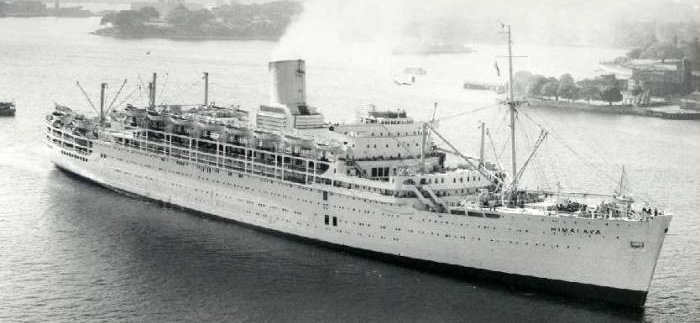
SS Himalaya (1949)
P&O · entered service 1949 · Ship Guide
Overview
SS Himalaya was P&O’s first major new passenger liner delivered after the Second World War and one of the defining ships of the postwar Britain–Australia trade. Built by Vickers-Armstrongs at Barrow-in-Furness, she entered service in 1949 with a 22-knot service speed and a large first-class component, reflecting P&O’s intention to restore a fast, prestigious long-distance service.
Her career also charts the decline of that same business. After traditional line voyages, she expanded into trans-Pacific service and cruising, was converted to one class in 1963, and spent her final years increasingly as a cruise ship before withdrawal in 1974.
Key Facts
P&O’s First Postwar Passenger Liner
Himalaya was ordered in March 1945, before the war in Europe had ended. Her construction therefore belongs directly to P&O’s plan for rebuilding a passenger fleet depleted and disrupted by wartime service.
Completion took longer and cost more than originally expected, but when delivered in September 1949 she represented a major statement of recovery. P&O’s technical records note that she was also the first liner equipped with a Weir evaporating plant for distilling fresh water.
Orcades as a Technical Counterpart
Himalaya shared the same basic hull and machinery concept as the Orient Line’s 1948 Orcades, built immediately before her at the same yard. Their superstructures and internal arrangements differed, but the pairing shows how closely related P&O and Orient Line’s postwar rebuilding programs had become.
The two ships make an especially useful comparison because they served the same broad Britain–Australia market while retaining distinct corporate identities. In later years those identities would move steadily closer together under P&O-Orient.
Fast Service to Australia
Himalaya sailed from Tilbury on her maiden voyage on 6 October 1949. P&O records credit the ship with reducing the London–Bombay passage from the prewar twenty days to fifteen and reaching Melbourne in twenty-eight days.
That speed mattered commercially. The postwar Australia route still involved a journey measured in weeks, and shaving days from the schedule improved the attractiveness of sea travel while also increasing the efficiency of a costly passenger liner.
Passengers, Cargo, and Migration
Her original configuration was unusual in carrying more first-class than tourist-class passengers: 758 first and 401 tourist according to P&O’s technical data. She also carried substantial cargo, including more than 6,600 cubic metres of refrigerated space.
Like other major Australia-route liners, Himalaya carried tourists, business travelers, officials, families, and migrants. Museums Victoria describes her as a passenger, mail, and cargo steamer on P&O’s India and Australia Mail service, placing her firmly within the postwar movement of people between Britain and Australia.
1956 Refrigeration Explosion
On 30 August 1956, while the ship was in the Mediterranean bound for Australia, an explosion occurred in a domestic refrigeration chamber. Four crew members were killed and twelve were injured.
The accident was one of the most serious incidents of her career, but the ship remained in service. It also illustrates the complexity of operating a self-contained passenger vessel whose hotel, cargo, machinery, and refrigeration systems all had to function continuously over very long voyages.
Trans-Pacific Expansion
In 1958 Himalaya made P&O’s first trans-Pacific voyage, extending a Sydney sailing to the west coast of the United States. The same year she operated a series of cruises from Sydney, showing how quickly the traditional liner schedule was beginning to merge with leisure travel.
A 1959 itinerary took her on an extensive voyage through Australia, New Zealand, the United States, Japan, and Singapore. These routes anticipated the increasingly global cruise patterns that would become central to P&O’s passenger business.
Modernization and One-Class Conversion
Himalaya underwent repeated modernization as passenger expectations changed. Air conditioning and stabilizers were introduced during her later service, and her public rooms evolved along with the market.
In 1963 she was converted to one-class operation for 1,416 passengers. Royal Museums Greenwich preserves photographs of the new “Boot and Piton Room” created during that refit, a small but revealing example of how spaces once divided by class were reworked for a more leisure-oriented passenger experience.
From Liner to Cruise Ship
The closure of the Suez Canal after the 1967 war forced changes in route planning, while jet aviation continued to erode demand for point-to-point sea travel. Himalaya increasingly relied on cruises from Australia and Britain during the early 1970s.
Her final liner voyage to Australia took place in 1974. She then completed additional cruises before leaving service and sailing to Taiwan for demolition.
Why Himalaya Matters
Himalaya is one of the clearest ships through which to read P&O’s postwar passenger strategy. She began as a fast prestige liner for the Australia route, directly comparable in hull and machinery to Orient Line’s Orcades, and ended as a one-class cruise-oriented ship in a market transformed by aviation.
Alongside Chusan, Arcadia, Iberia, and Canberra, she helps turn the archive’s postwar P&O coverage into a coherent fleet story rather than a set of isolated ships.
Related Liners
Sources
- P&O Heritage, Ship Fact Sheet: Himalaya (1949).
- Royal Museums Greenwich, P&O archive, Individual Ships: HIMALAYA: Miscellaneous material, 1949, P&O/65/156.
- Royal Museums Greenwich, P&O Collection photographs of Himalaya, including the 1963 one-class refit.
- Museums Victoria, Photograph — RMS Himalaya, P & O Line, circa 1950s, item HT 26611.