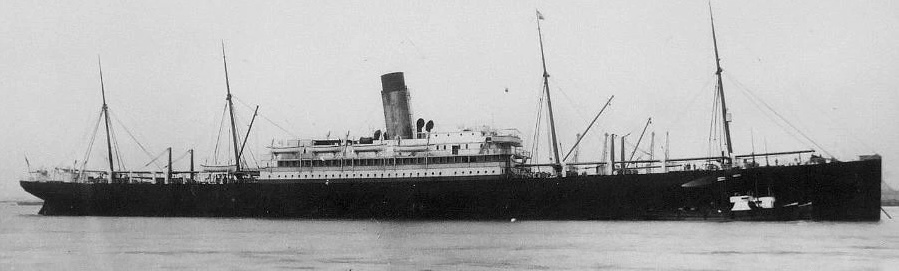
SS Minnehaha (1900)
Atlantic Transport Line · 1900 · Ship Guide
Overview
SS Minnehaha was an Atlantic Transport Line passenger-cargo liner built by Harland & Wolff at Belfast and launched on 31 March 1900. She belonged to the line's well-known group of large “Minne” ships and was designed for the direct London–New York trade, combining first-class passenger accommodation with unusually large cargo capacity.
That mixed role is central to understanding the ship. Minnehaha was not an emigrant liner in the usual multi-class sense; Atlantic Transport Line marketed an all-first-class passenger service while simultaneously carrying freight, horses, perishables, and other valuable cargoes. Her career therefore sits at the intersection of elite passenger travel and hard-working transatlantic commerce.
Key Facts
A Distinctive Passenger-Cargo Formula
Atlantic Transport Line occupied an unusual niche on the North Atlantic. Its large passenger ships could offer comfortable first-class accommodation without attempting to compete directly with the fastest or most spectacular Cunard, White Star, or German express liners. At the same time, the ships earned heavily from cargo.
Minnehaha is a particularly clear example of that model. Contemporary passenger lists document an affluent saloon clientele, while company material and later references emphasize the carriage of valuable freight and livestock. The passenger experience was exclusive, but the ship's commercial logic remained strongly cargo-oriented.
London and New York
The ship became a regular presence on Atlantic Transport Line's London–New York service. Surviving passenger lists document voyages in the early 1900s and into the years immediately before the First World War, including sailings from both London and Southampton.
Those documents are especially valuable because they preserve the social texture of the route: business travelers, diplomats, clergy, families, and prominent public figures appear alongside a ship whose lower spaces were devoted to substantial freight rather than steerage berths.
The “Minne” Fleet
Minnehaha belonged to the same broad fleet family as Minneapolis, Minnetonka, and Minnewaska. These ships gave Atlantic Transport Line a recognizable identity around the turn of the century and reinforced its direct London–New York service.
For attribution, the similar names can be a trap. Photographs, passenger lists, and postcards should be checked carefully for the exact ship name, date, and physical configuration rather than assigned generically to the “Minne” group.
First World War
The First World War transformed Minnehaha's operating environment. In 1915 she survived damage from a German-laid mine, demonstrating both the vulnerability of large merchant ships and the possibility of survival after serious wartime damage.
Her luck ended on 7 September 1917. German submarine U-48 attacked and sank Minnehaha, ending a seventeen-year career that had begun in the high-volume commercial Atlantic of 1900 and concluded in unrestricted submarine warfare.
Why Minnehaha Matters
Minnehaha helps broaden the story of transatlantic travel beyond prestige liners and mass steerage migration. She represents a commercially sophisticated middle ground: first-class-only passenger service combined with major freight capacity on a dependable direct route.
Her wartime history also gives the ship two sharply different documentary identities. Prewar passenger lists and advertising belong to an affluent commercial service; wartime records belong to a hazardous transport environment in which cargo and strategic movement took precedence.
Interpretive Notes
First class only does not mean passenger-only: Atlantic Transport Line's model paired exclusive passenger accommodation with major cargo capacity.
The “Minne” names require care: Minnehaha, Minneapolis, Minnetonka, and Minnewaska are easy to confuse in ephemera and secondary references.
Wartime material should be separated from peacetime interpretation: route, operating conditions, and purpose changed substantially after 1914.
Evidence-first ship guide