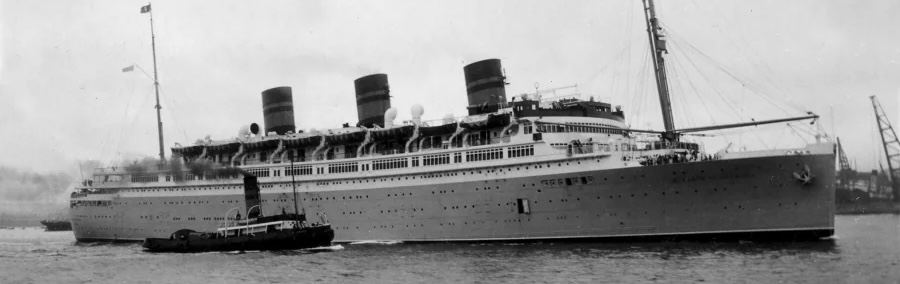
Monarch of Bermuda
Furness Bermuda Line · 1931 · Ship Guide
Overview
Monarch of Bermuda was purpose-built for the New York–Hamilton tourist trade and entered service in 1931. Rather than competing as a North Atlantic express liner, she sold a destination: Bermuda itself. Her schedules, interiors, and marketing were built around short luxury voyages linking Manhattan directly with the island.
Her later career was even more unusual. After wartime troopship service, a devastating 1947 fire appeared to end the ship. Instead, the wreck was acquired by the British government and rebuilt into the emigrant ship New Australia, later becoming the Greek Line's Arkadia.
Key Facts
A Destination Liner
The ship's commercial identity was inseparable from Bermuda tourism. Furness Bermuda Line advertising often treated the passage as part of the holiday itself, and surviving material frequently combines ship imagery with hotels, beaches, harbor scenes, and island leisure culture.
That makes Monarch of Bermuda useful beyond conventional liner history: her ephemera also belongs to the history of Caribbean and Atlantic tourism, New York leisure travel, and interwar destination marketing.
Designing for a Destination
Monarch of Bermuda was not simply a liner assigned to Bermuda after completion; the route shaped the ship's entire commercial identity. Short passages from New York favored luxurious public rooms, strong leisure marketing, and a schedule built around resort travel rather than long-distance migration or record-breaking speed. In effect, the ship functioned as part of the holiday product.
That is why surviving brochures and menus often devote as much attention to Hamilton, beaches, hotels, and island scenery as to machinery or dimensions. For research and collecting, those objects belong simultaneously to maritime history and to the history of interwar tourism. The ship and destination were deliberately marketed as one experience.
War and the 1947 Fire
During World War II the liner was requisitioned for troop transport. After the war she returned to the Tyne for reconversion to civilian service, where a major fire gutted the vessel in 1947.
The exact date deserves caution. Royal Museums Greenwich describes the fire as 24 March 1947, while Tyne Built Ships gives 24 May 1947. Both agree on the essential event and location. This guide therefore preserves the conflict rather than selecting a day without stronger primary evidence.
New Australia and Arkadia
The burned ship was initially regarded as a constructive total loss, but the Ministry of Transport reassessed and acquired the hull. Rebuilding transformed her appearance and purpose: the three-funnel Bermuda liner became the one-funnel emigrant ship New Australia, managed by Shaw, Savill & Albion.
In 1958 she was sold again, modernized and lengthened, and became Arkadia for the Greek Line. She remained in service until 1966, when she was broken up at Valencia.
One Hull, Three Different Markets
The contrast between Monarch of Bermuda, New Australia, and Arkadia is unusually stark. The same hull moved from luxury resort traffic to postwar emigrant service and then to Greek Line passenger work. Each rebuilding changed not only appearance but the social purpose of the ship, making name and date essential when interpreting photographs, plans, or ephemera.
Interpretive Notes
Do not collapse the names. Furness Bermuda Line artifacts belong to Monarch of Bermuda; postwar emigrant material belongs to New Australia; Greek Line material belongs to Arkadia.
The 1947 fire is a source-conflict example. The event itself is well documented, while the exact day differs between otherwise useful references. “Unknown pending stronger evidence” is preferable to invented certainty.
Evidence-first ship guide