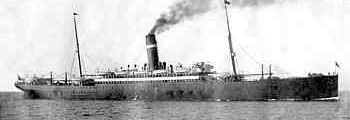
SS New England
Dominion Line · 1898 · Ship Guide
Overview
SS New England was a large twin-screw passenger liner built by Harland & Wolff at Belfast for the Dominion Line’s Liverpool–Boston service. Launched on 7 April 1898 and placed in service that June, she was designed for the mixed North Atlantic trade: cabin passengers, emigrants, mail, and cargo carried on a dependable route linking Britain and New England.
Her career extended well beyond the name under which she entered service. Transferred to the White Star Line in 1903, she became Romanic and served first between Liverpool and Boston and then between Boston and Mediterranean ports. Sold to the Allan Line in 1912 and renamed Scandinavian, she later carried Canadian troops during the First World War and completed her working life under Canadian Pacific ownership before being scrapped in 1923.
Identification note: despite occasional modern mislabeling, the documented SS New England of 1898 was not a Holland America Line vessel. Contemporary passenger material and surviving fleet histories identify her with the Dominion Line, followed by White Star, Allan, and Canadian Pacific. Holland America Line’s comparable Belfast-built liner of the same year was SS Statendam.
Key Facts
Design & Construction (Context)
New England belonged to a late-1890s generation of large intermediate liners built for regular rather than record-breaking service. Her twin screws and duplicated machinery improved reliability, while a moderate speed of about 15 knots balanced schedule-keeping with the fuel economy required on a route where freight and emigrant traffic were as important as first-class travel.
Her original accommodation for approximately 1,200 passengers reveals the commercial structure of the ship. First- and second-class travelers occupied a comparatively small portion of the available berths, while roughly two-thirds of her capacity was assigned to third class. The liner was therefore both a passenger vessel and a major instrument of migration between Europe and North America.
Service History (Summary)
1898: Entry into Dominion Line service. Launched at Belfast on 7 April, New England began her maiden voyage from Liverpool to Boston on 30 June 1898. She joined the Dominion Line’s principal Boston service, commonly calling at Queenstown.
1898–1903: Liverpool–Boston operations. During her first five years, the ship carried cabin passengers, emigrants, mail, and cargo between Britain and Massachusetts. Contemporary passenger lists preserve her role in an established migration corridor that did not depend upon New York as its American terminus.
1903: Transfer to White Star Line. Following the consolidation of Dominion and White Star interests within the International Mercantile Marine Company, New England was transferred to White Star and renamed Romanic. Her final Dominion Line sailing began in September 1903; her first White Star departure followed in November.
1903–1911: Boston and Mediterranean service. As Romanic, the liner initially remained on the Liverpool–Boston route before being assigned to Boston–Naples–Genoa service. The change reflected the growing importance of southern European immigration to the United States.
12 July 1907: Collision near Nantucket. In dense fog, Romanic collided with the fishing schooner Natalie B. Nickerson. The schooner sank and three members of her crew were lost; the liner recovered the survivors and brought them to Boston.
1912: Allan Line purchase. Withdrawn from White Star’s Mediterranean service, the ship was sold to the Allan Line and renamed Scandinavian. Her accommodation was revised to emphasize second- and third-class carriage, and she entered Glasgow–Halifax–Boston service in March 1912.
1914–1918: Wartime transport. After the outbreak of the First World War, Scandinavian carried Canadian troops to Britain and later operated under the Liner Requisition Scheme. Allan Line ownership passed into Canadian Pacific during the war.
1918–1922: Final commercial years. Released from government employment, Scandinavian returned to Atlantic passenger service under Canadian Pacific management. She served several routes linking Liverpool, Antwerp, Southampton, Canada, and the United States before being withdrawn in 1922.
1923: Demolition. After a period laid up at Falmouth, the veteran liner was sold for scrap and taken to Hamburg for breaking up.
Romanic, Scandinavian, and a Changing Passenger Market
The ship's successive names chart a broader change in North Atlantic passenger traffic. As Romanic, she moved from the established Liverpool–Boston trade into Boston–Mediterranean service, where southern European migration became increasingly important. When the Allan Line acquired her in 1912 and renamed her Scandinavian, the passenger arrangement was revised to emphasize second- and third-class—or, in contemporary marketing, "one cabin"—travel.
Allan Line publicity presented Scandinavian as a large, comfortable ship for travelers who did not require the elaborate class hierarchy of an express liner. That makes her useful evidence for the early-twentieth-century growth of simplified cabin-class service, a market positioned between traditional first class and steerage.
Canadian Pacific and the End of Service
Canadian Pacific absorbed the Allan Line in 1917, bringing Scandinavian into another major transatlantic system without changing the underlying ship. She continued through the wartime and immediate postwar period before being laid up in 1922.
She was sold for demolition and broken up at Hamburg in 1923. By then the vessel had spent roughly a quarter-century under three major corporate identities—Dominion, White Star, and Allan/Canadian Pacific—while remaining closely associated with Boston and the Canadian Atlantic. Her biography is therefore a particularly clear example of how mergers and route transfers could outlive the branding under which a liner had first become familiar.
Interpretive Notes
The ship’s three principal names correspond to three distinct phases in North Atlantic history. As New England, she served the established British–Boston trade; as Romanic, she participated in the expansion of Mediterranean immigration; and as Scandinavian, she became part of Canada’s passenger and wartime transport network.
Her ownership changes also illustrate how major shipping combinations reorganized ships and routes during the early twentieth century. The vessel herself remained broadly the same working liner, but corporate consolidation repeatedly altered her name, livery, passenger arrangement, and advertised identity.
The historical record is especially useful as a warning against assigning ships to companies solely through visual resemblance or proximity in time. Harland & Wolff built both New England and Holland America Line’s Statendam in 1898, but their ownership histories were separate.
Evidence-first ship guideSources (Selected)
Published tonnage and accommodation figures changed after later refits. Values above distinguish the ship’s original Dominion Line arrangement from her later Allan Line configuration wherever the surviving summaries permit.
- Ocean Liner Curator — Sources (master bibliography)
- Norway Heritage — SS New England, Dominion Line
- GG Archives — SS New England passenger lists
- RMS Republic Historical Site — SS New England
- SS Scandinavian (starting index; corroborate key facts)
- Holland America Line — 150th Anniversary historical timeline
- Norway Heritage — SS New England chronology and particulars
- Norway Heritage — SS Scandinavian chronology