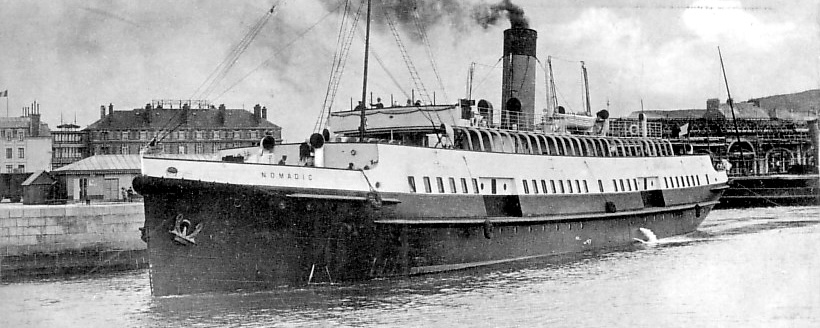
SS Nomadic
White Star Line · 1911 · Ship Guide
Overview
SS Nomadic was a purpose-built White Star Line tender designed for Cherbourg, where the largest transatlantic liners could not berth directly alongside the passenger facilities. Built by Harland & Wolff at Belfast as yard number 422, she formed part of the shore-to-ship infrastructure created for White Star’s new Olympic-class service.
Her role was deliberately distinct from that of SS Traffic. Nomadic handled first- and second-class passengers, while Traffic concentrated on third-class passengers, baggage, mail, and cargo. The pair therefore extended the class structure and operational choreography of the great liners into the harbor itself.
Today Nomadic is especially important because she survives: Titanic Belfast identifies her as the last remaining White Star Line vessel, preserved in Belfast after a working life that continued long after her original tender service.
Key Facts
Designed as Part of a Liner System
Nomadic makes the most sense when viewed not as a miniature ocean liner but as a purpose-built component of an integrated transport system. Titanic Belfast’s ship file emphasizes that White Star’s Olympic-class project required more than new ships: ports, docks, passenger facilities, hotels, rail connections, and transfer craft all had to function together. Cherbourg’s harbor could not receive the giant liners directly, so the tender became an essential link rather than an incidental service boat.
White Star could have relied on converted local craft, as other companies often did. Instead it commissioned dedicated tenders whose accommodation and handling arrangements reflected the service standards of the liners they met. The decision shows the company treating the passenger journey as an end-to-end experience, with the transfer from train and terminal to ship engineered as deliberately as the public rooms aboard the liner itself.
Titanic and the Cherbourg Transfer
Nomadic’s best-known assignment came in April 1912, when she carried first- and second-class passengers from Cherbourg out to Titanic. The association is important, but it should not reduce the tender to a single evening. She had been built for a recurring operational task and served generations of major liners calling at Cherbourg.
That broader context is useful for interpretation. The tender demonstrates how the scale of the newest express liners changed the infrastructure around them: the ship offshore, the tender alongside, baggage and passengers divided by function, and shore-side railway connections timed to the sailing. The celebrated liner was only the most visible part of a much larger machine.
A Long Working Life
Nomadic remained useful because a tender was fundamentally a working vessel rather than a prestige object. Her career extended through both world wars and through changes of ownership and use. Titanic Belfast notes that she later spent nearly three decades in Paris as a restaurant and entertainment venue, an extraordinary second life for a vessel designed to shuttle passengers across a harbor.
Her eventual return to Belfast transformed her significance again. Restoration work brought the vessel back into the physical setting of the shipyard that built her, and the restored ship and Hamilton Dock opened to visitors in 2013. In 2015 ownership passed to Maritime Belfast Trust, integrating Nomadic into the broader preservation and interpretation of Belfast’s maritime-industrial heritage.
Why Nomadic Matters
Nomadic survives where nearly every major White Star liner does not. That makes her valuable not simply as a memorial to Titanic, but as physical evidence of White Star design, Harland & Wolff workmanship, passenger-class organization, and the practical infrastructure of early twentieth-century liner travel.
Her scale is part of the lesson. Ocean-liner history can become dominated by record holders and flagships, yet vessels such as Nomadic reveal how those flagships actually functioned. A transatlantic liner network depended on dozens of less glamorous systems and craft; here, unusually, one of those working components survives intact enough to be studied directly.
Collecting & Attribution Notes
Objects claimed as “from Nomadic” should be distinguished from generic White Star material and from objects merely associated with Cherbourg. Strong attribution rests on vessel-specific documentation, dated photographs, yard records, institutional provenance, or a traceable chain of custody. White Star branding alone is not evidence that an item came from this tender.
Beyond the Titanic Connection
Nomadic is often introduced through her association with Titanic, but her working life was much longer than that single evening in April 1912. She spent decades tendering major liners at Cherbourg, served in both world wars, and remained in passenger-transfer work until the decline of traditional transatlantic liner traffic made the role increasingly obsolete.
After retirement from tender service in 1968, the vessel survived through an unusual second life in Paris as a floating restaurant and entertainment venue. That survival proved decisive: instead of being lost with most White Star service craft, she remained physically intact long enough to be returned to Belfast, restored, and interpreted as a historic vessel.
Why Nomadic Matters
Nomadic is the last surviving White Star Line vessel and an unusually direct material link to the company’s operating world. Her value is not simply that she once served Titanic; her structure, machinery, class-separated passenger spaces, and tender role preserve evidence of the broader transport system built around the Olympic-class liners.
Her preservation also changes the evidentiary landscape. Researchers are able to compare photographs, plans, fittings, spatial arrangements, and restoration decisions against a surviving hull rather than relying only on documents. That makes Nomadic both a ship and a reference object for studying White Star practice at Cherbourg.
Evidence-first ship guideSources (Selected)