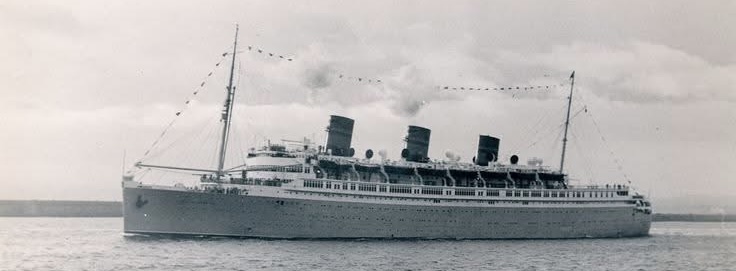
Furness Bermuda Line · entered service 1933 · Ship Guide
Overview
SS Queen of Bermuda was the Furness Bermuda Line’s purpose-built flagship for the New York–Bermuda trade, designed for fast,
comfortable “holiday timetable” travel: an overnight run out of New York, time ashore in Hamilton, and a scheduled return—an itinerary that produced
abundant printed material that is often dateable by voyage, season, or refit-era design cues.
For curatorial work, her documentary value is unusually strong because her career divides cleanly into distinct phases:
pre-war luxury passenger service, a wartime identity as HMS Queen of Bermuda (F73) and later troop transport, and a postwar return to the
route culminating in a major 1961–62 rebuild that altered her silhouette dramatically.
Evidence-first note: “Queen of Bermuda” is frequently abbreviated or mis-tagged as “RMS” in casual listings.
Use “SS Queen of Bermuda (Furness Bermuda Line, completed 1933)” for catalog titles unless the object itself shows another prefix.
1–2 September 1932; published sources differ by one day
Completed
14 February 1933
Maiden voyage
21 February 1933 · Liverpool–New York, before entering Bermuda service
Tonnage
About 22,575 GRT
Length / beam
About 553.4 ft / 76.7 ft
Propulsion
Steam turbines driving electric generators and motors · four screws
Speed
About 19 knots
Prewar route
New York–Hamilton, Bermuda
Royal Navy service
Armed merchant cruiser HMS Queen of Bermuda, pennant F73, from 1939
Fate
Withdrawn and scrapped in 1966
Design & Construction (Context)
Queen of Bermuda was ordered to replace the earlier Bermuda lost by fire in 1931, and her design reflects a very specific commercial goal:
a modern, prestige passenger ship built not for the transatlantic mail race, but for a reliable “resort liner” schedule.
That shaped everything curators see in surviving material—seasonal brochures, deck plans tuned to leisure amenities, and a visual identity tied to a single route.
Technically, her turbo-electric machinery belongs to a broader interwar strand of passenger-ship engineering where the advantages were operational smoothness
and flexible power transmission. For object attribution, this matters mainly when ephemera highlights machinery or “modern ship” selling points—those claims
often align closely with period advertising language, giving you anchors for dating (especially when paired with typography, logo style, or onboard-service headings).
Collecting lens: this route produced a high volume of “routine luxury” print—menus, passenger lists, luggage labels, cocktail napkins, and sailing cards.
High-confidence ship-level attribution typically requires the printed ship name, a Hamilton/New York itinerary, or imagery/plan views distinctive to the class.
Cut-away Views & General Arrangement
These two illustrations provide a visual guide to Queen of Bermuda’s internal arrangement and changing external profile.
Select either image to open a larger, viewport-aware view.
General arrangement
Passenger spaces and machinery layout
A sectional view can help identify the relationship between passenger decks, public rooms, service spaces,
machinery, and the ship’s purpose-built resort-liner arrangement.
Comparative view
Configuration and dating context
A second drawing or profile view is especially useful for comparing prewar and postwar arrangements and for understanding
the major 1961–62 reconstruction that replaced the original three-funnel silhouette with a single funnel.
Curatorial note: Published deck plans and sectional drawings may reflect a particular refit or service period.
Treat room names, capacities, and arrangements as era-specific unless the illustration itself clearly identifies its date.
Service History (Summary)
1933–1939: Furness Bermuda Line flagship. Entering service in 1933, Queen of Bermuda operated the New York–Hamilton run in tandem
with her sister Monarch of Bermuda. This pre-war period is the most prolific for collectible shipboard printing and route marketing.
1939–1943: Requisition and naval service. Requisitioned just before the outbreak of war, she was converted into an Armed Merchant Cruiser and
commissioned as HMS Queen of Bermuda (F73). Wartime photographs and accounts often emphasize camouflage, armament, and convoy duty—material that is
usually identifiable by the naval name and pennant.
1943–1947: Troopship employment and postwar movements. Returned from naval service and refitted for troop transport, she carried troops on multiple
routes and later supported repatriation tasks. Expect “official” wartime paper trails to use government or military framing rather than the pre-war holiday branding.
1949–1966: Return to Bermuda trade; later rebuild and final years. After overhaul and refit, she returned to New York–Hamilton service in 1949.
In 1961–62 she underwent a major rebuild that removed the familiar three-funnel silhouette and replaced it with a single modern funnel, marking a visually obvious
dividing line for dating photographs, postcards, and promotional material. She was withdrawn when the line ceased operations in 1966.
Interpretive Notes
Queen of Bermuda is a strong “evidence-friendly” ship for collectors because so many objects are route-specific and because her silhouette changes
create natural dating brackets. When cataloging, treat the object’s printed identifiers as primary: ship name, route (New York / Hamilton), and any printed
sailing date. Add narrative only after those anchors are secured.
Two common pitfalls: (1) generic “Bermuda” tourism ephemera that never names the ship, and (2) postwar material where the line branding is prominent but
the ship name is absent. In both cases, downgrade ship-level attribution unless you have a second anchor (e.g., a dated sailing list that matches a known itinerary,
a deck plan labeled to the vessel, or a photograph with unmistakable features from a specific configuration era).
Practical dating cue: if an image shows the post-1961 single-funnel profile, it is almost certainly from 1962 onward (after the rebuild returned her to service).
Pre-war and early postwar imagery typically shows the three-funnel appearance.
Bermuda service was its own passenger world:Queen of Bermuda operated in a short-sea luxury market very different from the classic week-long North Atlantic crossing. Regular New York–Bermuda service emphasized resort travel, repeated seasonal passengers, and the ship as part of the vacation itself rather than merely transportation between continents.
That makes the surviving general-arrangement and cutaway material especially useful. It helps connect photographs, cabin plans, public-room descriptions, and later alterations to the physical ship rather than relying only on promotional prose. Wartime service and subsequent rebuilding should still be separated from the peacetime Bermuda configuration when dating visual evidence.
Because the route was comparatively short, public-room layout and onboard leisure mattered disproportionately to the passenger experience. The preserved cutaway material is therefore not decorative extra content; it is direct evidence for understanding how the ship functioned as a floating resort.