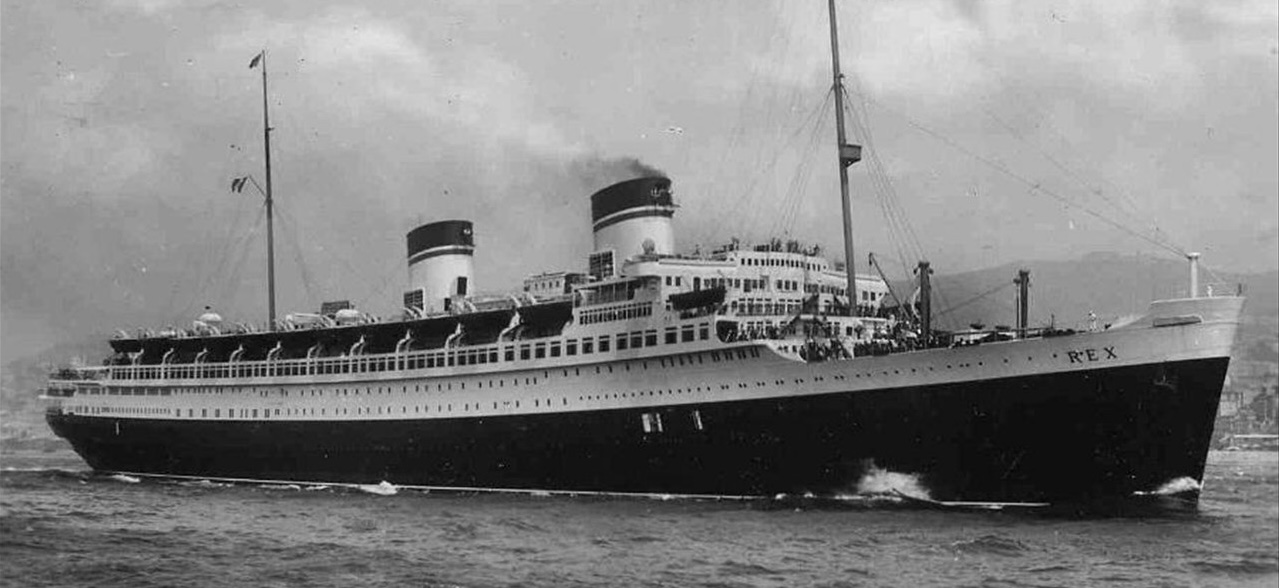
SS Rex
Italian Line · entered service 1932 · Ship Guide
Overview
SS Rex was built as an Italian prestige liner in the early 1930s—large, fast, and designed to project modernity on the North Atlantic at a moment when national liners doubled as floating advertisements. Her fame rests less on a single “legendary” voyage than on measurable performance: in August 1933, Rex captured the westbound Blue Riband for the fastest scheduled Atlantic crossing, briefly placing Italy at the top of the speed conversation in the era of Bremen, Europa, and later Normandie.
For collectors, Rex is a particularly rich ecosystem. Italian Line’s interwar graphic identity—menus, cabin stationery, baggage labels, postcards, and sailing ephemera—often survives in attractive condition, and the ship’s name was frequently printed as part of the brand. That’s helpful: ship attribution is much stronger when it is native to the object, not added later.
This page is written as a reference doorway: it summarizes widely documented facts, flags uncertainty where it exists, and avoids turning repeated anecdotes into “record” without evidence.
Key Facts
Design & Construction (Context)
Rex belongs to the “statement liner” generation: ships designed to look fast even at rest, with long, clean lines and a deliberately modern interior language for the time. The ship’s public identity was intertwined with industrial capacity and national messaging—an important context for interpreting her onboard print culture, souvenir programs, and photography, which often emphasize scale, speed, and modern comfort.
Collecting implication: Italian Line material from the early 1930s can be broadly “right era” without being ship-specific. Ship attribution is strongest when the ship name is printed on the piece, when the voyage is date-locked, or when there is a traceable chain of custody (e.g., passenger identity, kept correspondence, or institutional deaccession paperwork).
Blue Riband & the 1933 Record (Why It Matters)
In August 1933, Rex won the westbound Blue Riband—the widely recognized (though unofficial) accolade for the fastest scheduled Atlantic crossing by average speed. The often-cited benchmark run is expressed as “Gibraltar to Ambrose Light,” a standardized way of comparing performances over a defined segment rather than an entire port-to-port itinerary.
Curatorial note: “Blue Riband winner” is a claim that is easy to verify, and it’s an anchor point you can safely use when writing labels. Avoid letting it inflate into broader, vaguer claims (“fastest ship ever,” “unsinkable,” “never surpassed”) unless your specific wording is backed by a named source.
Service History (Summary)
After entering service in 1932, Rex operated as a flagship transatlantic liner through the 1930s, a period when passenger travel, mail, publicity, and national prestige were tightly linked. Surviving ephemera often reflects that blend: fine dining print, itinerary material, and shipboard stationery on one side, and promotional material built to circulate ashore on the other.
Collecting method: separate “shipboard-issued” from “shore-issued” items. A postcard or brochure can be authentic and period without ever having been aboard. That’s not a flaw—it’s just a different object category with a different evidentiary claim.
1938 Interception (A Useful Provenance Anchor)
One of the most frequently cited “afterlife” moments in Rex’s story is the 1938 publicity interception by U.S. Army Air Corps aircraft far out at sea—an event photographed and widely reported at the time. For collectors, this matters because it generated abundant date-locked press imagery and captions, which can help authenticate or contextualize photos and clippings.
If you’re evaluating a photograph labeled “Rex intercepted at sea,” look for period publication context: newspaper mastheads, wirephoto stamps, date lines, and captions that match known reporting patterns.
Wartime Disruption & Loss (Evidence Note)
Like many interwar liners, Rex’s peacetime identity ended under wartime conditions. By 1944 she was in the Adriatic region, where she was attacked from the air, burned, and capsized in shallow water near Capodistria/Koper. The wreck remained visible and was later broken up on site.
Collector caution: listings sometimes blur “wartime loss” into “battle relic” language. Treat “from the wreck” claims with the same discipline you’d apply to any salvage-associated object: demand documentary anchors (permits, logs, dated correspondence, institutional records). Without those, label conservatively: “Italian Line (period), associated with Rex” is different from “salvaged from Rex.”
Collecting Profile (What Tends to Survive)
In the market, you’ll most often encounter: (1) onboard and passenger ephemera (menus, stationery, postcards, baggage labels, cabin-class print), (2) promotional material (brochures, sailing lists, posters, agent literature), (3) press imagery tied to speed records and publicity events, and (4) modern reproductions or “upgraded” attributions. The first three can be historically meaningful—even without dramatic provenance—when they are honestly described.
Practical method: date what you can (postmarks, print codes, typography), determine whether “Rex” is printed as part of the original design, and keep “shipboard use” separate from “company issue.” When you cannot anchor it, use restrained language: “Italian Line, early 1930s, ship attribution unverified.”
Prestige, performance, and reality: Rex is often remembered through the 1933 Blue Riband, but her story is more useful when the record passage is placed beside the difficult 1932 maiden voyage and the broader effort to present the Italian Line as a modern national prestige operation. Speed was important, but so were scale, interiors, route branding, and the political meaning attached to the ship.
Blue Riband language also benefits from precision. The record belongs to a specific directional crossing and moment in time, not to a permanent title detached from chronology. That distinction keeps promotional shorthand from replacing the actual performance record.
Her later reputation can easily flatten that chronology into a single story of speed and grandeur. A better reading keeps the troubled maiden voyage, the 1933 record passage, ordinary scheduled service, and the ship’s eventual wartime fate as distinct phases. That preserves the difference between what contemporary publicity promised and what the operating record actually shows.
Evidence-first ship guide