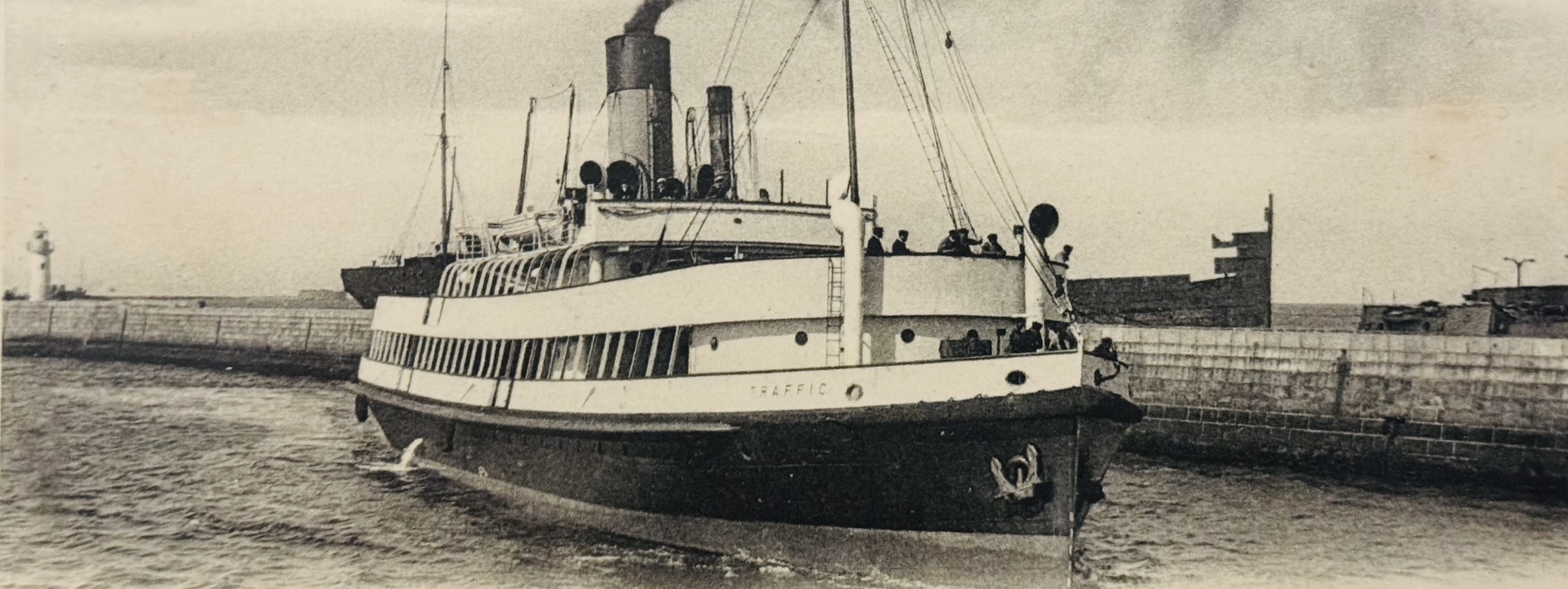
SS Traffic
White Star Line · 1911 · Ship Guide
Overview
SS Traffic was the smaller of White Star Line’s two purpose-built Cherbourg tenders, constructed by Harland & Wolff alongside SS Nomadic. She was intended primarily for third-class passengers, baggage, mail, and cargo, while Nomadic handled first- and second-class passengers.
That division of labor made Traffic part of the operating system created for the Olympic-class liners. Cherbourg’s facilities could not berth the largest transatlantic ships directly, so passengers and baggage had to be moved between shore and liner by tender. Traffic performed the less glamorous but indispensable half of that work.
Key Facts
Design & Operational Role
The distinction between Traffic and Nomadic was functional as well as social. Titanic Belfast’s documentation describes Traffic as the tender for third-class passengers, cargo, and baggage, including special baggage-handling equipment intended to speed turnaround. This was a practical response to the enormous volumes generated by the new Olympic-class service.
Seen in that light, Traffic is evidence of how thoroughly class separation extended through the travel system. The passenger’s category shaped not only accommodation aboard the liner but the vessel used to reach it. That is an important corrective to histories that treat embarkation as a single undifferentiated event.
Early Service at Cherbourg
Traffic and Nomadic were built together at Belfast and entered the Cherbourg service in 1911. Specialist White Star research records that the two tenders departed Belfast with Olympic on 31 May 1911 and reached Cherbourg on 3 June. From there they became routine components of White Star’s calls at the French port.
Her work was repetitive by design: move passengers and baggage efficiently, meet the liner’s timetable, and disappear again into the harbor system. That lack of glamour is precisely why surviving documentation matters. Traffic helps reconstruct the labor and logistics that made a major liner call possible.
Later Career and Wartime Loss
In 1934, after harbor improvements reduced the need for the original tender arrangement, Traffic was sold with Nomadic to a French harbor-services concern and renamed Ingénieur Riebell. She remained a working vessel rather than passing immediately into retirement.
Her Second World War history was far less fortunate. Specialist accounts record that she was scuttled by the French in June 1940 as German forces approached Cherbourg, subsequently raised by the Germans, and employed in wartime service. On 17 January 1941 she was sunk in the English Channel by a British torpedo. This corrects the sometimes-repeated claim that her final loss resulted from a collision.
Why Traffic Matters
Traffic is a useful counterweight to flagship-centered ocean-liner history. Her significance lies in function: she moved the people, luggage, mail, and cargo that allowed the great ships to keep their schedules. Without vessels like her, the celebrated scale of Olympic and Titanic would have been operationally awkward at ports such as Cherbourg.
The contrast with preserved Nomadic is also instructive. One tender survives as a museum ship; the other disappeared in wartime. Together they show both the richness and the fragility of the supporting infrastructure around the transatlantic liner system.
Collecting & Attribution Notes
Traffic-specific material is uncommon. Generic White Star or Cherbourg material should not be upgraded to a vessel attribution without evidence. Stronger identifications use the ship’s name, documented tender assignments, photographs, builder records, or a traceable provenance rather than branding alone.
Operational Role at Cherbourg
Traffic is best understood not as a miniature ocean liner, but as part of the shore-to-ship machinery that made White Star’s largest liners practical at Cherbourg. Built alongside Nomadic, she handled third-class passengers as well as baggage, mail, and cargo while Nomadic principally carried first- and second-class passengers. The arrangement separated passenger streams and accelerated transfer between the railway-connected port and liners waiting in deeper water.
That function placed Traffic directly inside the operating history of Olympic and Titanic. On 10 April 1912, both Cherbourg tenders participated in transferring passengers to Titanic during her maiden voyage. The tender system is therefore important evidence for how giant liners actually interacted with ports that could not berth them directly.
Later Career and Significance
During the First World War, Traffic was used in troop-transport work before returning to tender service. White Star later sold the Cherbourg tenders in the late 1920s as ownership and operating arrangements changed. Unlike Nomadic, Traffic did not survive into preservation, which makes photographs, plans, and contemporary documentation especially important to reconstructing the paired tender system.
Her significance lies less in glamour than in logistics. The great express liners depended on vessels such as Traffic to connect ship, port, railway, baggage handling, and passenger classes into one functioning transport network.
Evidence-first ship guideSources (Selected)