This page is a focused chronology rather than a full interpretive essay. It follows
SS United States
from William Francis Gibbs’s design ambitions and Newport News construction, through her 1952 Blue Riband crossing, Atlantic service, withdrawal, decades of layup, preservation campaigns, departure from Philadelphia, remediation at Mobile, and planned transformation into an artificial reef with a land-based museum component.
Date note: some milestones are exact launch, maiden-voyage, record, withdrawal, purchase, tow, or announced-project dates. Other entries are best read as operating phases, especially around late-career economics, preservation attempts, and the current reef-and-museum transition.
Identity note: United States changes meaning several times. She begins as an American engineering and national-security project, becomes the fastest North Atlantic passenger liner, spends most of her later life as an at-risk preservation cause, and is now being interpreted through a contested afterlife: underwater reef, salvaged artifacts, museum storytelling, and public memory.
Filters
Toggle categories to narrow the page by design, construction, records, passenger service, layup, preservation, or reef-and-museum afterlife.
⌕
Tip: Search matches section, date, title, description, and category tags.
1930s–1950 · Design ambitions and national purpose
1930s–1940s
William Francis Gibbs pursues the idea of a fast, safe American superliner
Design
Long before the ship appears on the ways at Newport News, Gibbs’s design philosophy is already clear: speed, fire safety, compartmentation, machinery performance, and strategic usefulness matter as much as passenger glamour. The eventual ship should be read as a design argument, not simply as a large commercial liner.
Postwar 1940s
The project takes shape in a Cold War and military-readiness context
Design
United States is planned for prestige passenger service, but also with potential military transport value. That dual identity helps explain her speed, power, compartmentalization, and the secrecy surrounding some technical details.
Curator note
The ship is often remembered as a luxury liner, but the evidence points to a more complicated object: national symbol, commercial transport, naval auxiliary in reserve, and engineering showcase at the same time.
8 February 1950
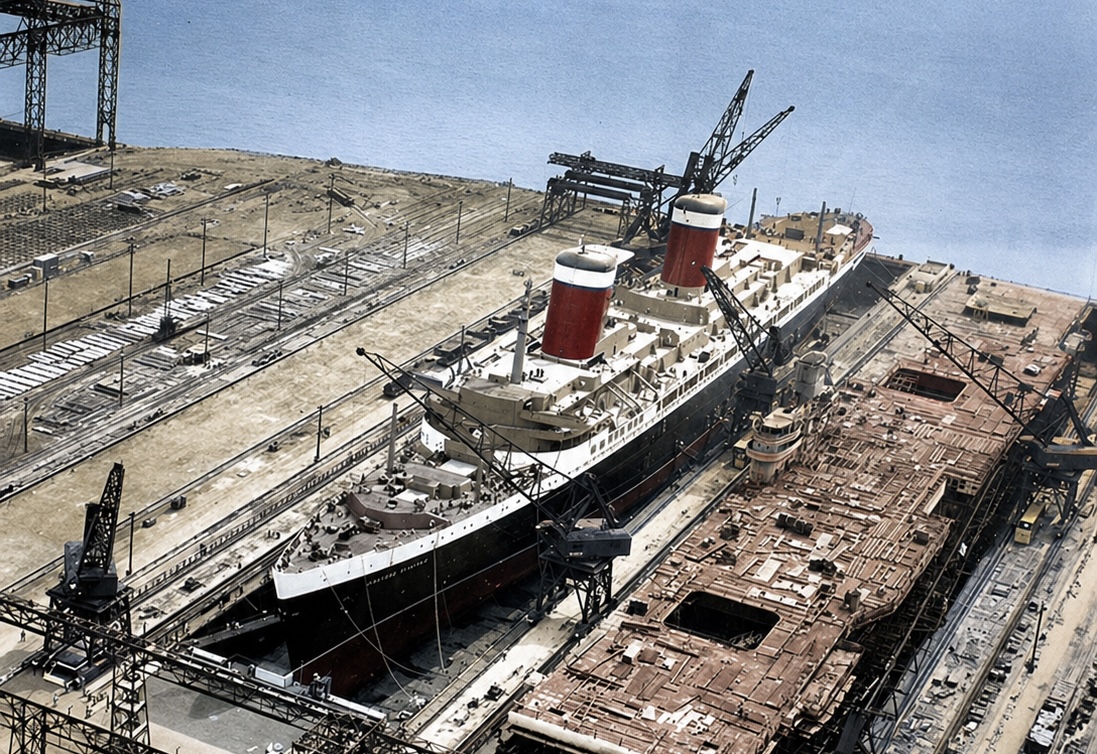
Keel laid at Newport News Shipbuilding
DesignConstruction
Construction formally begins in Virginia. The ship’s mixed steel-and-aluminum structure, enormous machinery power, and fire-conscious interiors reflect Gibbs’s priorities and the extraordinary expectations placed on the vessel.
1950–1952 · Construction, launch, trials, and maiden-voyage record
23 June 1951
SS United States is launched
Construction
The hull enters the water at Newport News. Public attention now turns from design promise to visible national flagship: a ship intended to project American technical confidence on the North Atlantic.
1951–1952
Fitting out completes the ship’s austere, fire-conscious passenger world
ConstructionDesign
Interior completion gives the liner her public face, but the design remains governed by safety and performance. The relative restraint of some materials and finishes should be understood against Gibbs’s aversion to combustible luxury.
June 1952
Sea trials confirm exceptional performance
ConstructionRecords
Trials demonstrate that the ship is more than publicity. Her machinery performance positions her to challenge the Atlantic speed record almost immediately upon entering service.
3 July 1952
Maiden voyage begins from New York
RecordsPassenger service
United States departs on her first eastbound crossing. The voyage is not merely an introduction to service; it becomes a deliberate demonstration of American liner speed and engineering capacity.
July 1952
The Blue Riband is won from Queen Mary
RecordsPassenger service
On her maiden crossing, United States breaks the transatlantic speed record, crossing in three days, ten hours, and forty minutes at an average speed reported around 36 knots. The achievement makes the ship inseparable from the language of records.
Curator note
This is the event that fixes the ship in public memory. It should be framed as both a technical achievement and a publicity event: the record mattered because it converted engineering performance into national prestige.
1952
The westbound record follows
RecordsPassenger service
The ship’s record reputation is reinforced in both directions. From this point forward, United States is not simply America’s flagship; she is the liner by which postwar speed claims are measured.
1952–1969 · Atlantic service, celebrity, and jet-age pressure
1950s
A fast, regular presence on the North Atlantic
Passenger serviceRecords
In the 1950s, the liner combines schedule reliability, celebrity passenger culture, patriotic symbolism, and unmatched speed. Her value is not only that she is fast, but that speed becomes part of her everyday commercial identity.
1950s–1960s
Safety and secrecy remain part of the ship’s legend
Passenger serviceDesign
The ship’s fire-safety reputation, high subdivision standards, and still-partly-mythologized machinery performance help build an identity distinct from older luxury liners. Even in service, United States is surrounded by a language of guarded capability.
Late 1950s–1960s
Jet-age travel undermines the express liner model
Passenger service
The rise of transatlantic jet service changes the economics of ocean travel. United States remains famous, but fame and speed cannot fully protect the scheduled passenger-liner business from air competition.
1969
United States is withdrawn from service
Passenger serviceLayup
After only seventeen years of commercial operation, the ship leaves active transatlantic service. The contrast is striking: one of the most capable liners ever built spends far longer inactive than she spent carrying passengers.
1969–1996 · Withdrawal, ownership changes, and stripped interiors
1970s
The ship enters a long uncertain afterlife
Layup
Various ownership and reuse ideas follow withdrawal. The vessel’s scale, maintenance needs, and specialized design make reuse difficult, even as her symbolic value remains unusually strong.
1980s–1990s
Hazard-removal and interior stripping reshape what survives
LayupPreservation
The ship’s interiors are substantially altered and many fittings are removed. Later preservation efforts therefore confront a paradox: the hull survives at monumental scale, but much of the passenger environment exists through artifacts, photographs, plans, and memory rather than intact rooms.
Curator note
For interpretation, this matters. A timeline should distinguish the survival of the ship’s exterior form from the survival of original interior fabric.
1996
Arrival at Philadelphia
LayupPreservation
United States arrives at the Philadelphia pier where she will become a familiar landmark for nearly three decades. Her visibility helps preservation awareness, but the berth also becomes a financial pressure point.
1996–2024 · Philadelphia landmark and preservation struggle
1996–2010
Multiple reuse visions compete with practical cost
PreservationLayup
Hotel, museum, mixed-use, and redevelopment concepts circulate, but the ship’s size and condition make every serious plan expensive. The preservation problem is not lack of affection; it is the scale of converting affection into a sustainable operating future.
2011
The SS United States Conservancy purchases the ship
Preservation
The Conservancy’s purchase prevents immediate scrapping and gives preservation advocates a new platform. It also begins a prolonged effort to secure a viable redevelopment or museum future.
2010s
Public campaigns keep the ship visible
PreservationLayup
Fundraising, media attention, artifacts, exhibitions, and public advocacy keep the ship in the national conversation. Even without a completed redevelopment, this period shapes how the liner is remembered and defended.
2021–2024
Berthing conflict threatens the ship’s future
PreservationLayup
A rent and pier dispute escalates into a preservation emergency. The ship’s Philadelphia berth, once a place of visibility, becomes the immediate problem that forces a decision about relocation and future use.
June 2024
A federal court orders the ship to leave Pier 82
PreservationLayup
The court order intensifies the search for a practical outcome. From this point, the story shifts from open-ended preservation planning to an urgent relocation problem.
October 2024
Okaloosa County purchase agreement is finalized
PreservationReef & museum
Okaloosa County, Florida, moves forward with a plan to acquire the ship for artificial-reef deployment, paired with museum and visitor-experience planning by the Conservancy. For supporters and critics alike, this marks a decisive turn in the ship’s afterlife.
2025–present · Relocation, remediation, and planned reef-and-museum afterlife
19 February 2025
United States departs Philadelphia
LayupReef & museumPreservation
The tow down the Delaware River ends nearly three decades at the Philadelphia pier. Visually, this is one of the most dramatic moments in the ship’s late history: the immobile landmark becomes a moving object again.
3 March 2025
Arrival at Mobile, Alabama, for remediation
Reef & museumPreservation
The ship reaches Mobile for cleaning, preparation, and modification before reef deployment. This phase includes removal of potentially harmful materials and work intended to prepare the hull for a controlled, upright sinking.
2025
Funnels, mast, and selected elements are removed for future interpretation
Reef & museumPreservation
Major recognizable components are removed during preparation, with the intent that salvaged pieces contribute to a future land-based museum. The ship’s identity is therefore being divided between an underwater hull and above-water interpretive material.
Curator note
This is a sensitive interpretive moment. It can be described as preservation by transformation, but it should not be simplified into either total rescue or total loss.
November 2025
Final reef location is announced off Florida’s Gulf Coast
Reef & museum
Officials announce a planned reef site roughly southwest of Destin and southeast of Pensacola, at about 180 feet to the bottom. The location links the ship to Northwest Florida’s artificial reef system and regional dive tourism.
2025–2026
Museum and visitor-experience planning continues
Reef & museumPreservation
The Conservancy’s museum planning emphasizes the ship’s design excellence, record-breaking crossing, Cold War context, passenger stories, labor, culture, immigration, and surviving collections. The land-based museum is essential for non-divers and for interpreting what the reef alone cannot explain.
Planned 2026
Controlled sinking as the world’s largest artificial reef
Reef & museum
As of late April 2026, deployment has been reported as delayed into May 2026 rather than completed. Once carried out, the assisted sinking would transform the ship from a preserved-but-inaccessible hull into a major artificial reef and dive destination.
Curator note
Until official deployment is confirmed, this page should keep the language future-facing: “planned,” “expected,” or “scheduled,” not “has become.”
After deployment
A divided afterlife: reef below, museum memory ashore
Reef & museumPreservation
The ship’s next chapter will depend on how well the underwater site, recovered artifacts, digital interpretation, and museum storytelling are connected. For a curator-minded page, the central question is not only where the ship rests, but how evidence, memory, and material survival are made legible to the public.
Continue Exploring SS United States
Use the timeline as the backbone, then move outward into design philosophy, speed records, interiors, specifications, and the ship’s afterlife.