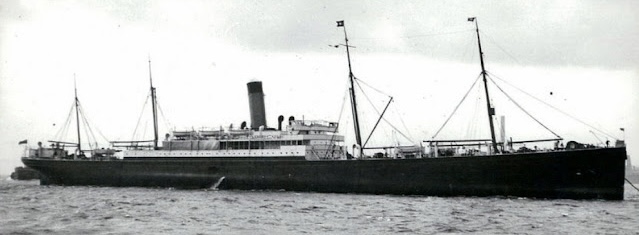
SS Winifredian
Leyland Line · 1899 · Ship Guide
Overview
SS Winifredian was a large British passenger-and-cargo liner built by Harland & Wolff at Belfast for Frederick Leyland & Company. Launched on 11 March 1899 and completed that July, she entered the Leyland Line’s Liverpool–Boston service as a highly specialized Atlantic carrier: part passenger ship, part refrigerated freighter, and part livestock transport.
Unlike the express liners competing for speed records, Winifredian was designed around capacity, economy, and reliability. She carried only about 140 passengers in a single cabin class, while her holds and between-decks accommodated general cargo, refrigerated produce, and hundreds of cattle. She served as a military transport during both the Second Boer War and the First World War, survived striking a mine in April 1917, and remained a familiar presence at Boston until her final crossing in 1928.
Although commonly described as a passenger liner, Winifredian was fundamentally a cargo liner whose passenger accommodations occupied superstructure space above the freight decks. This distinction is central to understanding both her appearance and her unusually long commercial life.
Key Facts
Design & Construction (Context)
Winifredian and her near-sister Devonian were among the most substantial single-screw cargo liners of their era. Their design developed Harland & Wolff’s emerging “big ship” approach without adopting the high power or twin-screw machinery associated with prestige passenger liners. A large hull, long waterline, and relatively modest engine produced an economical ship capable of carrying immense deadweight cargo on a dependable schedule.
Passenger spaces were concentrated in the superstructure above the shelter deck, leaving the principal internal volume available for freight and livestock. Her 140 passengers traveled in one cabin class broadly comparable to second class aboard larger liners. Contemporary descriptions emphasized spacious open decks, comfortable public rooms, plentiful meals, and a less formal atmosphere than that found aboard the major New York express ships.
Livestock carriage remained central to her economics. The ship was designed for approximately 820 cattle and could alternatively carry a mixed load of about 600 cattle and 900 sheep. Refrigerated capacity, initially limited, was enlarged repeatedly as the Atlantic trade in meat, dairy products, fruit, and other perishables expanded.
Service History (Summary)
1899: Entry into service. Launched at Belfast on 11 March and completed on 8 July, Winifredian departed Liverpool for Boston on her maiden voyage on 22 July 1899.
1899–1900: Second Boer War transport. The Admiralty chartered the new liner as Transport No. 78 in December 1899. She carried troops, cavalry, and horses to South Africa and later returned soldiers to Britain.
1900–1914: Liverpool–Boston mainstay. After military service, Winifredian resumed the Leyland Line’s principal route. Her eastbound cargoes commonly included cattle, grain, meat, cotton, apples, and other American produce; westbound voyages carried manufactured goods and smaller numbers of passengers.
1903–1914: Expanded refrigeration. Her refrigerated cargo space increased substantially, from 8,640 cubic feet in the early years to more than 43,000 cubic feet by 1903 and approximately 60,790 cubic feet by 1914. Electric ventilation was also installed for temperature-sensitive cargoes such as apples.
1910: Wireless installation. Leyland equipped Winifredian with wireless telegraphy. Her call sign was MFL, and the original installation reportedly had a range of approximately 250 miles.
1914–1917: First World War service. The liner again carried troops, horses, and military cargo. Heavy weather damaged her in February 1915, and she grounded briefly while entering Queenstown for repairs.
17 April 1917: Mine damage. While sailing in ballast from Hull toward Boston, Winifredian struck a mine laid by the German submarine UC-76 near Noss Head, Scotland. The explosion tore open her port bow around the forward holds, but the ship remained afloat, reached Invergordon under her own power, and was repaired.
19 August 1917: Torpedo narrowly misses. On an eastbound voyage from Boston, a torpedo passed close astern near Tory Island off northern Ireland. The liner escaped without damage.
1918–1919: American troop transport. Winifredian carried large contingents of United States troops to Europe and later returned American soldiers from France and Britain to Boston after the Armistice.
1922: Tow of SS Oxonian. In difficult weather near Newfoundland, Winifredian undertook an extended towing operation after the Leyland freighter Oxonian became disabled. The ships eventually reached St. John’s after repeated towline failures and hazardous maneuvering in fog, ice conditions, and heavy seas.
1927: Red Star employment. During a period of service rationalization within the International Mercantile Marine group, the veteran liner was used on Red Star Line’s Antwerp–New York route while remaining a Leyland-owned vessel.
1928–1929: Withdrawal and demolition. Winifredian left Boston on her final crossing on 6 October 1928, ending nearly three decades of regular association with the port. She arrived at Genoa for breaking up in May 1929.
Refrigeration and the Economics of the Boston Trade
One of the most revealing changes during Winifredian's long career was the steady enlargement of her refrigerated cargo capacity. Compiled register data record roughly 8,640 cubic feet of refrigerated space in 1901, about 43,400 cubic feet by 1903, and approximately 60,790 cubic feet by 1914.
Those alterations show how quickly the North Atlantic food trade was changing. Refrigerated meat, dairy products, fruit, and other perishables increasingly complemented the live-cattle trade for which ships such as Winifredian had originally been designed. Her longevity was partly a product of this ability to adapt a large cargo hull to changing freight markets without abandoning scheduled passenger service.
Military Transport and the 1917 Mine
Winifredian served as a transport in both the Second Boer War and the First World War, carrying troops, horses, and military cargo in addition to her normal commercial work. Her large holds and livestock arrangements made the transition to military transport unusually straightforward.
In April 1917 she struck a mine but survived. That survival is an important part of her wartime biography because several comparable Leyland cargo liners were lost to mines or submarines. Winifredian returned to service and ultimately resumed her familiar Liverpool–Boston role, remaining in operation until 1928 before being sold for demolition at Genoa in 1929.
Why Winifredian Matters
Her importance lies in the commercial world that prestige-liner histories often overlook. For nearly three decades she linked passenger travel with cattle carriage, refrigerated food, general freight, and military transport. The ship demonstrates that a liner could be historically significant because of adaptability and volume rather than luxury or speed.
Interpretive Notes
Winifredian demonstrates that the North Atlantic passenger trade was not limited to grand express liners. Her relatively small passenger complement traveled aboard a ship whose commercial purpose rested chiefly on freight, livestock, and refrigerated cargo. Passenger service was important, but it was integrated into a much larger transport system.
Her long Boston career also made her part of the city’s maritime identity. Teachers, academics, clergy, students, immigrants, cattlemen, and middle-class travelers repeatedly chose the Leyland service for its comparatively low fares, ample deck space, and informal atmosphere.
Durability defined the ship’s historical reputation. She survived severe Atlantic storms, a wartime mine explosion, a near torpedo strike, and demanding military and salvage work while maintaining her basic 1899 machinery and single-screw arrangement. Her nearly 29-year career validates the economic logic of a vessel built for steadiness rather than spectacle.
Evidence-first ship guideSources (Selected)
Published dimensions may distinguish registered length from overall length. This guide uses the registered length recorded in shipping registers while noting that contemporary descriptions commonly gave an overall length of approximately 570 feet.
- Ocean Liner Curator — Sources (master bibliography)
- National Museums Liverpool — Imperial Yeomanry aboard SS Winifredian
- Royal Museums Greenwich — agreements and official logs for Winifredian
- GG Archives — SS Winifredian passenger list, 1 June 1922
- Norway Heritage — SS Winifredian
- Wanted on Voyage — Leyland liners SS Winifredian and SS Devonian
- SS Winifredian (starting index; corroborate key facts)
- SS Winifredian — compiled register chronology and refrigeration figures (starting index; corroborate against registers)