Andrea Doria, Cristoforo Colombo & Leonardo da Vinci: Postwar Italian Design Evolution
The Olympic class was a design family, not a set of identical copies. Across Olympic, Titanic, and Britannic, White Star and Harland & Wolff refined passenger spaces, absorbed operating experience, responded to disaster, and altered the third ship under wartime conditions.
Basic answer
How did the Italian Line’s postwar flagship formula evolve?
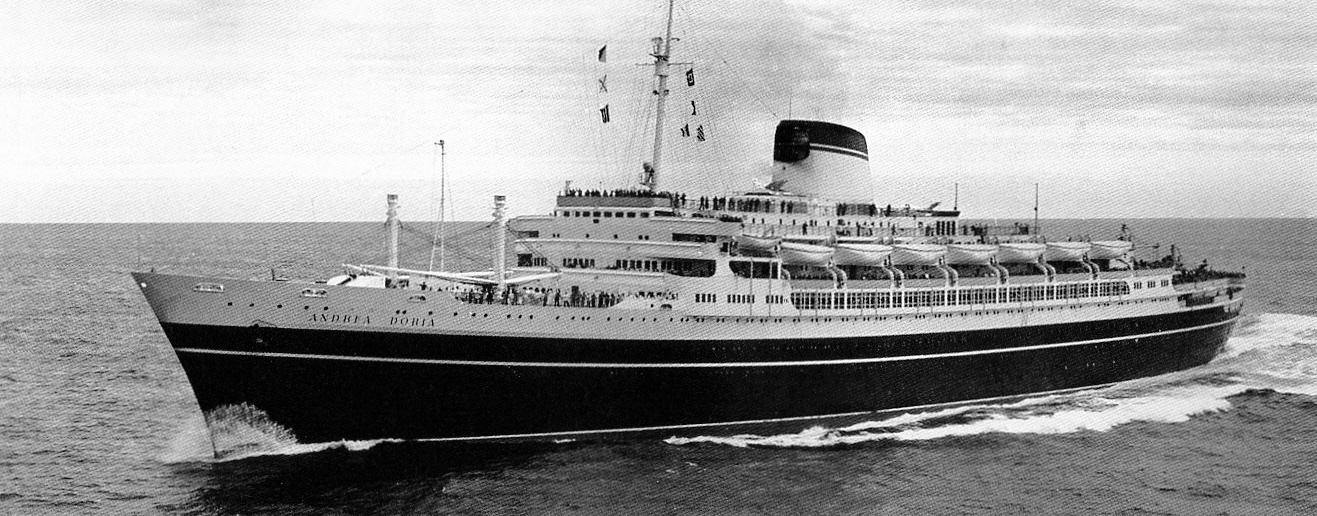
Andrea Doria and Cristoforo Colombo were true sister ships, built by Ansaldo as a coordinated postwar pair for the Genoa–Naples–New York service. Leonardo da Vinci, ordered after the loss of Andrea Doria, was not a third sister. She was a larger later design that filled the same commercial and symbolic role while entering a transatlantic market already being transformed by jet aviation.
Postwar rebuilding
Andrea Doria and Cristoforo Colombo restore the route
Italy emerged from the Second World War without the great interwar flagships that had once projected national prestige abroad. The new North Atlantic program therefore had to do more than replace tonnage. It had to present a modern Italian identity appropriate to the 1950s rather than recreate Rex and Conte di Savoia.
Andrea Doria entered service in 1953, followed by Cristoforo Colombo in 1954. Both were turbine-powered twin-screw liners of roughly 29,000 gross tons, designed for about 23-knot service and multi-class passenger operation. Their scale was more moderate than the giant express liners of the 1930s, but their role as national showcase ships remained unmistakable.
The sister pair
Shared design, separate careers
Andrea Doria
The first sister became the better-known public symbol of Italy’s postwar return to the Atlantic—and later the center of one of the era’s most famous passenger-ship disasters.
Cristoforo Colombo
The second sister entered service in 1954 and continued the same basic route and design program, ultimately enjoying a much longer career.
Shared formula
Both combined turbine propulsion, modern Italian interiors, moderate express speed, and a passenger mix suited to the postwar North Atlantic.
Historical imbalance
Andrea Doria’s loss dominates public memory, but Cristoforo Colombo is essential for understanding how the design actually performed over a long service life.
1956
The loss of Andrea Doria breaks the planned pair
The collision with Stockholm on 25 July 1956 and the sinking of Andrea Doria the following day abruptly ended the two-ship system. Cristoforo Colombo remained in service, but the Italian Line now faced both an operational gap and a symbolic one.
That distinction matters. Replacing Andrea Doria was not simply a matter of restoring passenger capacity. The company also needed to demonstrate continuity, technical competence, and confidence after a disaster known around the world.
Next generation
Leonardo da Vinci is a replacement, not a sister
Leonardo da Vinci was launched in 1958 and entered service in 1960. At about 33,340 gross tons and roughly 763 feet in length, she was larger than the Andrea Doria pair and carried about 1,300 passengers in multi-class liner service.
She retained the broad operating logic of the earlier ships—steam turbines, twin screws, roughly 23-knot service speed, and the Genoa–Naples–New York route—but she belonged to a later design moment. Her role was to restore capacity and prestige without simply reproducing the lost ship.
Continuity and revision
What stayed the same—and what changed?
Route continuity
All three belonged to the Italian Line’s postwar North Atlantic system centered on Genoa, Naples, and New York.
Machinery continuity
The broad propulsion formula remained conservative: steam turbines driving twin screws at service speeds in the low-20-knot range.
Scale increased
Leonardo da Vinci was larger in gross tonnage and passenger capacity than the earlier sister pair.
Market changed
By 1960, jet aircraft were already eroding the economic assumptions behind large transatlantic passenger ships.
A changing passenger market
The replacement arrived into a different Atlantic
The most important difference between the 1953–54 sister pair and Leonardo da Vinci may not be visible in the hull at all. The market had moved. When Andrea Doria entered service, ocean liners still occupied a central place in transatlantic passenger travel. By the time Leonardo da Vinci arrived in 1960, jet aircraft were rapidly changing journey times, passenger expectations, and route economics.
This makes Leonardo da Vinci a transitional ship. She was conceived as a prestigious liner replacement, yet her later career increasingly moved toward cruising after the arrival of Michelangelo and Raffaello. The design evolution therefore intersects directly with the decline of the scheduled liner system itself.
Timeline
From paired sisters to late-liner transition
Andrea Doria is launched
The first of the new postwar sisters emerges as a symbol of Italian maritime reconstruction.
Andrea Doria enters service
The new Italian Line flagship begins Genoa–Naples–New York service.
Cristoforo Colombo follows
The sister ship completes the intended two-ship postwar program and establishes operational continuity.
Andrea Doria is lost
The collision with Stockholm destroys one half of the planned pair and creates both a capacity gap and a prestige challenge.
Leonardo da Vinci is launched
The replacement project takes physical form as a larger, later-generation Italian liner.
Leonardo da Vinci enters service
The route regains a major flagship, but the economics of Atlantic passenger travel are already shifting toward air transport.
The late-liner role changes
Cristoforo Colombo and Leonardo da Vinci increasingly illustrate the transition from scheduled liner service toward cruising and eventual withdrawal.
Read the three together
One program across two design generations
Related interpretation
Continue the story
Evidence note
Replacement does not mean sister ship
Leonardo da Vinci is often discussed with Andrea Doria because she filled the operational and symbolic gap left by the 1956 loss. That relationship should not be mistaken for class identity. Cristoforo Colombo was the true sister; Leonardo da Vinci was a separate later design. Keeping those relationships distinct prevents route continuity from being confused with design continuity.
Selected sources